
Last Updated: November 8, 2026
Quick Summary
Life cycle analysis of bespoke joinery materials measures environmental impact from raw-material extraction to end of life, covering extraction, manufacturing, use and disposal. For bespoke joinery, results depend on the functional unit and system boundary set, so compare materials on the same basis.
- Most assessments follow four stages: raw-material extraction, manufacturing, use phase and end of life.
- The functional unit is the reference the whole study is measured against, such as one door for 30 years.
- Timber stores biogenic carbon in the finished door or window for its whole service life.
- Compare materials using the same functional unit, boundary, service life and maintenance regime.
- An EPD covering one product line tells you nothing about a bespoke piece made to your dimensions.
Table of Contents
- What Life Cycle Analysis of Bespoke Joinery Materials Measures
- Life Cycle Assessment (LCA) for Timber: Inventory Data and Impact Methods
- Environmental Impact of Timber Windows and Doors Across the Use Phase
- Embodied Carbon in Building Materials: Comparing Oak, Hardwood and Alternatives
- Environmental Product Declarations for Building Products and What They Reveal
- Running an LCA on a Real Bespoke Joinery Project: Data, Waste and Yield
- Specifying Bespoke Joinery With Life Cycle Data in Hand
- Frequently Asked Questions
What Life Cycle Analysis of Bespoke Joinery Materials Measures
Life cycle analysis of bespoke joinery materials measures the environmental impact of a door, window or staircase from raw-material extraction to end of life. It covers every stage in between: processing, manufacture, transport, installation, decades of use, then reuse, recycling or disposal. In short, it turns "sustainable timber" from a vague claim into numbers you can compare. This guide explains what those numbers actually mean for a bespoke project.
The Four Stages From Raw-Material Extraction to End of Life
Most assessments follow four stages.
- Raw-material extraction: felling timber, quarrying, harvesting.
- Manufacturing and processing: sawmilling, drying, machining, finishing.
- Use phase: installation, maintenance, service life, thermal performance.
- End of life: reuse, recycling, energy recovery or disposal.
A 2025 study of 25 furniture pieces across eight groups used this staged approach to show where impacts concentrate, with the peer-reviewed life cycle assessment of furniture confirming that material choice and lifespan drive most of the result.
Functional Unit and System Boundary in a Joinery Assessment
The functional unit is the reference the whole study is measured against. For a door, it might be "one external door providing a defined U-value for 30 years." The system boundary is the line around what gets counted: which processes, which transport, which end-of-life routes. Change either one and the results shift. That is why two "sustainable" products can carry wildly different figures.
Life Cycle Assessment (LCA) for Timber: Inventory Data and Impact Methods
Life cycle assessment for timber starts with a life-cycle inventory: how much energy, water and material each stage consumes, and what emissions it produces. Those inputs then feed an impact assessment, which converts them into indicators such as global warming potential, acidification and resource depletion.
Timber has one feature many materials lack: trees absorb carbon as they grow. That biogenic carbon is stored in the finished door or window for its whole service life. A 2018 methodical approach for industrially produced furniture, summarised in the systematic LCA method for furniture, sets out how to capture these flows consistently.
Environmental Impact of Timber Windows and Doors Across the Use Phase
The use phase is where timber joinery earns its keep. A well-made timber window or door lasts decades, and its thermal performance keeps cutting heating demand year after year. The longer the service life, the more the upfront impact is spread across each year of use.
Maintenance matters too. A periodic repaint protects the timber and extends life. Neglect it, and the whole calculation changes. If you want the fuller case, read our guide to the advantages of sustainable timber doors.
Embodied Carbon in Building Materials: Comparing Oak, Hardwood and Alternatives
Embodied carbon is the total greenhouse gas emitted to produce a material, expressed as carbon dioxide equivalent (CO2e) and normally reported per kilogram or per cubic metre. For a bespoke door, window or staircase, the useful figure is embodied carbon per functional unit, for example, per installed door providing a stated U-value for 30 years, because that is the only basis on which different materials can be compared fairly.
Comparisons only hold when the system boundary is the same. A cradle-to-gate figure (extraction through manufacture) excludes transport, installation, maintenance and end of life; a cradle-to-grave figure includes them. Most published material datasets are cradle-to-gate, so a like-for-like comparison of oak against aluminium usually means comparing cradle-to-gate figures and then adding transport and maintenance separately. Change the boundary and the ranking can change with it.
With that caveat, the broad pattern is generally consistent. Solid timber generally carries lower cradle-to-gate embodied carbon than metals, particularly where it is responsibly sourced, because the tree absorbs carbon as it grows. Aluminium and steel carry substantially higher cradle-to-gate figures because smelting and refining are energy-intensive, although recycled aluminium has a markedly lower footprint than primary aluminium. Engineered boards, MDF, plywood, particleboard, generally sit between solid timber and metals, but the resin or adhesive content matters: urea-formaldehyde and melamine-urea-formaldehyde binders add to the impact, and low-emission boards are available.
Species still differ within the timber category. Softer hardwoods machine easily but may need more protection, which shifts impact into the use phase through more frequent refinishing. Veneered boards can reduce solid-timber volume in non-structural components, but the veneer, substrate and adhesive must be counted together. Glass is energy-intensive to produce but is usually a small fraction of a joinery unit by mass; fixings, ironmongery and finishes are easy to overlook and can add a surprising share.
The practical lesson for a bespoke commission is to compare on a consistent basis: same functional unit, same boundary, same service life, same maintenance regime. If you are weighing species for a project, our advice on choosing stable timber for doors covers the practical side, and the durability and maintenance assumptions you settle on will feed directly into the comparison above.
Environmental Product Declarations for Building Products and What They Reveal
An Environmental Product Declaration (EPD) is a verified summary of a product's environmental impact, based on a full assessment. EPDs let you compare products on a like-for-like basis, provided the functional unit and system boundary match.
Watch out: an EPD covering one product line tells you nothing about a bespoke piece made to your own dimensions. For custom joinery, the declaration is a starting point, not the answer.
Running an LCA on a Real Bespoke Joinery Project: Data, Waste and Yield
Most LCA guidance is written for mass-produced furniture or whole buildings. Because a bespoke commission has no product average to lean on, comparing its material choices with the distinction between handcrafted and mass-produced furniture, as reflected in Lazy Bear Creationz, can clarify which assumptions belong to the project itself.
Step 1, Fix the functional unit and boundary before collecting anything. For a door, write down something like "one external door, 2.1 m by 0.9 m, providing a stated U-value for 30 years, cradle to grave." For a staircase, state the rise, going, width and expected service life.
Step 2, Build a quantities schedule from the cutting list. Take the board volumes by species and thickness, the veneer area, the substrate volume, the glass area, the ironmongery and fixings by mass, and the finish by volume or area.
Step 3, Attach supplier declarations and dataset figures. For each material, record the source: an Environmental Product Declaration where one exists, a published embodied-carbon dataset otherwise, and the supplier's own declaration for anything unusual. Note the dataset's boundary and reference year, because mixing cradle-to-gate and cradle-to-grave figures is the most common error in project-level assessment.
Step 4, Record transport distances and modes. Log the distance from supplier to workshop and from workshop to site, with the mode (road, sea, rail).
Step 5, Capture manufacturing energy and yield. Record workshop electricity and gas for the project where metering allows, or apportion by machine hours. Then calculate yield: the board volume that ends up in the finished unit against the board volume purchased.
Step 6, Model the use phase and end of life. State the assumed service life, the maintenance regime (for example, a repaint every five to seven years) and the end-of-life route (reuse, recycling, energy recovery or landfill). These assumptions often change the ranking between materials more than the upfront figures do.
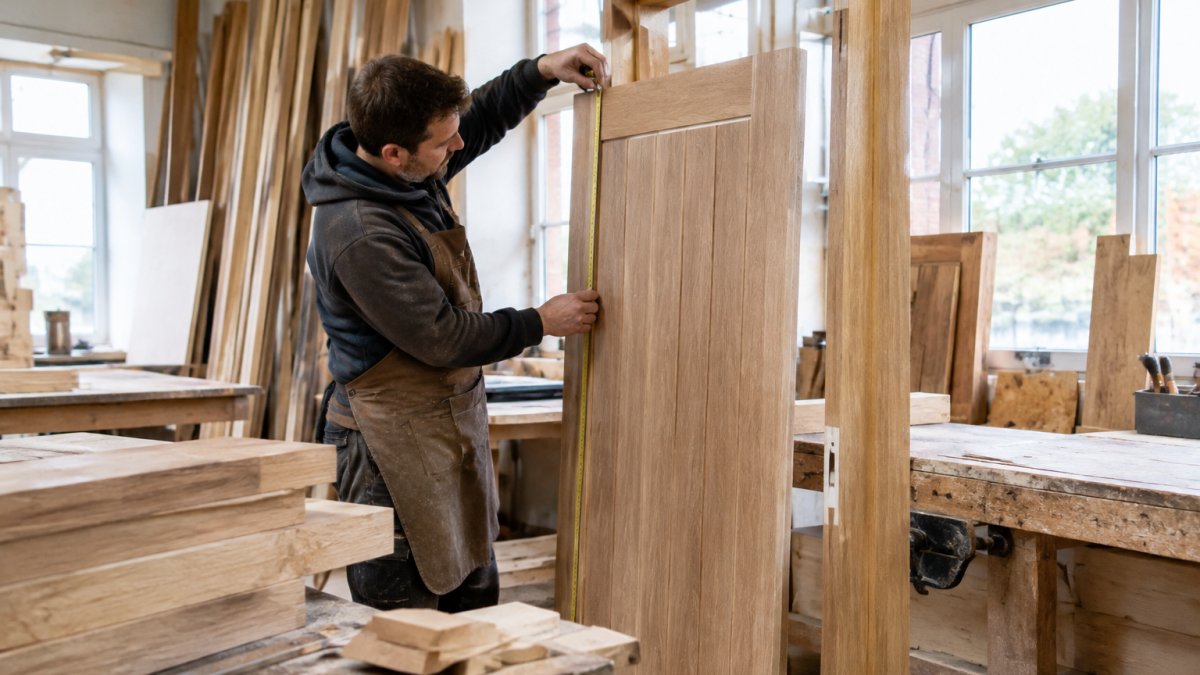
Waste and yield deserve particular attention in custom fabrication. Good nesting and cutting planning cuts waste before it is created; offcuts that are large enough can be reused for smaller components such as glazing beads, mouldings or drawer parts, which effectively reduces the impact allocated to the main unit.
A worked example makes the workflow concrete. The 2023 whole-life-cycle furniture design study described in the whole life cycle of a furniture design illustrates how designing for the full life reduces the harm of discarded furniture, and the same logic applies to a bespoke commission. You can see the kind of work this applies to on our bespoke work page.
Note that apportioning workshop energy by machine hours is an approximation; state the method used so the result can be interpreted correctly.
The workflow below is the one that works in practice for a bespoke joinery commission.
| Step | What to do |
|---|---|
| Step 1 | Fix the functional unit and boundary before collecting anything |
| Step 2 | Build a quantities schedule from the cutting list |
| Step 3 | Attach supplier declarations and dataset figures |
| Step 4 | Record transport distances and modes |
| Step 5 | Capture manufacturing energy and yield |
| Step 6 | Model the use phase and end of life |
Specifying Bespoke Joinery With Life Cycle Data in Hand
Specifying with data means asking three questions of every quote: what is the functional unit, what is the system boundary, and what service life is assumed. Answers to those three make quotes comparable.
Durability, repairability and refurbishment belong in the specification too. A door that can be rehinged and refinished outlasts one that cannot. Before you commit, get cost context from our bespoke joinery cost guide, and read why thermal performance matters for joinery if efficiency is a priority.
A common mistake is treating a headline carbon figure as the whole story.
The challenge is that life cycle data only pays off when the joinery itself is built to last. That is where we come in. Arborfield Joinery has been a family business since 1953, with full manufacturing facilities for bespoke joinery and staircases, a huge range of doors on display, and free mainland shipping on orders over £900. Get started with Arborfield Joinery and specify joinery with the numbers behind it.
Frequently Asked Questions
What is a life cycle assessment of joinery materials?
A life cycle assessment of joinery materials measures the environmental impact of a product from raw-material extraction through manufacturing, installation, use and end of life. For bespoke joinery, the assessment covers timber sourcing, machining energy, finishes, transport to site and eventual reuse or disposal. The result is expressed against a functional unit, such as one door providing a defined service life, so different specifications can be compared on a like-for-like basis rather than on purchase price alone.
How do timber, steel and composite materials compare over their life cycles?
Timber generally carries lower embodied carbon than steel because trees sequester biogenic carbon as they grow. Steel and composites can win on maintenance intervals in exposed situations. The deciding factor is service life: a hardwood external door that lasts decades spreads its impact over far more years than a cheaper unit replaced every few years. Assess the whole product life cycle, not the material in isolation.
Does a longer-lasting joinery product have a lower environmental impact?
Usually yes. Manufacturing impact is fixed at the point of production, so a door or window that stays in service for 30 years carries a much smaller annual share of that impact than one replaced after 10. Durability also reduces waste generation and the transport and processing emissions tied to replacement. This is why repairability and refurbishment matter in a life cycle assessment of bespoke joinery materials: re-coating and re-hanging a sound frame avoids the extraction and manufacturing stage entirely.
What information is needed to assess the life cycle of a joinery product?
You need the material specification and quantities, the functional unit and system boundary, manufacturing energy and yield figures, finish and treatment data, transport distances, expected service life and maintenance schedule, plus an end-of-life route such as reuse, recycling or disposal. Environmental product declarations for building products can supply some of this in standardised form. Where a supplier cannot provide a declaration, project-level data collection from the workshop and delivery records fills the gap.

Share:
Choosing Between Engineered Wood and Solid Wood Doors for Durability
Internal Doors for Home Office Soundproofing