

Last Updated: October 31, 2026
Quick Summary
Choose stable timber by judging three things: the species, how the timber was dried, and how the door was built. Dense hardwoods such as oak, sapele, utile and iroko hold their shape better than softwood, and engineered or laminated construction resists warping more than a single solid plank.
- Internal doors in heated buildings should be around 8-12% moisture content at fitting.
- External doors in sheltered positions are commonly specified at around 12-16% moisture content.
- Seal all six faces of a door, including the top and bottom edges.
- Allow the door time on site to acclimatise before hanging, laid flat and off the floor.
- Ask in writing for the moisture content, timber grade and door construction before buying.
Table of Contents
- Why Stability Decides Whether a Timber Door Lasts
- Hardwood vs Softwood for Doors: Which Holds Its Shape?
- The Best Timber for Stable Doors: A Species-by-Species Comparison
- Timber Door Warping and Swelling: What Causes Movement
- Solid, Laminated or Engineered: How Construction Affects Stability
- Exterior Timber Door Treatment and Weather Protection
- A Practical Stability Check: What to Look For Before You Buy
- Choosing Your Stable Timber Door from Arborfield Joinery
- Frequently Asked Questions
Why Stability Decides Whether a Timber Door Lasts
Stable timber is wood that holds its shape through every season, resisting the warping, swelling and shrinking that ruins badly chosen doors.
A door that moves will stick in summer and rattle in winter. It may split along the grain or pull away from its frame entirely.
So how do you choose stable timber for doors with confidence? Judge three things: the species, how the timber was dried, and how the door was built.
Hardwood vs Softwood for Doors: Which Holds Its Shape?
Hardwood generally holds its shape better than softwood for external doors, because denser timber moves less as moisture levels change.
The distinction is botanical, not a quality ranking. Hardwoods come from broad-leaved trees; softwoods from conifers.
For a front door exposed to driving rain, hardwood is usually the safer bet. Browse our hardwood external doors to see real options. For internal doors, a good softwood can perform perfectly well.
Dense Hardwoods: Oak, Sapele, Utile and Iroko
Oak is the benchmark for stable timber doors: dense, hard-wearing and widely available. European oak moves moderately with the seasons but behaves predictably when properly seasoned.
Sapele, utile and iroko are strong alternatives. Sapele and utile offer mahogany-like warmth and good stability. Iroko is exceptionally durable and resists moisture well.
- Oak: the all-rounder, takes a finish beautifully
- Sapele: stable and rich in colour, good value
- Utile: similar to sapele, reliable in service
Softwoods and Modified Timbers: Accoya and Thermally Treated Wood
Accoya is modified softwood treated through acetylation, a process that reduces how much the timber absorbs water.
Thermally treated timber is heated to change its cell structure, lowering moisture movement and improving durability, though it darkens and can become more brittle.
Neither is a shortcut: they still need correct installation and a protective finish.
The Best Timber for Stable Doors: A Species-by-Species Comparison
The best timber for stable doors depends on exposure, budget and finish. Use the table below to compare at a glance.
| Timber | Stability | Weather Resistance | Best For | Notes |
|---|---|---|---|---|
| Oak | High | High | Front and stable doors | Needs a finish; moves predictably |
| Sapele | High | Good | Painted or clear-finished doors | Warm tone, good value |
| Utile | High | Good | External doors | Similar to sapele |
| Iroko | Very high | Very high | Exposed, wet positions | Heavy and hard-wearing |
| Accoya | Very high | Very high | Demanding weather | Modified softwood |
| Thermally treated | Good | Good | Budget-conscious projects | Darkens; can be brittle |
Timber Door Warping and Swelling: What Causes Movement
Warping and swelling happen when timber takes on or loses moisture unevenly. Wood is hygroscopic: it absorbs water from damp air and releases it in dry conditions.
Uneven drying is the usual culprit. If one face gains moisture faster than the other, it cups or bows. Poor sealing makes this worse, because bare timber drinks water quickly. The fix is controlling moisture at every stage: specification, storage, acclimatisation and installation.
Target moisture content: what to aim for
There is no single correct figure, because the right moisture content depends on where the door will live.
- Internal doors in heated buildings: aim for around 8-12% MC at fitting.
- External doors in sheltered positions: around 12-16% MC is commonly specified.
- Exposed or coastal positions: err towards the upper end of the external range, and expect more movement regardless.
These are guides, not absolutes. The principle is that the door should arrive at, or very near, the moisture content it will reach in service. A door fitted wet will shrink; a door fitted too dry for a damp porch will swell.
Acclimatisation: give it time on site
Acclimatisation means letting a door sit in the environment where it will be fitted so it settles to local conditions before hanging. Allow the door time on site before hanging, longer in cold or damp weather, with the door laid flat, off the floor, and packaging removed.
Do not acclimatise a door in an unheated, newly plastered building and then expect it to behave in a heated room. Plaster, screed and paint release water vapour for weeks.
Installation conditions that prevent movement
- Seal all six faces, including the top and bottom edges. These are the most commonly forgotten and the most exposed to moisture.
- Leave the correct expansion gap around the door in its frame. A door fitted tight has nowhere to go when it swells.
- Use the right fixings and avoid over-tightening hinges and locks, which can distort a stile.
Why construction and finish matter as much as moisture
A laminated or engineered door resists movement better than a solid one because opposing grain layers restrain each other. A well-sealed door resists moisture uptake better than a bare one, and proper end-grain protection resists water ingress at the joints, where most failures start.
Comparing frame options? Our exterior door frame review covers how kits affect fit and stability.
Solid, Laminated or Engineered: How Construction Affects Stability
Engineered and laminated timber is generally more stable than a single solid plank, because layers with opposing grain restrain each other's movement. Solid timber is one piece of wood; engineered timber bonds several layers together.
That layering is the key.
Unfinished Rustic Oak Ledged Internal Door →
Solid timber still has its place, especially in traditional settings and period properties where authenticity matters. But for large panels and demanding exposures, engineered construction earns its keep.
Exterior Timber Door Treatment and Weather Protection
Every exterior timber door needs a protective finish, and the finish is only as good as its maintenance.
Choose a finish suited to the timber and the look you want. Opaque paints shield best from sunlight. Clear oils and stains show the grain but need more frequent recoating.
- Seal all six faces, not just the visible ones
- Recoat according to the manufacturer's schedule
- Check weather seals and thresholds annually
For the detail on draughts and driving rain, read our guide to weatherstripping exterior timber doors.
A Practical Stability Check: What to Look For Before You Buy
Most buying guides tell you to 'look for straight grain' and leave it there. That is not a method, it is a slogan. Stability is measurable, and you can assess it before you spend a penny by comparing four things: moisture content, expected movement, grain orientation and dimensional tolerances.
1. Ask for the moisture content, and know what to compare it to
Moisture content (MC) is the weight of water in the timber expressed as a percentage of its oven-dry weight.
A door that arrives wetter than its final room will shrink as it dries, opening joints and leaving gaps.
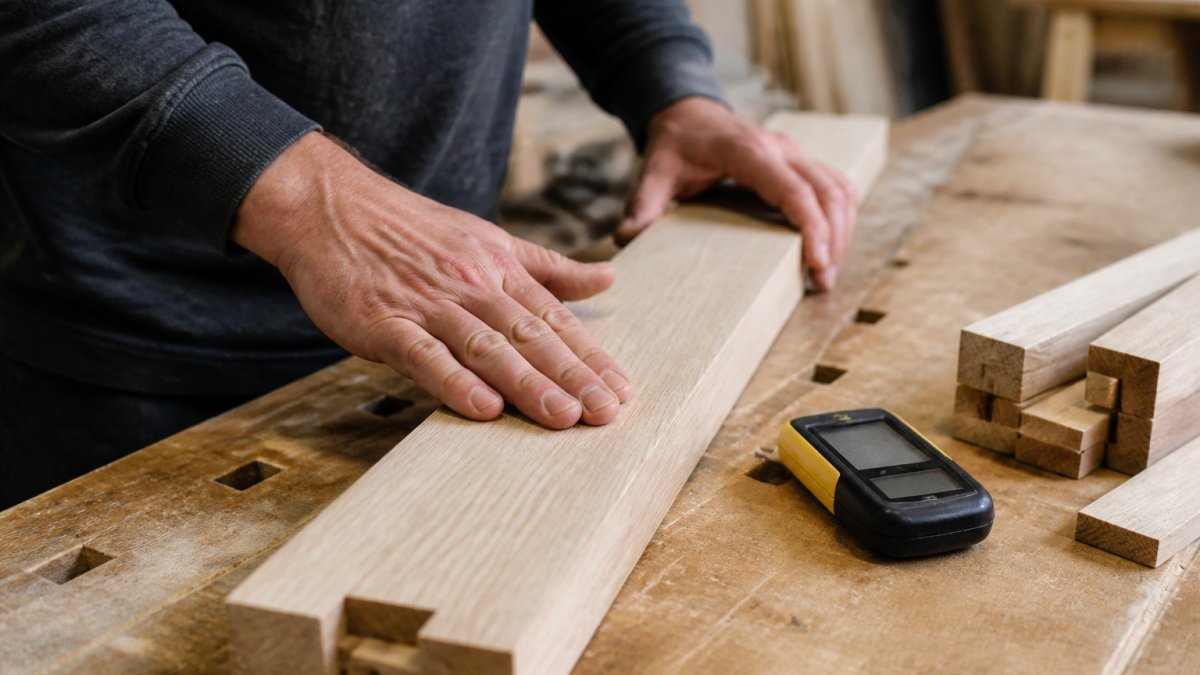
Take your own readings if you can. A pin-type moisture meter costs little and lets you check several points across a stile or rail rather than trusting a single spot reading.
2. Compare movement, not just species reputation
All timber moves as moisture changes, but it moves far more across the grain than along it. That is why a wide board cups while a narrow one barely notices.
A practical rule of thumb: the lower the movement figure and the denser the timber, the more predictable it will be in service. This is why dense hardwoods and modified timbers such as Accoya are favoured for wide door stiles and panels.
3. Read the grain orientation
Grain that runs straight along the length of a stile is the most stable orientation. Diagonal or 'wild' grain, and grain that runs out at an angle to the face, will twist as it dries.
On panels and wide boards, quarter-sawn or rift-sawn stock is more stable than flat-sawn because the growth rings meet the face at a steeper angle.
4. Check dimensional tolerances and defects
A door that is twisted or bowed before it is hung will not straighten itself later. Check for:
- Twist: sight along the door from one corner; opposite corners should sit in the same plane.
- Bow and cup: lay a straightedge across the width and along the length; gaps should be small and even.
- Checks and splits: surface checks are common in some species and may be cosmetic, but splits running into joints or through the full thickness are not.
Ask what grade the timber is.
5. Confirm how it was dried and how it was built
Kiln drying gives more control over final moisture content; air drying alone can leave a higher and more variable MC. Then ask how the door is constructed: solid, laminated or engineered. A laminated stile with opposing grain is more stable than a solid stile of the same species.
A common mistake is buying on appearance alone. A beautiful board with wild grain can move badly. Straight grain is boring, and boring is stable.
Choosing Your Stable Timber Door from Arborfield Joinery
Picking stable timber comes down to species, moisture and construction, checked in that order. Get all three right and your door will serve for decades.
Then you can browse our stable doors and see the styles available.
Frequently Asked Questions
What is the best timber for stable doors?
Accoya undergoes acetylation, which reduces how much moisture the wood absorbs, so it moves far less across seasons. Oak offers excellent durability and weather resistance when finished correctly. Softwoods can work for internal doors or painted external doors if the timber is properly seasoned and protected, but they need more maintenance to stay stable.
How do you choose timber that is less likely to warp?
Check three things: species, moisture content and grain. Ask for timber kiln-dried to around 8-12% moisture content for internal use, or 12-16% for external doors, and confirm it has been acclimatised to your site before fitting. Look for straight, even grain with no large knots near the edges, and avoid boards with visible cupping or twist. Engineered or laminated cores resist warping better than solid planks because the layers counteract each other's movement.
Is hardwood or softwood better for stable doors?
Hardwoods such as oak, Sapele and Iroko are generally denser and more durable, making them the safer choice for external stable doors exposed to rain and wind. Softwoods are lighter, cheaper and easier to work, and perform well internally or when painted and maintained regularly. The deciding factors are exposure, budget and finish: a well-treated softwood door can last decades, but a hardwood door usually needs less maintenance to stay stable in wet conditions.
How should timber stable doors be treated and maintained?
Apply a breathable finish suited to the species: a microporous wood stain or paint for softwoods, and a UV-resistant oil or stain for oak and other hardwoods. Treat all faces, including the top and bottom edges, before hanging. Re-coat every 12 to 24 months depending on exposure, and check seals, hinges and drainage channels at the same time. Keeping the door dry and allowing air to circulate around it does as much for stability as the finish itself.
Timber that moves is timber that fails, and the difference is decided before the door is ever hung. Arborfield Joinery has helped homeowners, builders and designers choose the right doors since 1953, with expert advice on property suitability, a huge range on display, and free mainland shipping on orders over £900. Get started with Arborfield Joinery and choose a door built to stay straight.

Share:
Timber front door security for UK homeowners
7 Oak Weather Bar Mistakes That Let Rain In