
Table of Contents
- Consider Your Home's Style and Architectural Age
- Understand Internal Door Styles and Designs
- Choose the Right Internal Door Materials
- How to Measure an Internal Door Accurately
- Account for Installation and Fitting Requirements
- Calculate Internal Door Fitting Costs
- Check Fire Safety and Building Regulations
- Evaluate Privacy, Durability, and Long-Term Value
- Frequently Asked Questions
Last Updated: October 19, 2026
Consider Your Home's Style and Architectural Age
Your home's style determines which internal door designs look right, buying internal doors for a Victorian terrace requires different choices than for a 1970s bungalow or a modern apartment. Get this wrong and your new doors clash with the rest of your interior, no matter the quality.

At Arborfield Joinery, we've helped hundreds of homeowners match doors to their properties. The key is understanding what your home's era and style demand, rather than picking what you like in isolation.
Traditional properties benefit from panel doors with period-appropriate mouldings. Contemporary homes suit flush doors or minimalist designs with clean lines. If your property is a mix of styles, pick doors that echo the dominant character. A Victorian property with a modern kitchen extension, for instance, works best with doors that bridge both aesthetics rather than clash between them.
Consider the existing joinery: your new internal doors should complement skirting boards, architraves, and original features, not contradict them. If unsure, ask whether the door would look natural in a period photograph of your home's era.
Understand Internal Door Styles and Designs
Internal door styles fall into a few core categories, and each serves a different purpose and aesthetic.
Panel doors have raised or recessed sections. Four-panel designs suit period properties, two-panel doors work in both traditional and contemporary spaces, and six-panel doors add visual interest to larger openings. Panel doors add character and break up flat wall space.
Flush doors are completely flat on both sides. They suit modern interiors and compact spaces where panel designs would feel cramped, and are straightforward to paint and easier to clean.
Glazed doors include glass panels, usually in the upper half. These allow light to travel between rooms and make smaller spaces feel more open.
Shaker-style doors feature simple, clean lines with minimal moulding. They suit both traditional and contemporary interiors because the design is timeless rather than trendy.
Style affects function too: a glazed door between kitchen and dining room lets you see who's there while cooking, while a solid panel door to a bedroom provides visual privacy and separation.
Choose the Right Internal Door Materials
Door material affects durability, appearance, maintenance, and cost. Common options are solid timber, engineered timber with veneer, MDF, and composite materials.
Solid timber doors are the most durable and valuable long-term. Oak, pine, and other hardwoods develop character and can be refinished if damaged. They cost more upfront but often outlast cheaper alternatives by decades.
Engineered timber with veneer uses a timber or composite core faced with real wood veneer. It's stable, resists warping, and costs less than solid timber, a smart middle ground for most homeowners.
MDF doors are made from compressed wood fibres, typically primed white and ready to paint. They're affordable, smooth, and stable, but don't take stain well and are less durable than timber in high-traffic or damp rooms.
Composite materials blend wood, plastic, and resin. They're extremely durable, resist moisture and warping, and need minimal maintenance, an excellent choice for bathrooms or kitchens.
Solid-Core vs Hollow-Core Construction
Solid-core doors have a dense interior running the full height and width, making them heavier, more soundproof, and more durable, with better acoustic privacy between rooms.
Hollow-core doors have a cardboard honeycomb interior with timber or composite facing. They're lighter, cheaper, and easier to handle, but don't match solid-core sound insulation or durability.
For bedrooms, home offices, or any room where sound control matters, solid-core is worth the extra cost. For hallways and less-used spaces, hollow-core is perfectly acceptable. The Melbourne pre-finished FD30 fire door is a solid-engineered core example, designed for added strength and durability in properties where fire safety matters.

Finish Options: Paint, Wood Grain, and Pre-Finished
Primed white doors arrive ready to paint, giving you complete control over colour to match your interior scheme. The Vermont white primed 2 panel recessed internal door is an example, arriving primed and ready for your final paint colour.
Pre-finished doors arrive fully painted or stained and ready to hang, saving time and labour. They're ideal if you want a professional result without painting, and wood grain finishes show the timber's natural beauty with less maintenance than paint.
Painted finishes in contemporary colours (matte black, deep blue, sage green) suit modern interiors. Painted doors are easy to refresh if you want to change your colour scheme later.
Wood grain finishes suit traditional and contemporary spaces alike. Oak, walnut, and natural finishes age gracefully and develop character over time. The Coventry prefinished oak internal door showcases real American white oak veneer with a crown cut finish, bringing natural wood character without the need for on-site finishing.
How to Measure an Internal Door Accurately
Measuring your door opening correctly is essential, a door even slightly too large or small won't fit properly, leaving gaps that affect aesthetics, sound insulation, and draught control.
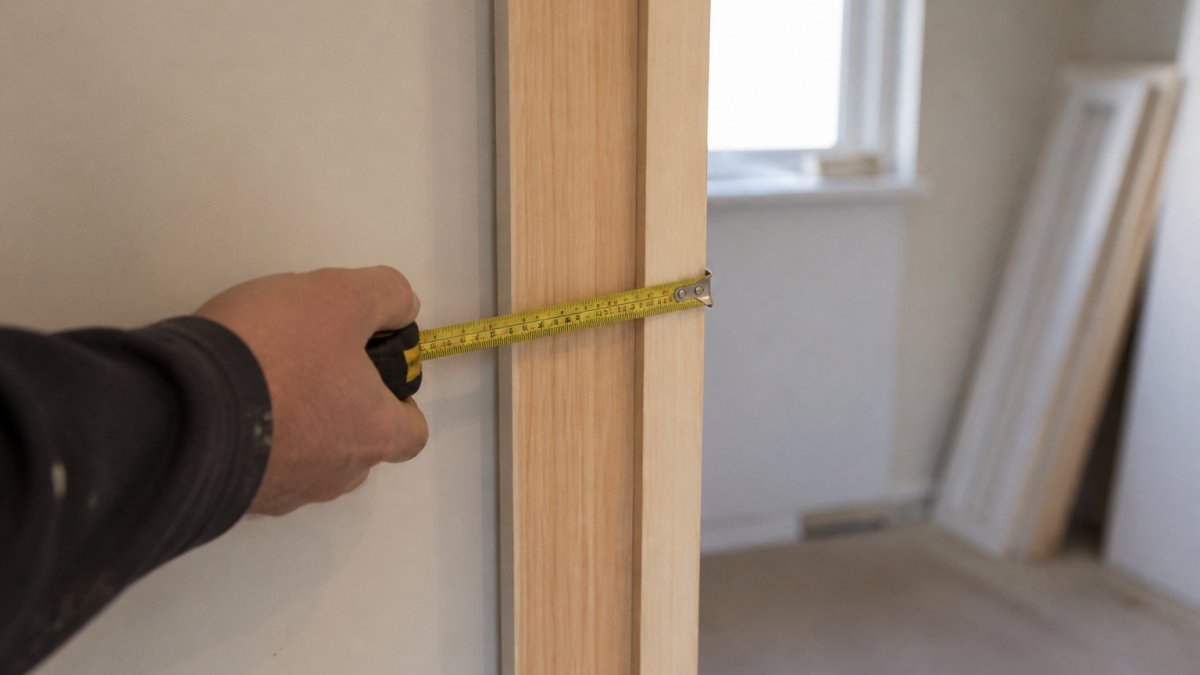
Measure the height from the bottom of the frame to the top at the left, centre, and right.
Measure the width at the top, middle, and bottom, again using the smallest measurement. Door sizes are typically stated as width × height (e.g., 762mm × 1981mm).
Check the frame depth (the thickness of the wall). Standard frames are 35mm, 40mm, or 50mm deep. Measure from the inside face of the frame to the outside face.
Measure the depth of the opening if you're replacing an existing door. The new door should sit in the same space without requiring frame alterations.
Double-check your measurements before ordering, measure twice, order once. A door 5mm too wide won't fit.
Account for Installation and Fitting Requirements
How your door is installed affects both the final result and the total cost. Understanding installation requirements helps you plan your project timeline and budget.
Hanging the door means fitting it into the frame with hinges. Most internal doors use three evenly spaced hinges, too close together and the door can sag; too far apart and it may bind.
Coventry Prefinished Oak Internal Door →
Door furniture (handles, locks, hardware) must fit your chosen door and match your interior. Standard handle height is 1000mm from the floor; finishes include chrome, black, and bronze.
Frame and lining must be level and square. If your existing frame is out of plumb, the door won't hang properly and the frame may need adjustment or replacement first.
Skirting boards and mouldings may need adjusting to accommodate the new door. If it's thicker than the original, you may need new architraves.
Fitting time typically ranges from 30 minutes to 2 hours per door, depending on whether the frame is existing or new and whether adjustments are needed.
Professional fitting is recommended unless you're experienced with carpentry. Poor fitting leads to sticking, gaps, and acoustic problems.
Calculate Internal Door Fitting Costs
Understanding the full cost of buying internal doors and fitting them helps you budget accurately. The total cost includes the door itself, frame and lining (if needed), hardware, and fitting labour.
Door cost varies widely by material and finish. A basic white primed MDF door might cost £80-£120. A pre-finished oak door costs more, the Coventry prefinished oak internal door is £159.75.
Frame and lining (if needed) add £100-£300 depending on materials and complexity. If you're reusing an existing frame, this cost doesn't apply.
Hardware (hinges, handles, locks) ranges from £20-£80 per door depending on quality and finish.
Fitting labour typically costs £80-£150 per door if you hire a professional fitter. This varies by region and complexity.
Total installed cost for a basic internal door replacement is often £250-£400. A premium oak door with new frame and professional fitting might cost £600-£1,000.
Arborfield Joinery offers free UK mainland shipping on orders over £900, which helps offset costs if you're buying multiple doors at once.
Check Fire Safety and Building Regulations
Fire safety requirements for internal doors depend on your property type and room use. Understanding these regulations ensures your doors meet legal standards and protect your home.
Fire doors are required in certain locations within residential properties. According to UK Building Regulations guidance on fire safety, fire doors must be fitted between a habitable room and a staircase, and between a garage and the rest of the house.
Fire door specifications include a fire rating (typically FD30 or FD60, meaning the door resists fire for 30 or 60 minutes).
Building Regulations in England, Scotland, Wales, and Northern Ireland set standards for door installation.
Accessibility requirements may apply if you're adapting your home for someone with mobility difficulties. Doors should be easy to open and close, and handles should be at an appropriate height.
Acoustic performance isn't legally required for most internal doors, but sound insulation is important in practice. Solid-core doors provide better sound reduction than hollow-core alternatives. If you need privacy in a home office or bedroom, solid-core construction is worth considering.
Checking your local Building Control requirements before you buy ensures your doors meet legal standards. If you're unsure, ask a professional fitter or contact your local authority.
Evaluate Privacy, Durability, and Long-Term Value
The door you choose affects how well it performs over years of use. Privacy, durability, and long-term value are practical considerations that go beyond initial cost.
Privacy and sound control matter in bedrooms, bathrooms, and home offices. Solid-core doors reduce sound transmission significantly more than hollow-core alternatives, worth the investment if you work from home or need quiet bedrooms.
Durability depends on material, construction, and maintenance.
Maintenance varies by finish: painted doors need occasional repainting, wood grain finishes may need refinishing after many years, and pre-finished doors need only occasional cleaning.
Repairability matters if your door is damaged.
Long-term value considers cost and lifespan: a premium oak door may last 40+ years, while a budget MDF door might need replacing in 15-20 years.
At Arborfield Joinery, we stock doors from leading manufacturers and offer bespoke manufacturing for non-standard openings.
Choosing the right internal doors transforms how your home feels and functions. Start by understanding your home's architectural character, then match door styles, materials, and finishes to it.
Frequently Asked Questions
How do I measure for a replacement internal door?
Measure the height, width, and thickness of your door opening at three points: top, middle, and bottom. Record the smallest measurement for height and width to ensure a proper fit. Measure the frame depth to confirm the door lining thickness. Double-check all measurements before ordering, as internal doors come in standard sizes (typically 32mm thick, with heights of 1981mm or 2040mm). If your opening is non-standard, bespoke options are available to fit precisely.
What's the difference between solid-core and hollow-core internal doors?
Solid-core doors contain timber or engineered materials throughout, offering superior durability, sound insulation, and acoustic privacy, ideal for bedrooms and living spaces. Hollow-core doors are lighter and more affordable but provide less sound dampening and durability. For long-term value and homes where privacy matters, solid-core construction is the better investment. Many contemporary doors, like the Coventry Prefinished Oak Internal Door (£159.75), feature solid-core construction for enhanced strength.
Do internal doors need to comply with fire safety regulations?
Yes. Fire doors (FD30 rated) are required in certain locations under Building Regulations, particularly in flats, shared properties, and near escape routes. FD30 doors provide 30 minutes of fire resistance. If your property requires fire doors, choose a certified option like the Oak Melbourne Pre-Finished FD30 Fire Door (£329.50), which is engineered for strength and durability while meeting safety standards.
What factors affect the total cost of buying and fitting an internal door?
Total cost includes the door itself (ranging from £117-£330+ depending on material and finish), hardware such as hinges and handles, frame adjustments, and professional installation labour. Pre-finished doors reduce on-site painting costs. Bespoke doors for non-standard openings cost more but eliminate gaps and drafts. Delivery is free on orders over £900. Request a full quotation including labour to avoid budget surprises.
Share:
Internal Oak Cottage Doors: How to Choose the Right Style in 2026
Eco-Friendly and Sustainable Window Materials UK: A Buying Guide