

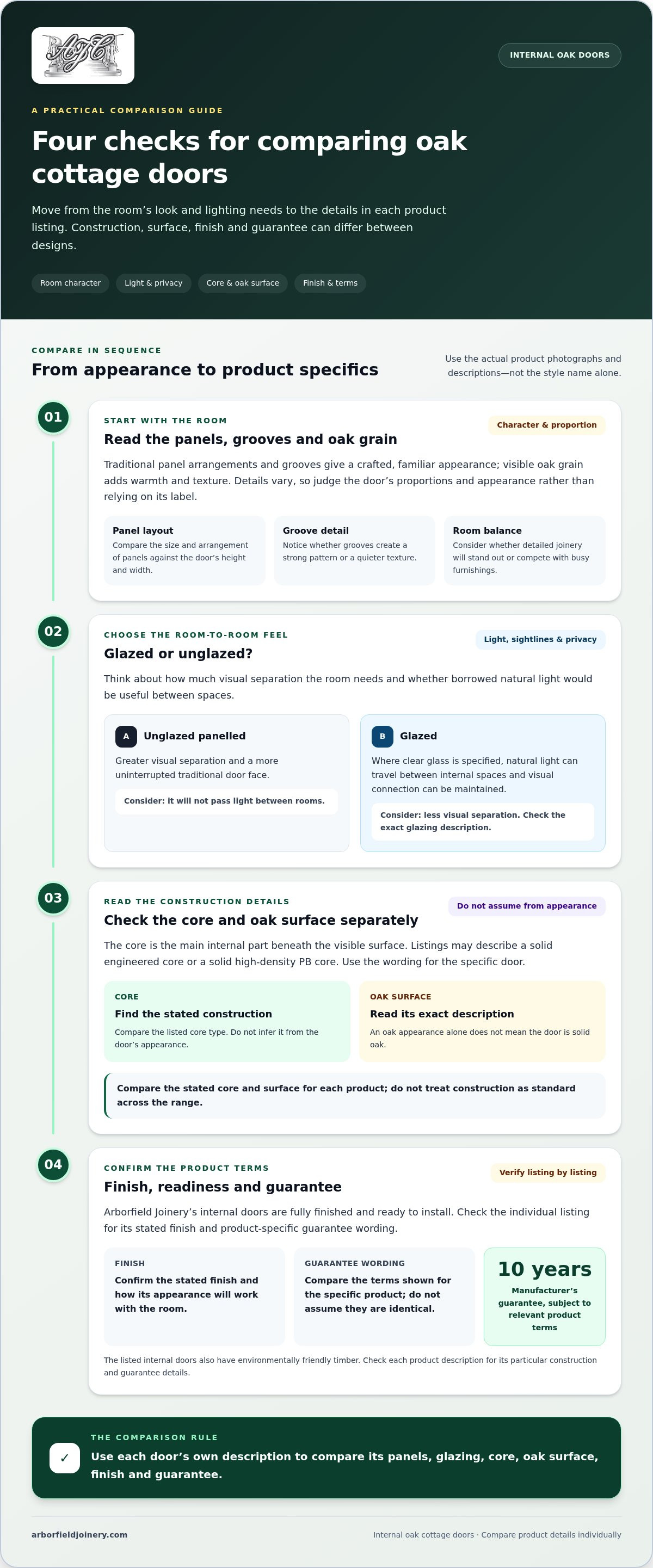
What gives an oak door a cottage feel? When choosing internal oak cottage doors, look beyond the label: panel layout, groove detail, visible grain and finish all shape the character of a room. A glazed design can let natural light pass between spaces, while an unglazed panelled door creates a clearer visual boundary.
This guide explains how to compare cottage-style details, glazing, construction and finish, with practical checks for measuring your opening and choosing a door that suits your interior. Arborfield Joinery is a family-run business with a 120+ door showroom and a range of internal oak doors to browse. Compare each product’s description and dimensions before ordering, as details can differ between designs.
Key Takeaways
- Learn which panel and groove details give internal oak cottage doors their traditional character, and how oak grain adds warmth.
- Compare the core, oak surface, finish and product-specific guarantee wording before choosing.
- Weigh panelled and glazed designs against the room’s need for privacy, borrowed light and visual continuity.
- Use a pre-order checklist to compare opening measurements, exact door dimensions, handing and finish.
- Discover how Arborfield Joinery’s “70+ Years Family Run Business” heritage supports a considered choice for your home.
What gives internal oak cottage doors their distinctive character?
Cottage style is a family of design cues, not one fixed door specification. Traditional panel arrangements and grooves can give a door a familiar, crafted appearance, while oak’s natural colour and visible grain add warmth and texture. Together, these details can make a door feel like part of the room’s design rather than simply a division between spaces.
A cottage-style internal oak door uses panel or groove detailing to evoke traditional joinery, with the oak’s visible grain adding warmth and visual interest. The exact layout and level of detail vary, so judge a design by its proportions and appearance rather than relying on the style name alone.
Which design details create a cottage-style look?
Compare the size and arrangement of the panels, then look at the depth and direction of any grooves. Clearly defined panels can make a stronger traditional statement, while quieter detailing can suggest cottage character without appearing ornate. Consider the room as well: a detailed door may stand out against plain walls, but could compete with busy furnishings or prominent patterns.
- Compare panel proportions with the door’s height and width.
- Notice whether grooves form a strong pattern or a more subtle texture.
- Consider how much visual detail is already present in the room.
Can cottage oak doors work in newer interiors?
Yes. Traditional detailing can create a useful contrast in a newer home, particularly alongside clean lines and a restrained palette. Oak grain can also soften a scheme built around painted surfaces or simple furnishings. The result depends on the door’s design and the colours, light and materials around it, so consider the whole room rather than choosing from a style description alone.
For a connected look, repeat a related oak tone or natural finish in furniture, shelving or flooring. An exact match is not essential: a complementary tone can help the door feel considered, while a more pronounced contrast can make it a focal point. If the room already contains prominent wood details, compare their colour and grain with the door before deciding.
Arborfield Joinery’s internal oak door range gives you designs to compare. Use the product photographs and descriptions to assess each door’s actual panel or groove detail, then picture it against your walls, flooring and furnishings. The most convincing choice is not necessarily the most elaborate one. Look for proportions and oak character that feel right in the room.
How to compare oak construction, core and finish
Doors with a similar oak appearance can have different construction and surface descriptions. Read each product listing individually rather than assuming that one door’s features apply across the range. Start by comparing the core, oak surface, finish and guarantee wording:
| Detail | What to look for | Why it matters |
|---|---|---|
| Core | The stated solid engineered core or solid high-density PB core | Shows how the door is described internally. Don’t infer a core type from its appearance. |
| Oak surface | The exact description of the oak surface in the listing | Clarifies what the product information says about its visible oak finish. |
| Finish | The stated finish for the door | Helps you understand the appearance of the door you are choosing. |
| Guarantee | The product-specific guarantee or warranty wording | Lets you compare the stated terms without assuming they’re identical across products. |
Check construction and finish product by product; don’t treat them as standard across all internal oak cottage doors. For a broader explanation of door construction and types, Designing Buildings Wiki provides useful context on how doors are made and described.
What does the core description tell you?
The core is the main internal part of the door, beneath its visible surface. Product listings describe internal doors as having a solid engineered core or solid high-density PB core. These are specific construction descriptions, so use the wording shown for the door you’re considering. An oak appearance alone doesn’t mean the door is solid oak. Check the listing for both the stated surface and core before comparing options.
How do unfinished and finished doors differ?
Arborfield Joinery’s internal doors are fully finished and ready to install. Read the individual listing to confirm the specific finish and see how it will work with your room. Don’t assume that two doors with a similar oak appearance have the same surface or finish.
The listed internal doors also have environmentally friendly timber, a solid engineered or solid high-density PB core, and a 10-year manufacturer’s guarantee, subject to the relevant product terms. Check each listing for its specific construction and guarantee wording. If you’re weighing up internal oak doors, browse Arborfield Joinery’s oak door range and compare the individual product details side by side.
Glazed or panelled: compare cottage oak door styles
The choice between an unglazed panelled door and a glazed design affects more than appearance. It changes how much you can see between rooms, whether natural light can pass through and how connected adjoining spaces feel. Consider what the room needs, then compare the precise glazing description and panel layout shown for each door.
| Style | Pros | Things to consider |
|---|---|---|
| Unglazed panelled | Offers greater visual separation and a more uninterrupted traditional door face. | Won’t pass light between rooms, so consider the existing light and sightlines. |
| Glazed | Where the product includes clear glass, it can allow natural light to travel between internal spaces and maintain a visual connection. | Offers less visual separation than an unglazed door. Check the listing for the precise glazing description. |
When might a panelled cottage oak door suit the room?
An unglazed panelled door can reinforce a traditional interior, particularly where the room already features natural materials or classic details. It creates a clearer visual boundary between spaces, which may suit a room where you’d prefer not to see directly through the doorway. Consider the view from both sides and whether the door’s pattern complements nearby joinery or competes with it.
For an opening between a hallway and a room where visual separation matters, an unglazed design may feel like a natural fit. In a darker passage, consider whether blocking light from the adjoining room suits the layout. A door’s appearance alone doesn’t establish how it performs for sound or other practical needs, so don’t assume benefits that aren’t stated in its product information.
When might glazed detailing be worth comparing?
Glazing can let natural light pass between internal spaces, which may be useful when one room receives more daylight than the next. Clear glass keeps the view more open than an unglazed panelled door, while the oak frame and detailing can retain a traditional character. The amount and arrangement of glass shape the overall look, so use the product description and images to assess each design individually.
Picture the door from both sides and consider what will be visible through it. A glazed door between a hallway and living space can create a stronger visual connection; an unglazed version gives the opening a more distinct boundary. Light, layout and furnishings all affect how the finished room feels.
Use only the glazing details stated for the specific door. Clear glass, where specified, is not the same as other glazing types. Likewise, don’t infer that a glazed or panelled style is fire-rated. Any fire-door rating or certification must be explicitly stated in that product’s listing. Comparing these details helps you choose internal oak cottage doors with the right balance of character, light and visual separation for the room.
What to check before ordering an internal oak cottage door
Measuring the opening and reading the product page carefully can help you avoid choosing a door that doesn’t suit your space or finish preferences. Use this checklist to compare the details before ordering. If you’re also considering the frame, the internal doors and door frames guide offers useful context for making your selection.
Which measurements and details should you compare?
Start with the existing opening, then compare your measurements with the exact dimensions shown for the door. Don’t assume that size labels are interchangeable. Use the listed measurements for the specific product and consider how they relate to your opening. Also review any product information about hinges, handing and fitting, as these details can affect whether the door suits the way the opening is arranged.
- Measure the opening. Record its height and width, then compare them with the product dimensions rather than relying on a general size label.
- Check the door size. Match the exact dimensions on the listing to your measurements. If the opening or existing frame isn’t square, take that into account when assessing the fit.
- Review handing and hinge details. Use the product information and any diagrams to understand the specified arrangement and how the door is intended to open.
- Confirm the finish. Check the door’s stated finish and consider how it will work with the rest of the room.
- Read trimming information. Internal doors can be trimmed for installation flexibility, but check the chosen product’s guidance before deciding how it can be adjusted. Don’t apply an allowance from another door or rely on a generic figure.
These checks are especially useful when comparing internal oak cottage doors that look similar in photographs. Differences in listed size, handing or finish can determine whether a particular option suits your opening and project.
Which delivery and returns terms should you read?
Before completing your order, read the product and delivery information so you understand the stated terms. Delivery is within 3-7 working days of the order being despatched. Arborfield Joinery’s 14-day return policy requires the packaging to be unopened and pictures to be taken. Keep the packaging intact and take pictures as required if you may need to make a return.
Once you’ve checked the opening, dimensions, handing, finish and product-specific trimming information, you’ll be in a stronger position to choose. Compare Arborfield Joinery’s internal oak doors against your checklist, paying close attention to the details for each individual door.
Choose your oak cottage door with Arborfield Joinery
A good choice brings together panel character that suits your interior, a finish that works with your plans and glazing that gives the room the balance of light and privacy you want. Compare internal oak cottage doors by their individual details rather than relying on a broad style label. Check the exact product description, especially for construction, dimensions, finish and product-specific terms.
What can you expect from Arborfield Joinery?
Arborfield Joinery is a family-run business supplying doors, windows and stairs since 1953, with the positioning “70+ Years Family Run Business.” Its showroom displays 120+ doors, giving you the opportunity to explore a range of designs in person. Personal service can help you consider how different door styles relate to your home, while the product listings provide precise information for comparing individual options.
Listed internal doors have a 10-year manufacturer’s guarantee, subject to the relevant product terms. Read the guarantee wording on the chosen door’s listing rather than assuming that the same conditions apply to every product. It’s a useful comparison point alongside construction and finish, particularly when you’re choosing between doors that look similar.
If you’re weighing up oak details and finishes, the internal oak doors guide offers further context for comparing styles. Use it alongside the individual listings to narrow down which door suits your opening and room.
Take the next step towards the right door
Begin with the room itself. A pronounced panel design may suit a traditional scheme, while a simpler profile may work well alongside cleaner lines. Consider whether glazing would help light pass between spaces and whether the finish suits your plans. Then compare the selected door’s exact dimensions and specifications with the measurements and requirements for your opening.
Arborfield Joinery’s online shop lets you browse internal oak doors and review the details for each product. Use the individual listing for current dimensions, finish and terms, and compare like with like. A door is part of the wider interior, so choose one that feels right in the room as well as fitting the opening.
Make your choice a natural part of home
The right door should feel at ease in its setting, bringing character to the room without competing with the details around it. As you consider internal oak cottage doors, picture the design from both sides of the opening and think about how its finish will sit alongside the colours and materials you already love.
Arborfield Joinery’s “70+ Years Family Run Business” heritage, personal service and showroom with 120+ doors on display offer ways to explore your options. Listed internal doors include a 10-year manufacturer’s guarantee, subject to the applicable product terms. Compare the details that matter to your home, then explore the range at your own pace.
Explore internal oak doors and find a design that feels right for your home.
Frequently Asked Questions
What is the difference between a cottage oak door and a Mexicano-style door?
A cottage oak door is a broad style description, while Mexicano-style usually refers to a recognisable plank-effect design with vertical grooves and horizontal rails. The terms can overlap, so don’t rely on the label alone when comparing doors. Look at the face pattern, panel arrangement and oak finish in the product photographs and description. This makes it easier to judge which design suits your interior, whether traditional or contemporary.
How much do internal oak cottage doors cost?
There isn’t one price for all internal oak cottage doors. The price depends on the individual door and its listed specification, including its design, size, glazing and finish. Use the current price shown on the product listing rather than relying on a general estimate. Compare like for like, including the stated construction and product-specific guarantee terms, to understand what each option offers.
Can an internal oak cottage door be used as a fire door?
Only if the specific door is described as a fire door and its listing provides the relevant fire-door information. An oak finish or cottage-style appearance doesn’t indicate a fire rating. Check the chosen product’s description for its stated rating and any certification. Q-MARK and Certifire © apply only to specified fire-door options. Don’t assume an ordinary internal oak door can be treated as a fire door or used in its place.
What does the 10-year manufacturer’s guarantee cover?
Arborfield Joinery’s company statement describes a “10 Year guarantee - Against Faulty Materials and Workmanship”. The terms that apply to a particular door are product-specific, so read its listing and guarantee wording for the relevant conditions. Keep your order details and product information together after purchase for reference to the guarantee attached to your chosen door.
Can I order an internal oak cottage door in a non-standard size?
Yes, Arborfield Joinery supplies bespoke internal doors made to your exact specification. For a non-standard opening, note the required measurements and compare them with available product dimensions before choosing a standard listing. If a bespoke door is the right route, provide accurate size requirements and consider the style and finish you want. This can be useful in older homes where an existing opening may not match a commonly listed door size.
Are all internal oak doors made from solid oak?
No. An oak appearance doesn’t necessarily mean a door is made entirely from solid oak. Construction can vary, so check the individual listing for the stated surface and core rather than inferring materials from photographs or the word “oak”. A product may specify an oak surface alongside a separate core description. Reading both details helps you understand what the door is made from before comparing it with other options.
Share:
Maintain Wooden Staircases in Period Properties
What to Look for When Buying Internal Doors