
Table of Contents
- What Are Flush Internal Doors?
- The Benefits of Flush Internal Doors
- The Drawbacks and Limitations to Consider
- Hollow Core vs Solid Core Doors: Which Construction Suits Your Home?
- Acoustic Performance and Fire Safety Compliance
- How to Choose Internal Doors for Your Project
- Cost-Effectiveness and Environmental Impact
- Frequently Asked Questions
Last Updated: September 26, 2026
What Are Flush Internal Doors?
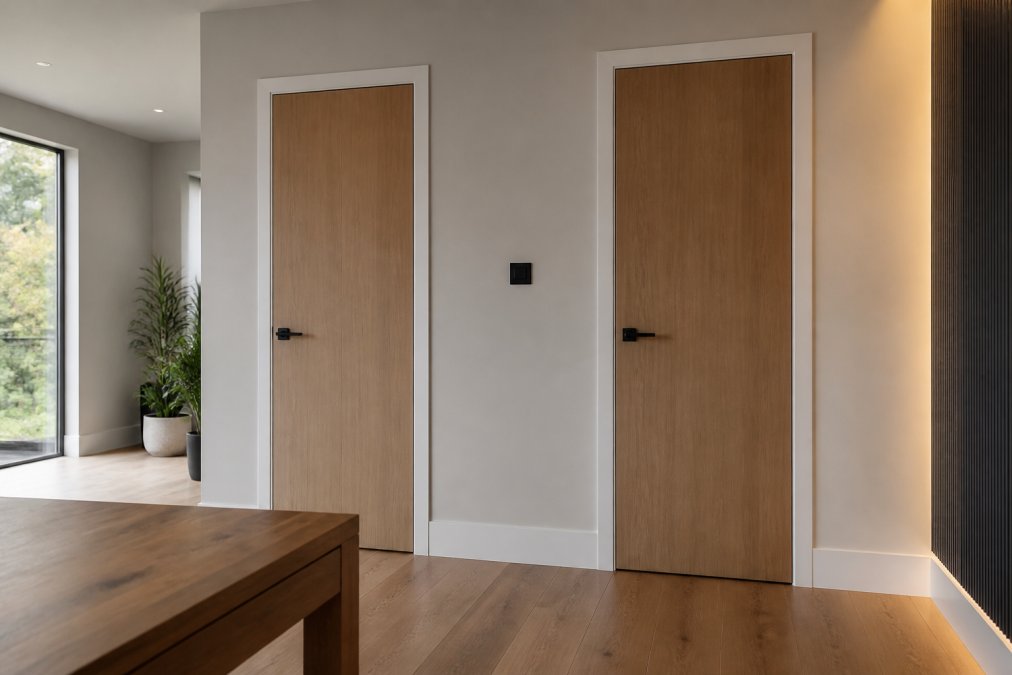
Flush internal doors have a completely flat, smooth surface that sits level with the door frame, with no raised panels, mouldings, or decorative detailing, clean lines that suit contemporary and traditional interiors.

At Arborfield Joinery, we have supplied flush doors since 1953. A flush door is a blank canvas: it disappears into the wall when closed, making small rooms feel larger and letting your flooring, furniture, and lighting do the talking.
But they are not right for every property. This guide covers the genuine benefits and drawbacks, cost, installation, acoustic performance, and repairability, so you can decide with clear eyes.
The Benefits of Flush Internal Doors
The main benefits of flush internal doors are aesthetic versatility, straightforward installation, and easy maintenance. Their flat surface accepts paint, veneer, or laminate finishes, so one style can serve a whole house.
Minimalist Aesthetic and Seamless Integration
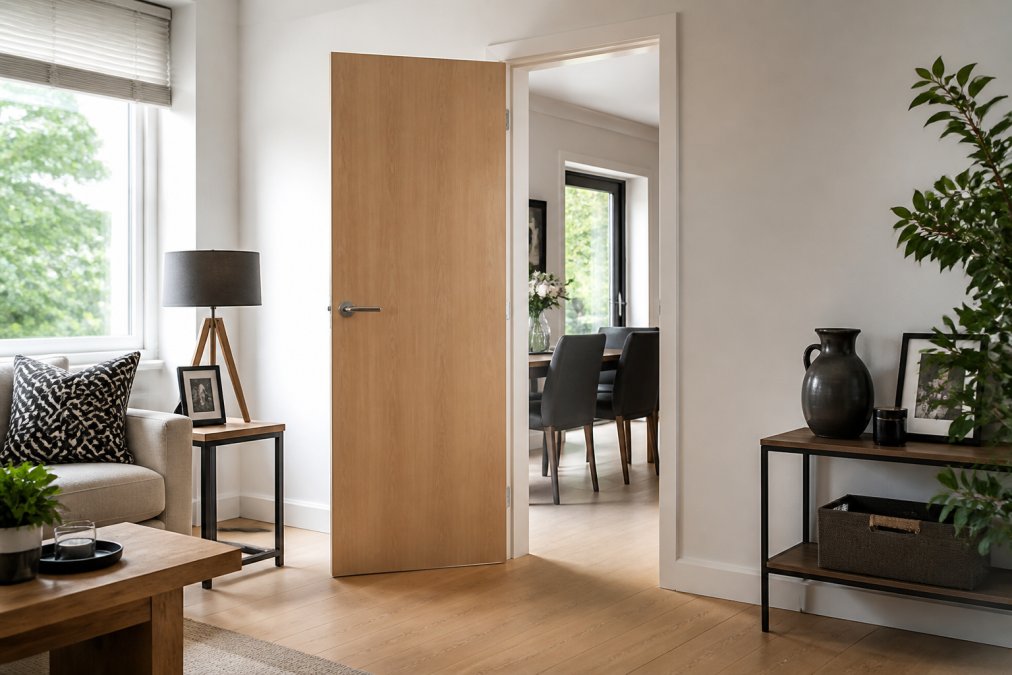
A flush door's flat face aligns neatly with the frame, so the door reads as part of the wall rather than an object fixed to it. That is why architects specify flush doors in open-plan renovations, where a panelled door would interrupt the sightline.
Easy Installation and Standard Sizing
Flush doors are widely available in standard sizing, keeping cost and lead time down. Most stock sizes suit typical openings without modification.
The Drawbacks and Limitations to Consider
The drawbacks of flush internal doors are limited design flexibility, visible surface damage, and repair difficulty. A flat door has nowhere to hide a scuff, dent, or scratch, and a hollow core version offers little stability for heavy hardware.
Limited Design Flexibility and Customisation
A flush door is, by definition, plain. If you want raised panels, moulded details, or a period-correct profile, it cannot deliver them.
Damage Visibility and Long-Term Repairability
Surface damage shows immediately on a flat door. A hollow core door with a thin facing is especially vulnerable: a stray trolley wheel or slammed handle can puncture the skin, and the damage is hard to repair invisibly.
Hollow Core vs Solid Core Doors: Which Construction Suits Your Home?
Solid core doors are the better choice for most homes; hollow core doors suit low-traffic areas and tight budgets. The difference is what sits inside: a solid core is filled with dense material, while a hollow core is mostly empty with a light frame and thin facings.
| Feature | Hollow Core | Solid Core |
|---|---|---|
| Weight | Light, easy to hang | Heavier, needs solid fixings |
| Sound insulation | Limited | Noticeably better |
| Impact resistance | Low | High |
| Fire rating options | Rarely available | Available, including FD30 |
| Best for | Cupboards, low-traffic rooms | Bedrooms, bathrooms, busy hallways |
Acoustic Performance and Fire Safety Compliance
Acoustic performance and fire safety are where flush doors genuinely differ, and where cheap doors fall short. Both come down to mass, density, and how well the door is sealed into its frame, not the flush style itself.
Acoustic performance: what the numbers actually look like
Sound reduction is measured in decibels (dB), and the difference between constructions is substantial:
-
Hollow core flush door: typically reduces sound transfer by roughly 15-20 dB. Speech and television audio pass through clearly; it is barely better than an open doorway for privacy.
-
Solid core flush door (35-44mm): typically achieves around 28-32 dB. Normal conversation in an adjacent room becomes indistinct, which is usually enough for a bedroom or study.
-
Solid core with acoustic seals and a drop-down threshold: can reach the low-to-mid 30s dB. This is the specification to aim for where a bathroom or home office sits next to a busy hallway.
-
An intumescent or acoustic perimeter seal in the frame rebate.
-
A drop-down automatic threshold seal at the base.
-
A snug fit, no more than a 2-3mm gap on the closing edge.
-
Solid timber or MDF linings rather than hollow plasterboard returns.
Fire safety: FD30, FD60, and where the rules bite
In the UK, a fire door is a tested, certified product, not simply a solid door. The two ratings you will see most often are:
- FD30: provides at least 30 minutes of fire resistance. This is the standard for most domestic situations, including doors onto a protected escape route and doors between a dwelling and an integral garage.
- FD60: provides at least 60 minutes. It is generally specified in flats, buildings with a storey above 11 metres, and some commercial or mixed-use settings.
The gap most guides miss
Most articles on flush doors mention fire safety in a single sentence and never explain that a fire door is a system, not a leaf. If you are specifying for a garage door, flat entrance, or loft conversion, the certification paperwork matters as much as the door itself, and should be retained for the life of the installation.

How to Choose Internal Doors for Your Project
Choosing internal doors comes down to four decisions: construction, finish, size, and certification. Work through them in that order and the rest follows.
- Construction: solid core for bedrooms, bathrooms, and hallways; hollow core only for cupboards and low-traffic spaces.
- Finish: pre-finished veneer saves time and gives a consistent surface; primed doors let you match a specific paint colour.
- Size: measure the opening accurately. Standard sizes keep costs down; bespoke sizes solve awkward Victorian openings.
- Certification: specify a certified fire door wherever the Building Regulations require one.
Cost-Effectiveness and Environmental Impact
Flush doors are generally cost-effective because they use less material and simpler manufacturing than panelled designs. But the headline price is only part of the story, the real cost sits in how long the door lasts and what it is made of.
Upfront cost versus whole-life cost
As a broad guide, within the flush door category:
- Hollow core: the cheapest option, typically 30-50% less than an equivalent solid core door.
- Solid core, primed: mid-range. You pay for the core density and the extra weight of materials.
- Solid core, pre-finished veneer: the top of the range. The premium covers the veneer selection, the factory finish, and the quality control that comes with it.
Those figures only make sense once you factor in lifespan. A hollow core door in a busy hallway may need replacing within 5-10 years once the facings puncture or the frame twists. A solid core door, correctly hung and occasionally refinished, will often last 30 years or more, frequently making it the cheaper choice over that period, the opposite of what the sticker price suggests.
What FSC certification actually verifies
FSC (Forest Stewardship Council) certification is not a marketing label, it is a chain-of-custody system confirming that the timber in the door can be traced through every stage of processing to a forest managed to defined environmental and social standards. In practice, that means:
- No conversion of natural forest to plantation.
- Protection of high conservation value areas.
- Compliance with local law and workers' rights.
- Independent auditing of the supply chain.
Embodied carbon: hollow core versus solid core
This is the angle most guides ignore. A hollow core door uses less material, so its embodied carbon is lower at manufacture. But that advantage is often wiped out by a shorter service life, a door replaced three times over 30 years carries roughly three times the embodied carbon of one that lasts the full period.
Frequently Asked Questions
What are the disadvantages of flush doors?
The main drawbacks include limited design flexibility compared to panelled or moulded doors, and the fact that surface damage is more visible because there is no raised moulding to hide it. Hollow core versions also offer less structural stability and sound insulation. However, solid core flush doors address many of these issues, providing better durability and acoustic performance at a higher price point.
Are flush doors of good quality?
Quality depends entirely on construction. A solid core flush door, like those from Arborfield Joinery, offers excellent durability, structural stability, and sound insulation. Hollow core versions are lighter and cheaper but less robust. Look for solid engineered cores, solid lippings, and manufacturer warranties. For example, the Oak Flush door features a solid engineered core and comes with a 10-year conditional warranty.
What is the difference between hollow core and solid core flush doors?
Hollow core doors have a lightweight internal frame with a honeycomb or cardboard core, making them cheaper and easier to hang but less durable and poor at blocking sound. Solid core doors use a dense particleboard or engineered timber core, offering better structural stability, acoustic performance, and fire resistance. Solid core options like the Oak Verde Veneer Flush Internal Door are heavier but far more robust.
Are flush doors more expensive than traditional options?
Not necessarily. Basic hollow core flush doors are often cheaper than panelled doors. However, solid core and fire-rated flush doors cost more due to materials and certification. At Arborfield Joinery, prices range from £105.00 for the Flush White Primed Internal Door to £157.00 for the Oak Verde Veneer Flush Internal FD30 Fire Door. The cost reflects construction quality, finish, and safety ratings.
Share:
Oak Newel Posts for Stairs: How to Choose the Right Fit
FD30 Oak Fire Doors: A UK Buyer’s Guide to Safety, Style and Fit