
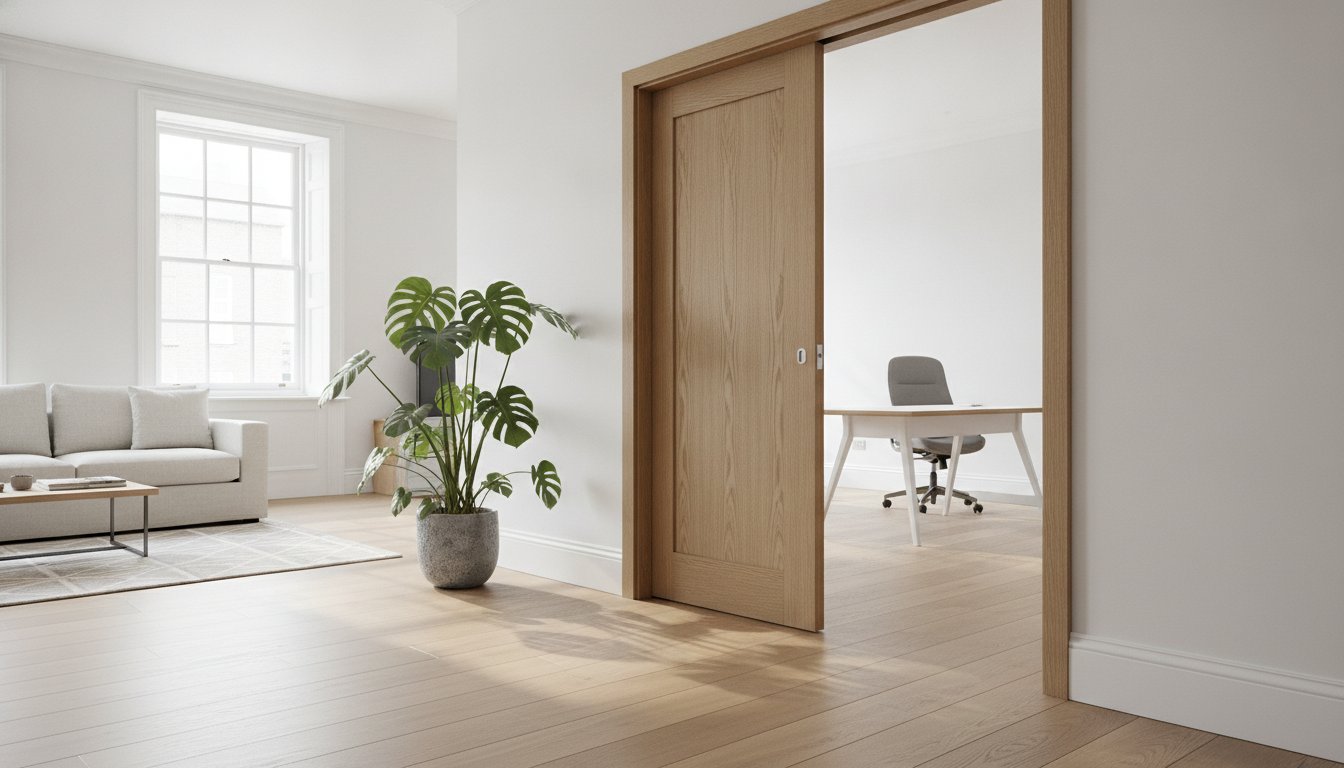
How much of your home's footprint are you currently sacrificing to the simple arc of a swinging door? In a typical British home, a standard internal door can waste nearly ten square feet of usable floor area, often dictating where you place your furniture or how you navigate a hallway. It's a common frustration for many homeowners who feel their living space is restricted by traditional joinery. Investing in high-quality pocket door systems UK wide offers a sophisticated solution that transforms this dead space into functional territory while adding a touch of contemporary elegance.
We understand the hesitation that comes with making a permanent architectural change. You might worry about a flimsy mechanism that rattles or feel confused about whether your existing stud or solid walls can accommodate a hidden cavity. This guide draws on our heritage of joinery expertise to demystify the selection process. You'll discover how to choose a robust system that glides silently for a lifetime, ensuring your home benefits from a seamless, high-end finish. We'll explore everything from structural requirements and wall thickness to the latest fire safety standards, providing the clarity you need to enhance your property's value and aesthetic.
Key Takeaways
- Learn how to reclaim significant floor space by swapping traditional door swings for a sleek, "disappearing" door solution that enhances your home's layout.
- Understand the vital differences between single and double configurations and when your project requires an FD30 fire-rated system for safety compliance.
- Discover how to choose the perfect timber leaf to ensure your pocket door systems UK remain a durable and visually stunning part of your home's architecture.
- Master the technical requirements of stud wall installation, focusing on the relationship between frame kits and finished wall thickness for a flush, professional finish.
- See why heritage craftsmanship is the key to preventing warped doors and ensuring your sliding system operates silently for decades to come.
What is a Pocket Door System and Why Does Your Home Need One?
A pocket door system is a precision-engineered sliding mechanism that allows an internal door to glide effortlessly into a concealed cavity within the wall. Unlike traditional hinged doors that require a significant arc to open, these systems hide the door leaf entirely when it's not in use. If you've ever felt that a room's layout was compromised by the swing of a door, you're experiencing a common architectural dilemma. By removing this arc, you regain valuable floor area that can be used for furniture, storage, or simply better movement. For a foundational look at the history and basic mechanics of this design, you can read more about What is a Pocket Door and its various applications.
Beyond the practical gain of floor space, there's an undeniable aesthetic appeal to a door that simply "disappears". In modern UK interiors, minimalist design is often at the forefront, and pocket door systems UK wide provide a sleek, uncluttered finish that hinged doors cannot match. They create a seamless transition between rooms, maintaining clean lines whilst providing privacy when needed. It's a sophisticated touch that suggests bespoke quality and thoughtful property development.
The Anatomy of a Pocket Door Kit
A reliable pocket door kit consists of several critical components that work in harmony. The overhead track carries the weight of the door leaf, whilst the steel cage or frame creates the structural pocket that protects the timber whilst it's hidden. High-quality hangers and rollers are the heart of the system; they must be robust enough to handle heavy timber doors, such as oak or walnut, without sagging or creating noise. When we curate these systems, we prioritise precision-sealed bearings that ensure a smooth, silent glide every time you operate the door. A well-constructed cage also ensures the wall remains rigid and prevents the plasterboard from cracking over time.
Reclaiming Your Living Space
Where can these systems make the most impact? They're transformative in en-suites where a swinging door might hit the toilet or basin, and in small kitchens or utility rooms where every inch of thoroughfare matters. By removing the door swing, you gain the freedom to install premium Kartell bathroom products UK that might otherwise have been impractical in a confined space. Beyond these tight spots, pocket doors encourage a better "flow" amongst interconnected living areas. Double pocket doors are particularly effective for "flexible living", enabling you to merge a dining room and lounge into one grand entertaining space or divide them for a cosy evening. It's clear why the cavity sliding door is the primary space-saving joinery solution in 2026. It offers a permanent architectural improvement that makes your home feel larger, brighter, and significantly more versatile.
Technical Specifications: Single vs Double and Fire-Rated Systems
Single pocket door systems UK wide are the standard choice for en-suites and larders, but double systems offer a truly grand entrance between a dining room and kitchen. The track mechanism is the most vital part of the technical specification. It must be rated to support the significant weight of high-quality internal oak doors, which can be much heavier than hollow-core alternatives. Choosing a system with a high weight capacity ensures the door won't sag or drag over time, maintaining that effortless glide for years.
You'll also need to decide between assembled and self-assembly kits. Assembled kits are factory-aligned for maximum rigidity and speed on-site, whilst self-assembly versions are often easier to transport through narrow hallways or up tight staircases. Both provide a robust result if the installation follows the manufacturer's guidance precisely. The choice usually depends on your project timeline and the physical access to the room being renovated.
When Do You Need a Fire-Rated Pocket Door?
In many UK homes, especially those with three storeys or integral garages, fire safety is a legal requirement rather than a choice. According to the UK Building Regulations, doors leading to protected stairwells or hallways often must meet the FD30 standard. This means the pocket system must be specifically tested to provide 30 minutes of fire resistance. These systems integrate intumescent strips into the frame, which expand when heated to seal the cavity. Modern engineering ensures that these safety features remain completely hidden, so you don't have to sacrifice your minimalist interior aesthetic for compliance.
Unframed vs Framed (Classic) Systems
The "Classic" pocket system is designed to work with traditional internal doors and door frames, allowing you to finish the opening with matching architrave and skirting. This is often the best choice for Victorian or Edwardian properties where you want the new door to feel like it's always been there. Conversely, unframed or "Syntesis" styles eliminate the need for architrave altogether. The plasterboard is finished right up to the edge of the opening, creating a flush, ultra-modern look that suits minimalist apartments perfectly. These high-end pocket door systems UK homeowners love provide a clean finish without distracting details. If you're looking for a bespoke finish that adds value, viewing these styles in person at our showroom is a great way to start your journey with Arborfield Joinery.
Matching the Door Leaf: Oak, Walnut, and Urban Styles
Whilst the sliding track acts as the silent engine of your installation, the door leaf is the visible soul of the project. It's a common mistake to view the metal frame and the timber door as separate purchases, but they must work in perfect synergy. When selecting pocket door systems UK homeowners should prioritise high-quality timber that resists the unique environmental conditions of a wall cavity. A door hidden inside a wall doesn't benefit from the same airflow as a standard hinged door, making material stability and expert joinery essential to prevent warping over time.
Oak remains the most popular choice across Britain, valued for its incredible durability and classic grain patterns. It provides a sense of permanence and weight that complements the precision of a high-end sliding system. For those seeking a more dramatic, luxury aesthetic, walnut offers a deeper, richer tone that serves as a striking focal point. If you're modernising a space, our "Urban" range features slim, black-framed designs that bring an industrial edge to the "disappearing" door concept, proving that space-saving solutions can also be a bold style statement.
The Timeless Appeal of Oak and Walnut
Natural timber brings a tactile warmth to an interior that synthetic materials struggle to replicate. The intricate grain of oak or the smooth, chocolatey hues of walnut often make them a firm favourite amongst those curating a premium interior. These natural finishes can be beautifully coordinated with other elements in your home. You can easily match your premium pocket doors to existing laminate internal doors in secondary rooms to maintain a cohesive design language throughout the property. When ordering, consider whether you prefer a pre-finished leaf for immediate installation or an unfinished option that allows you to apply a bespoke stain on-site. Pre-finished doors are often better for pocket systems as the factory seal provides a consistent barrier against moisture.
Glazed Pocket Doors for Natural Light
Dark hallways and windowless en-suites are often the biggest beneficiaries of pocket door systems UK wide. By choosing a glazed leaf, you allow natural light to permeate through the home even when the door is closed for privacy. This simple change can make a small, cramped room feel significantly larger and more inviting. For bathrooms, sandblasted or etched privacy glass offers the perfect balance, obscuring the view whilst harvesting every bit of available light. Whether you opt for a single large pane or a multi-light "Urban" style, the result is a home that feels brighter and more connected.

Planning and Installation: Measuring and Stud Wall Requirements
Successful installation of pocket door systems UK wide begins long before a single screw is driven into a stud. It's a structural change that requires methodical planning to ensure the finished result is as functional as it is beautiful. To help you prepare, we've outlined five essential steps for a smooth project:
- Determine your desired door leaf dimensions first, as the kit size depends entirely on this.
- Identify whether you're working with a new stud partition or retrofitting against a solid wall.
- Clear the intended "pocket" path of all electrical cables, light switches, and plumbing.
- Select your finished wall thickness, typically matching standard 100mm or 125mm stud work.
- Establish a perfectly level finished floor line to prevent the door from drifting or dragging.
Precision is non-negotiable during the structural phase. If your stud work isn't perfectly plumb, or if the floor has a slight slope, the door won't glide with that signature "silent" operation. You should also consider your finishing touches early on. Forgetting to account for the depth of skirting boards or the placement of light switches is a common pitfall that can lead to frustrating delays during the final decorating stage.
How to Measure Correctly for a Pocket Kit
Understanding the difference between the "opening size" and the "overall frame size" is the most critical part of the measuring process. The opening size refers to the visible gap where the door will sit when closed, whilst the overall frame size includes the entire metal cage that will be hidden inside the wall. To ensure a perfect fit, you must create a checklist that records the height, width, and total depth of the available wall cavity. Keep in mind that the total wall space required is roughly double the door width to allow the leaf to retract fully into its hidden pocket.
Integrating with Stud and Solid Walls
Most pocket door systems UK homeowners choose are built into new timber or metal stud partitions. This is the most straightforward method, as the kit replaces a section of the stud work. For a standard UK finish, we recommend using 12.5mm plasterboard on both sides of the frame to achieve a sturdy, flush result. If you're working with an existing solid masonry wall, you'll need to employ the "false wall" method. This involves building a new, slim stud frame directly in front of the brickwork to house the pocket mechanism. Once you've mapped out your space, view our range of pocket door systems to find the perfect technical match for your home's structural needs.
Why Quality Joinery Matters for Your Pocket Door System
A pocket door system is a permanent architectural feature. Choosing a flimsy kit or a low-grade door leaf is a false economy that often leads to rattling tracks and sticking panels. As your "Quality Curator", we believe the hardware's precision must match the door's integrity. Our 70-year heritage has taught us that internal doors hidden within a wall cavity face unique atmospheric pressures. Premium timber, selected for its natural resistance to warping, ensures your investment adds tangible value to your property. Have you considered how a bespoke finish can transform a standard renovation into a high-end home improvement? For those managing technical builds that require high-performance components, you can explore Nylon 11 & 12 Flexible Tubing to see how precision-engineered materials support durable infrastructure.
We've been a family-run specialist since 1953. We've seen the industry evolve, yet our commitment to reliable craftsmanship remains steady. Whilst we don't provide installation services, we supply the trade-grade products that professional installers prefer to work with. Our Berkshire showroom features over 120 doors, allowing you to experience the silent glide of our pocket door systems UK wide before you commit to a purchase. We understand that logistics matter for large projects, which is why we offer free mainland shipping on orders over £900. It's part of our commitment to providing a premium yet attainable experience for every homeowner.
Creating a Cohesive Interior Design
A home feels most considered when the joinery speaks the same language throughout every room. You can coordinate your pocket doors with our bespoke stairs and other timber elements to create a unified, elegant aesthetic. Choosing premium timber isn't just about style; it's about long-term sustainability and avoiding the waste associated with cheap, short-lived alternatives. Our experts are always on hand to help you navigate the technical details, ensuring your chosen doors complement your home's unique character. Ready to transform your living space? Explore our full range of pocket door systems and internal doors today and discover the difference that seven decades of expertise makes.
Transform Your Home with Hidden Joinery
You've seen how these systems eliminate the restrictive arc of traditional doors and why technical precision in stud work ensures a lifetime of silent operation. By choosing high-quality oak or walnut leaves, you're investing in a permanent architectural feature that adds real value to your property. Selecting the right pocket door systems UK wide is a sophisticated choice for both form and function, turning dead space into usable territory.
As family-run joinery experts since 1953, we invite you to see these systems in person at our showroom, where over 120 doors are on display for your inspection. We also provide free UK mainland shipping on orders over £900 to support your home improvement journey. View our premium range of Pocket Door Systems and internal doors today to find the perfect match for your interior. Your path toward a more spacious and elegant home starts with the right choice of heritage craftsmanship.
Frequently Asked Questions
Do pocket doors provide good soundproofing between rooms?
Pocket doors generally offer slightly less acoustic insulation than standard hinged doors because of the small gaps required for the sliding motion. However, you can significantly improve this by using high-quality timber leaves like solid oak and installing brush strips or acoustic gaskets. These seals close the gaps around the perimeter whilst the door is closed, providing a level of privacy suitable for most domestic settings like bedrooms or home offices.
Can I install a pocket door into an existing solid brick wall?
Yes, you can install a pocket door against a solid brick wall by using the "false wall" or "twin wall" method. This involves building a slim timber or metal stud frame directly in front of the existing masonry to house the pocket door systems UK residents prefer for retrofitting. This new cavity is then plastered to match the rest of the room, creating a seamless look without compromising the building's structural integrity.
What happens if a pocket door gets stuck or comes off the track?
Captive rollers in high-quality systems make it almost impossible for the door to jump off the track during normal use. If the door feels stuck, it's usually due to a small obstruction in the floor guide or a loose screw. Most modern kits allow you to remove the architrave or a small access panel to adjust the hangers or clean the track without the need to tear down the entire wall.
Are pocket doors suitable for bathrooms and en-suites?
Pocket doors are exceptionally well-suited for bathrooms and en-suites where floor space is often at a premium. Because they don't require a swing arc, you can position sanitaryware like basins or toilets much closer to the doorway. We recommend using a moisture-resistant finish on your timber door leaf to ensure it remains stable in humid environments, along with a dedicated privacy thumb-turn lock for peace of mind.
Do I need a special type of door handle for a pocket door?
You do need specialised "recessed" or "flush" pull handles so the door can retract fully into the wall cavity without hitting the frame. Standard protruding lever handles would prevent the door from opening all the way. Most systems also include a "finger pull" on the leading edge of the door, which allows you to easily slide the leaf out of the pocket when it's fully recessed within the wall.
Can I hang pictures or shelves on a wall containing a pocket door?
You can hang lightweight pictures using short screws or adhesive hooks, but you must be extremely careful not to penetrate the internal cavity. Standard screws for heavy shelves or television brackets will likely strike the door leaf or damage the sliding mechanism. If you plan to hang heavy items, you should incorporate additional timber supports into the stud work outside the pocket area during the initial installation phase.
How much more expensive is a pocket door compared to a standard door?
A pocket door system is generally more expensive than a standard door because it requires a specialised metal frame kit and more complex structural work. Whilst the initial investment for the hardware and timber leaf is higher, many homeowners find the cost is offset by the value of the reclaimed floor area. It's an architectural upgrade that often adds more to a property's appeal than a basic hinged door.
Is it possible to have a fire-rated pocket door for a kitchen?
It's certainly possible to install a fire-rated pocket door for a kitchen, provided you select a kit certified to FD30 standards. These systems are specifically engineered with intumescent materials that seal the cavity in the event of a fire. Choosing these pocket door systems UK wide ensures building regulations are met whilst maintaining a sleek, open-plan feel between your kitchen and the rest of your living space.
Share:
Bespoke Timber Windows for Victorian Homes: A Planning Guide
Bespoke Joinery Design Consultation: A Complete Guide