
Last Updated: November 3, 2026
Quick Summary
Natural ventilation works best as a routine: keep trickle vents open year-round for steady background airflow, then open windows fully for short bursts after showering, cooking and waking. Short, deliberate bursts clear moisture and pollutants while losing far less heat than windows left ajar all day.
- Keep trickle vents open and unblocked, including in winter, to maintain background airflow.
- Open windows fully for a few minutes, two or three times a day, rather than leaving them ajar.
- Ventilate after showering, cooking and waking, when moisture and odours build up.
- Open internal doors and use opposite-side openings to create cross-ventilation through the home.
- Keep the heating at a steady, moderate setting so the house does not become prone to damp.
Table of Contents
- Why Natural Ventilation Matters in UK Homes
- 1. Use Trickle Vents Year-Round, Not Only When It Is Warm
- 2. Open Windows Briefly and Often Instead of Leaving Them Ajar
- 3. Create Cross-Ventilation by Opening Internal Doors
- 4. Ventilate a House Without Losing Heat
- 5. Tackle Condensation at the Source with Natural Airflow
- 6. Improve Airflow in Rooms With Only One Window
- 7. Choose Doors and Glazing That Support Good Airflow
- Frequently Asked Questions
Why Natural Ventilation Matters in UK Homes
Natural ventilation is the movement of fresh air through a home without fans or mechanical systems, and it is one of the simplest ways to improve indoor air quality. The same question keeps coming up for homeowners: how do you let fresh air in without losing the warmth you have paid for?
Natural ventilation is the movement of fresh air through open or controlled openings, driven by temperature differences and wind rather than powered fans. A research article on natural ventilation to improve indoor air quality in homes sets out the aim of helping non-expert users identify a suitable ventilation strategy for their own home (Natural ventilation to improve indoor air quality (IAQ) in homes).
The tension is real. Venting moisture, cooking fumes and everyday pollutants keeps a home healthier, yet every change of air costs some heat. Guidance from the UK Government recognises this trade-off, advising that trickle vents be kept open and unblocked even though doing so can increase heating energy use (Existing home ventilation guide).
For a broader look at how the building fabric affects heat loss, our guide to finding a good U-value for UK windows explains the performance figures that matter when you compare glazing.
1. Use Trickle Vents Year-Round, Not Only When It Is Warm
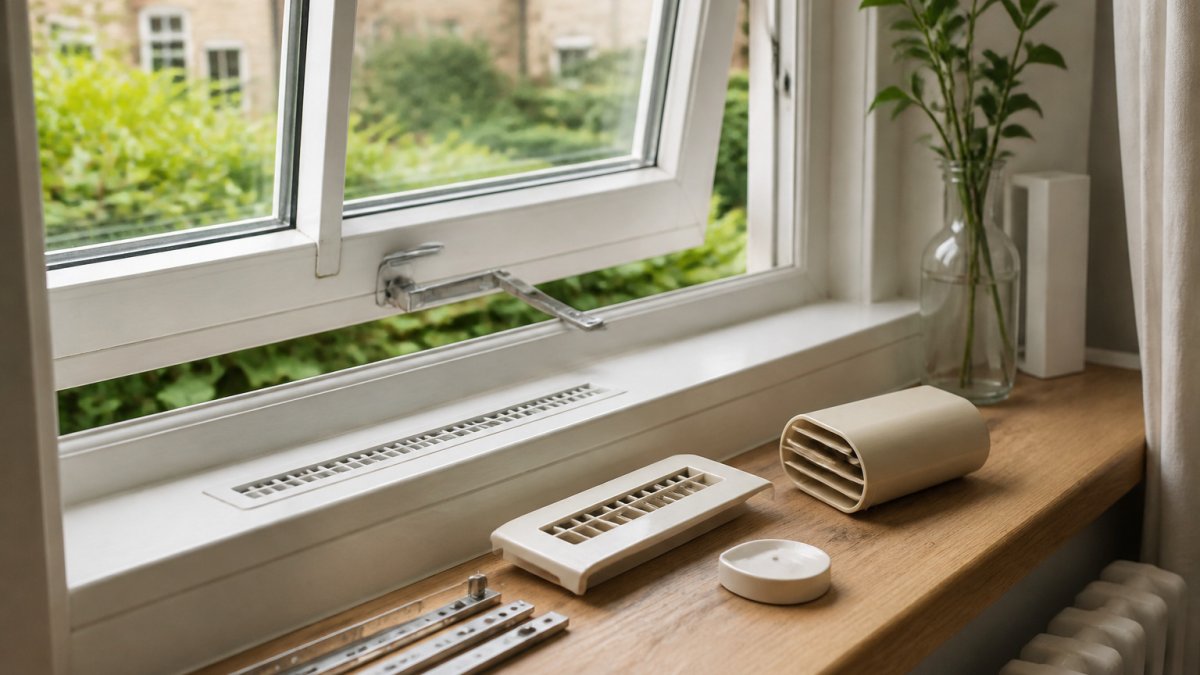
Trickle vents are small, controllable openings built into window frames that provide background ventilation. Many homeowners close them in winter to stop draughts, which is understandable but usually a mistake. Government guidance advises keeping trickle vents open and unblocked, including in winter, because they supply the steady background airflow that clears moisture and pollutants between other ventilation events (Existing home ventilation guide).
Leave them open and adjust only if a room becomes uncomfortably cold. Closing them entirely often leads to condensation on cold glass and window reveals, which invites mould. Keep them clear of dust and paint too, since a blocked vent does nothing.
2. Open Windows Briefly and Often Instead of Leaving Them Ajar
A short burst with a fully open window clears a room far faster than a window left slightly open for hours. A few minutes wide open refreshes the air while the room's fabric, furniture and surfaces keep most of their heat. A window left ajar all day cools the room continuously, and that is where most wasted energy comes from.
Build the habit around moments that produce moisture or odour: after a shower, after cooking, or after a room has been occupied for a while. Two or three quick openings often do more good than one long one.
3. Create Cross-Ventilation by Opening Internal Doors
Cross-ventilation happens when air enters on one side of a home and leaves on the other, carrying stale air out with it.
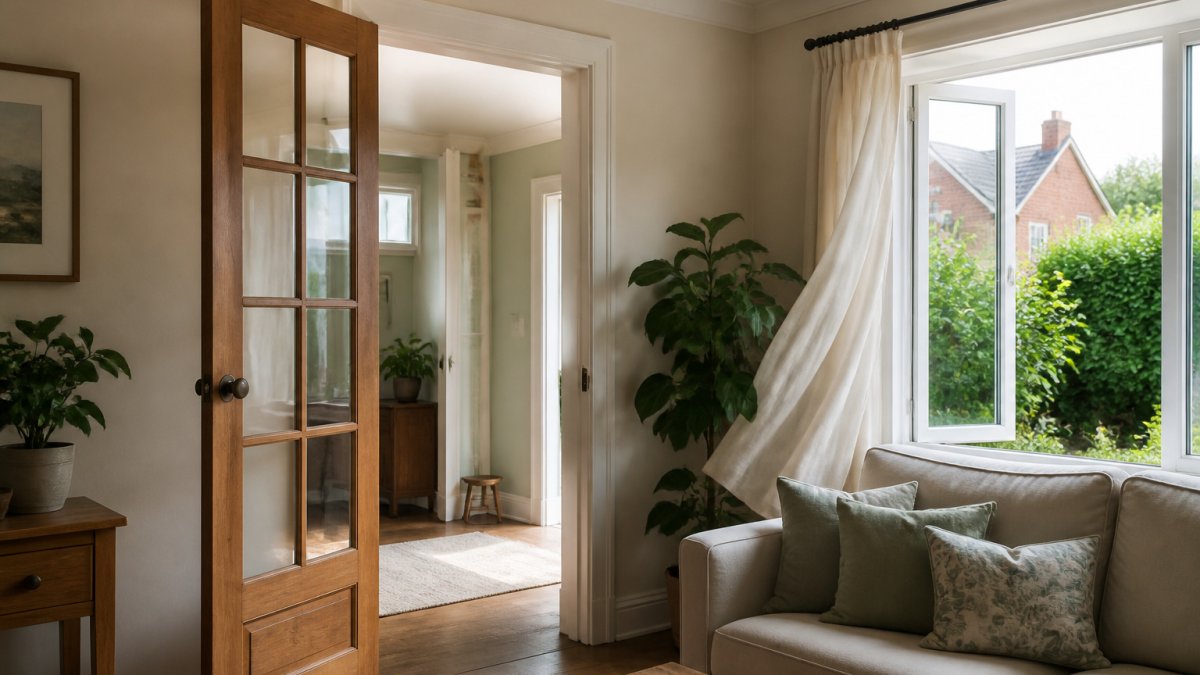
What most guides leave out is that cross-ventilation is driven by two distinct forces, and your layout decides which one you can use. The first is wind pressure: air pushes against the windward face and is drawn out on the leeward face. The second is the stack effect: warm air rises and escapes through high openings while cooler air is drawn in at low level.
The openings you choose matter as much as the doors between them. Aim for an inlet and an outlet of roughly similar size on opposite or adjacent faces, with a clear internal route between them.
House type changes the tactic:
- Victorian and Edwardian terraces. These usually have a front and rear elevation only, so the natural route is front-to-back through a hallway and a rear room. Opening a front window and a rear window on the same floor, with the intervening doors ajar, gives a straight path. Where the hallway is the only through-route, propping the internal doors open for ten minutes is more effective than opening one window wide.
- 1930s semis and interwar homes. The side elevation often has few or no openings, so the usable route is again front-to-rear. A landing window can act as a high-level outlet, letting the stack effect work even when the wind is light.
- Modern new-builds. These are usually much more airtight, so cross-ventilation depends on the trickle vents and opening lights actually being used. Running the trickle vents continuously and using the purge openings only when needed keeps the balance steadier than opening windows wide in short bursts.
- Flats and single-aspect rooms. Where there is only one external face, cross-ventilation is not possible in the strict sense. Use the stack effect within the room by opening the top and bottom of the same window where the frame allows, and keep the door to the rest of the home ajar so air can move to a second opening elsewhere.
Watch out: an open internal door is only useful if the air has somewhere to go. Opening every door in a house with windows on one side only does not create cross-flow; it just moves stale air around.
If you are replacing internal doors, glazed options keep the visual connection between rooms and make it easier to see when a room is stuffy, but the airflow benefit comes from the gap around the door and from leaving it open, not from the glazing itself.
Mexicano 1 Light 3/4 Glazed White Primed →
4. Ventilate a House Without Losing Heat
This is the central dilemma, and it is solvable. The aim is to replace stale air with fresh air while keeping the warmth you have already paid for. The most effective approach combines continuous background ventilation through trickle vents with short, targeted bursts of full opening.
What most guides avoid is the arithmetic. When you open a window wide for a few minutes, the warm air that leaves is replaced by cooler outside air, and the heating system then has to raise that air back to room temperature.
The practical tool is a ventilation schedule rather than a rule about whether to open windows at all. A workable pattern for a typical occupied home is:
- Morning, after waking. Open bedroom windows wide for five to ten minutes while dressing. Bedrooms accumulate moisture and carbon dioxide overnight, and a short burst clears them before the heating comes on for the day.
- After showering. Run the extract fan if there is one, and open the bathroom window for a few minutes. Keep the bathroom door closed during and immediately after so moisture does not spread to cooler rooms.
- While cooking. Use the extractor hood or open a kitchen window, and cover pans. Cooking produces both moisture and fine particles, and a burst at the hob is more effective than opening a window elsewhere later.
- Mid-afternoon. A short whole-house purge, two or three windows on opposite faces open for five minutes, clears accumulated pollutants when the house has been closed up.
- Before the heating comes on in the evening. A final short burst replaces stale air while the house is still warm, so the heating is not fighting a cold-air load overnight.
Keep the heating running at a steady, moderate setting rather than switching it off and on, since a house that is not heated at all is more prone to damp. If you are also replacing doors, our piece on five ways to reduce energy bills with new doors covers how draught-proofing and insulation work together.
A low-cost humidity or carbon dioxide sensor takes the guesswork out of the schedule.
Watch out: sealing a house to save heat without providing background ventilation simply moves the moisture problem into the fabric.
5. Tackle Condensation at the Source with Natural Airflow
Condensation forms when warm, moist air meets a cold surface such as a window pane or an external wall. It is one of the most common causes of mould in UK homes, and the fix starts with airflow rather than wiping surfaces down.
Reduce moisture where it is produced: extract or open a window after showering, cover pans while cooking, and avoid drying washing indoors without ventilation. If you see persistent damp, check the surrounding timber as well. Our guide to signs of moisture damage in wooden doors shows what to look for.
6. Improve Airflow in Rooms With Only One Window
A room with a single external window is harder to ventilate because there is no obvious route for air to pass through. Create a pressure difference by opening the single window at the top and bottom where possible, which lets warm, stale air rise and escape while cooler fresh air enters lower down. Keep the door to the room ajar so air can move to and from the rest of the house.
Where the room is small or stuffy, a trickle vent in the window frame and a regular short opening will usually be enough. Rooms without any window at all need a different solution entirely, and that is a job for a qualified installer.
7. Choose Doors and Glazing That Support Good Airflow
The ventilation strategy you choose depends partly on the openings you already have. Poorly fitted doors and windows leak heat in winter and can make trickle vents less effective, while well-fitted units hold warmth and let you control airflow precisely.
Our comparison of double and triple glazing sets out the savings you can expect, and our article on the benefits of triple glazed timber windows explains why timber frames suit this kind of upgrade.
Interior doors play a role too. Glazed internal doors let natural light and air move between rooms while keeping spaces defined. The Mexicano 1 Light 3/4 Glazed White Primed door at £139.99 offers clear glazing that helps light flow through a hallway or living room while the solid engineered core adds strength and durability.
| Door | Finish | Starting Price | Best Suited To |
|---|---|---|---|
| Mexicano 1 Light 3/4 Glazed | White Primed | £139.99 | Hallways and living rooms |
| Oak Shaker 4L Clear Glass | Pre-Finished Oak | £180.00 | Separating kitchen and living areas |
| Oak Melbourne Pre-Finished | Pre-Finished Oak | £365.50 | Large spaces and home offices |
| White Moulded 10 Lite Glazed | White Primed | £159.99 | Traditional homes |
Frequently Asked Questions
How can I improve natural ventilation in my home?
Start by keeping background ventilators such as trickle vents open and unblocked, then open internal doors so air can move between rooms. Ventilate in short bursts by opening windows fully for a few minutes, particularly after cooking, showering or drying clothes indoors. Clear furniture away from vents and air bricks so air can flow freely. Checking that extract fans in kitchens and bathrooms are working also makes a noticeable difference to humidity levels across the home.
How do you ventilate a house without losing heat?
Short, full openings of windows lose far less heat than leaving a window ajar for hours, because the room air is replaced quickly and the walls and furniture keep their warmth. Keeping trickle vents open provides a controlled level of background airflow without a large heat loss. Closing doors to rooms you are not heating keeps warm air where you need it.
Should trickle vents be left open all the time?
In most homes, yes. Guidance on home ventilation advises keeping trickle vents open and unblocked, including in winter, because they provide the background airflow that helps limit damp and condensation. The guide acknowledges that open vents can increase heating energy use, so the trade-off is real. If condensation is a persistent problem, leaving them open is usually the better choice than closing them to save energy.
Does opening windows help reduce condensation and mould?
Yes, when done regularly. Condensation forms when warm, moist air meets cold surfaces, so removing moisture-laden air from kitchens and bathrooms reduces the chance of mould forming on walls and around windows. Brief, full openings after steam-producing activities work better than small, continuous gaps. Combining this habit with background ventilation through trickle vents gives the most consistent results across the year.

Share:
Compare bifold door brands, costs and slim sightlines
Acoustic Internal Doors for UK Homes and Workplaces