
An oak door is far more than a simple entrance; it is a living piece of furniture that defines the character of your home for a lifetime. Choosing between the various oak door styles available today involves more than just picking a pretty grain. You likely want that perfect balance of traditional charm and modern durability, yet you might feel held back by the fear of timber warping in the damp British climate. We know that the choice between solid and engineered cores can feel like a technical minefield when you simply want an investment that stands the test of time.
This guide provides the absolute confidence you need to select, fit, and preserve your timber with expert precision. You will learn how to distinguish high-quality craftsmanship from lesser alternatives and how to establish a maintenance routine that keeps your wood glowing. We will explore everything from the latest 2026 fire safety standards to the best finishes for your specific environment. By the end, you will have a clear path to a beautiful, durable door that enhances your home’s value for decades to come.
Key Takeaways
- Learn how to distinguish between various oak door styles to find the perfect match for your home's architectural character and heritage.
- Discover why engineered oak construction often provides superior stability against warping in modern centrally-heated British homes compared to traditional solid timber.
- Master the "three-point check" technique to ensure your measurements are precise before purchasing your new joinery.
- Gain clarity on the best protective finishes, from hardwax oils to varnishes, to seal your door immediately and prevent moisture damage.
- Understand the vital role of kiln-drying and expert seasoning in ensuring your door remains a durable, high-quality investment for decades.
Understanding Oak: Why This Timber Remains the Gold Standard for British Homes
An oak door represents more than a simple threshold; it is a hallmark of quality joinery that has anchored British homes for centuries. Homeowners value this timber for its exceptionally dense grain, which provides a level of structural integrity that few other materials can match. When you invest in oak, you aren't just buying a door. You are securing a piece of architectural heritage that offers unparalleled longevity. This section explores why, amongst all available oak door styles, the raw material itself remains the definitive choice for the discerning homeowner.
The biological properties of oak timber, specifically those found in the Quercus genus, include a high concentration of tannins. These natural compounds act as a built-in preservative, making the wood remarkably resistant to fungal decay and insect attacks. This inherent resilience is precisely why oak remains the preferred choice for the unpredictable British climate, where dampness and fluctuating temperatures can wreak havoc on lesser woods. It is a timber that has evolved to survive, making it perfectly suited to the traditional and contemporary architecture found across the United Kingdom.
Beyond its durability, the sensory experience of a high-end oak door is unmistakable. You will notice a reassuring weight when you swing it closed, accompanied by a solid sound that speaks to its superior insulation. It doesn't just look warm; it feels warm to the touch, providing a tactile comfort that synthetic alternatives cannot replicate. These benefits include exceptional sound insulation, where the dense cellular structure naturally dampens noise between rooms, and impressive thermal efficiency that helps maintain a consistent temperature throughout your living space.
The Aesthetic Appeal: Grain Patterns and Colours
The visual character of oak is defined by how the timber is harvested. Crown-cut oak displays the classic "cathedral" arch grain, providing a bold and traditional look. In contrast, quarter-sawn oak offers a more linear, stable grain with beautiful medullary rays that catch the light. As the door ages, UV exposure will naturally mellow the timber, evolving the initial pale tones into a rich, golden hue. This versatility allows oak door styles to complement both heritage interiors and the minimalist palettes of contemporary apartments.
Oak as a Sustainable Choice
Choosing quality timber is a powerful statement against the "throwaway" culture of modern home renovation. Whilst laminate or synthetic doors might require replacement every decade, a well-maintained oak door can last for generations. We prioritise the use of timber with FSC and PEFC certifications, ensuring that your home improvement project supports responsible forestry. By selecting a material that lasts a lifetime, you reduce the environmental impact of your home whilst adding genuine, lasting value to your property.
Solid vs. Engineered: How to Select the Right Oak Door Construction
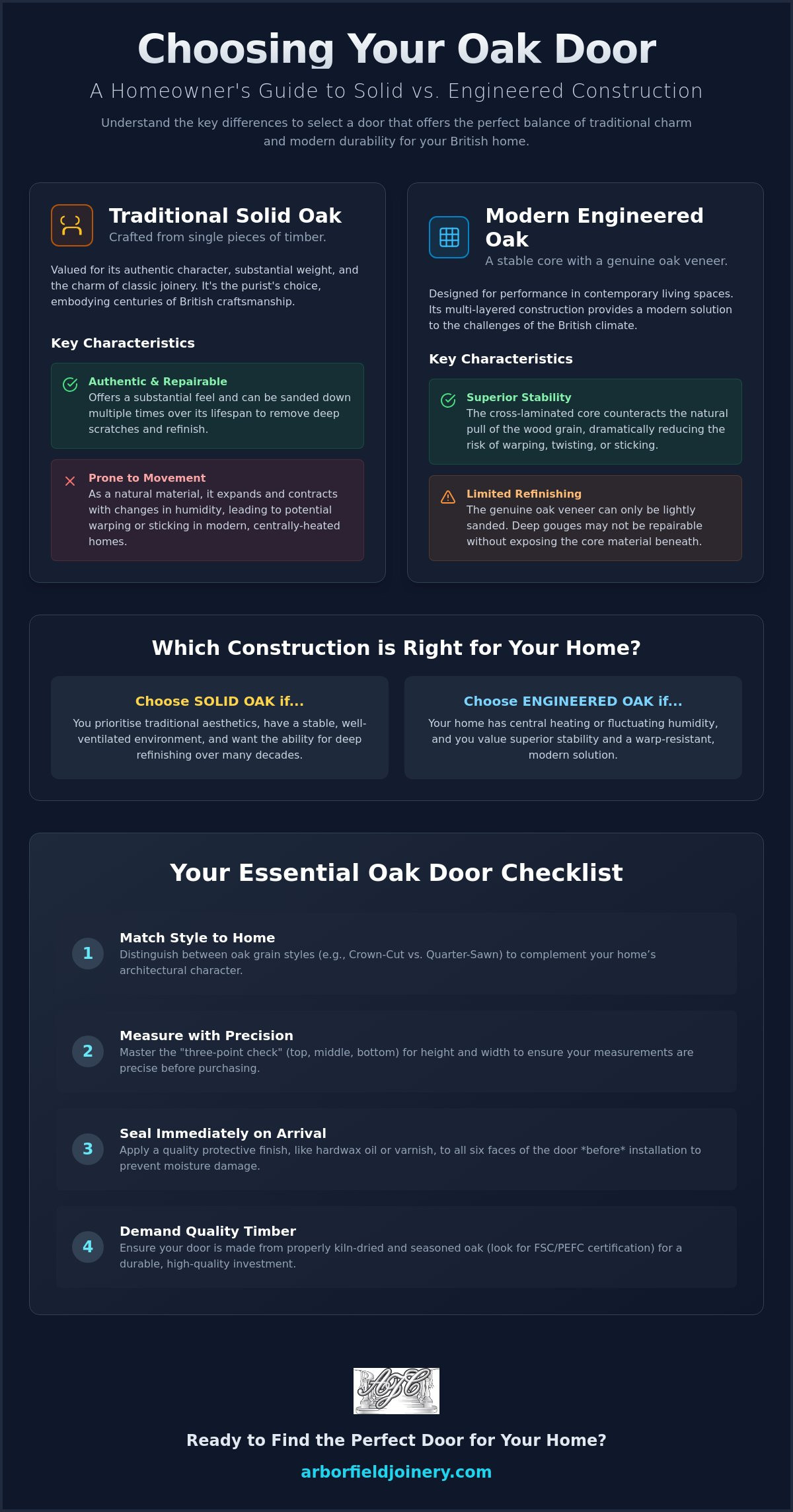
Selecting the right internal door often feels like a choice between tradition and technology. Whilst many homeowners assume that solid timber is the only mark of quality, the reality of modern living requires a more nuanced approach. Understanding the anatomy of your door is the first step in ensuring your chosen oak door styles perform beautifully for a lifetime. A solid oak door is crafted from single pieces of timber joined together, whereas an engineered door features a robust core of high-density particleboard or integrated timber lengths, wrapped in a genuine oak veneer. This structural difference dictates how the door will behave once it's hung in your home.
The "stability debate" is particularly relevant in the United Kingdom, where our homes often transition from damp winter air to the dry, consistent heat of central heating. Solid timber is a hygroscopic material; it breathes, expands, and contracts. In a modern, well-insulated environment, this can lead to the heartbreak of warping or sticking. According to research on the physical characteristics of timber published by the USDA Forest Products Laboratory, different oak species exhibit varying levels of shrinkage and stability. Engineered doors solve this by using cross-laminated layers that counteract the natural pull of the wood grain, keeping the door perfectly flat regardless of the radiator's temperature.
From a cost-to-benefit perspective, engineered doors are typically 30% to 50% more affordable than their solid counterparts. This makes them an excellent choice for a cohesive look throughout a large property. However, you shouldn't mistake "engineered" for "low quality." You can spot a premium engineered door by checking the lipping thickness. A thick solid oak lipping around the edges allows for more significant trimming during installation and ensures that, once hung, the door is indistinguishable from a solid piece of joinery. If you're looking for a balance of heritage aesthetics and modern performance, you might explore our range of oak doors to see these construction methods in person.
When to Choose Solid Oak
Solid oak remains the gold standard for period properties and heritage restorations where authenticity is paramount. Because the door is timber through and through, it possesses a significant structural mass that offers a unique tactile "thud" when closed. The primary advantage is its legacy; a solid door can be sanded back and refinished multiple times over a century. It also offers the most flexibility for non-standard openings, as you can trim the stiles and rails more aggressively than you can with a veneered product.
The Benefits of Engineered Oak
For the majority of contemporary British homes, engineered oak is the practical winner. Its resistance to twisting and bowing makes it the only sensible choice for areas with fluctuating humidity, such as kitchens or en-suite bathrooms. It's also a more sustainable way to use the oak tree, as the high-value decorative timber is used for the visible veneer whilst the core utilizes faster-growing or recycled timber components. You get the exact same visual grain patterns found in traditional oak door styles but with a level of precision that suits modern living.
How to Measure and Prepare for Your Oak Door Installation
Accuracy at the measurement stage is the difference between a door that glides effortlessly and one that sticks every winter. Before you browse our various oak door styles, you must ensure your existing frames are ready to receive a premium joinery product. This process requires a few simple but essential tools: a high-quality steel tape measure, a spirit level, and a notepad to record your findings. Whilst it's tempting to measure the old door, you should always measure the internal frame itself to account for any settling that has occurred over the years.
The "three-point check" is the most reliable method for assessing an opening. You should also verify the "squareness" of the frame by using your spirit level on the jambs and the head. If the corners aren't a true 90 degrees, you'll need to account for this during the trimming process. Using expert woodworking techniques ensures that your preparation is as professional as the door itself. Don't forget to consider the floor clearance; modern hard flooring or thick pile carpets often require a specific gap at the base to prevent the timber from dragging and damaging the finish.
Step-by-Step Measurement Guide
To get the width, measure across the top, middle, and bottom of the frame; always record the widest measurement to ensure your door covers the entire opening. For the height, measure at the left, centre, and right sides, and use the longest measurement as your guide. Always measure the structural frame opening rather than the existing door leaf to avoid repeating previous fitting errors.
Accounting for Trimming Allowances
Most high-quality oak doors feature a "trimming zone" on the solid lipping, which typically allows for 6-10mm of adjustment on all sides. This is essential for fitting doors into the slightly irregular frames often found in British homes. You must be careful not to over-trim, as cutting beyond the lipping can compromise the structural integrity and stability of the joinery. For more detailed advice on choosing between different oak door styles and their specific requirements, read The Ultimate Guide to Internal Oak Doors. Ensuring you stay within these allowances will keep your warranty intact and your door looking bespoke.
Finishing and Sealing: How to Protect the Natural Beauty of Your Oak
Oak is a porous, living material that continues to respond to its environment long after it has been hung. If you leave your new door in its raw state, it will quickly absorb or lose moisture, leading to the structural instability we discussed in previous chapters. Immediate sealing is non-negotiable. By applying a high-quality finish, you lock in the timber's natural moisture content and create a barrier against the spills and humidity of a busy household. Different oak door styles may require different approaches to highlight their unique grain patterns, but the goal remains the same: long-term preservation.
You generally have three professional paths for finishing your joinery. Hardwax Oil is the modern favourite; it penetrates deep into the fibres whilst leaving a breathable, tactile surface that feels like real wood. Polyurethane Varnish provides a much tougher, plastic-like shield that is ideal for high-traffic areas or commercial settings, though it can sometimes mask the timber's natural texture. Traditional Wax offers a classic, low-sheen elegance, but it requires more frequent reapplication and provides less protection against water staining. Whichever you choose, you must follow the "end grain rule." The top and bottom edges of the door act like sponges. If these aren't sealed with the same care as the faces, moisture will seep in and cause the door to bow.
How do you know when it's time to refresh the finish? Look for signs of dullness or a tactile roughness when you run your hand across the panels. If water no longer beads on the surface, the protective barrier has been compromised. To ensure your home remains beautiful, you can browse our premium oak doors and find the perfect match for your interior vision.
How to Apply a Hardwax Oil Finish
Success starts with preparation. Sand the door in the direction of the grain using progressively finer grits, starting at 120 and finishing at 180 to open the pores without scratching the surface. Apply the oil using a lint-free cloth or a high-quality natural bristle brush, ensuring an even, thin coat. Most professionals recommend at least two coats, allowing for the specific drying times noted on the tin, to achieve full saturation and a durable finish.
Maintaining Your Oak Doors Year-Round
Daily care is remarkably simple. Avoid harsh chemical cleaners that can strip the oils; instead, use a slightly damp, soft cloth to remove dust. It's also vital to monitor your home's environment. Keeping humidity levels between 40% and 60% will prevent the timber from moving excessively during seasonal shifts. If you notice minor scuffs, a "patch repair" approach works wonders with oil finishes; simply sand the affected area lightly and reapply a small amount of oil to blend it back to perfection.
Sourcing Quality: Why Craftsmanship and Heritage Matter for Your Joinery
When you begin comparing different oak door styles, it's easy to focus solely on the visual design. However, the true value of premium joinery lies in the invisible processes that occur long before the wood reaches your home. Mass-produced doors often prioritise speed and volume, which can lead to timber that hasn't been allowed to settle. In contrast, specialist joinery craftsmanship focuses on the selection of slow-grown timber and precise seasoning. This patience ensures that the cellular structure of the wood is stable, reducing the risk of the movement or splitting that we discussed in our earlier chapters on construction and climate.
Long-established suppliers understand that correctly kiln-drying oak is a delicate science. If the moisture is removed too quickly, the internal fibres become stressed; if too much remains, the door will shrink once your central heating is turned on. Expert joiners monitor these levels with precision, ensuring every component is perfectly seasoned for the British environment. This level of care is why a high-quality door feels different from a budget alternative. There is a tangible sense of weight and a smoothness to the grain that only comes from meticulous preparation and a deep respect for the raw material.
Visiting a physical showroom is often the best way to appreciate these finer details. Testing the weight of the oak and seeing the various grain patterns in person allows you to make a decision based on sensory reality rather than a digital image. This environment also provides access to expert advice that can help you create a cohesive interior. For instance, matching your new doors with your stairs requires a discerning eye for wood tones and profiles to ensure the transition between levels feels seamless and intentional.
The Arborfield Joinery Heritage
We take immense pride in our role as a family-run enterprise, a journey that began in 1953. This decades-long history has allowed us to evolve alongside the industry whilst maintaining our core commitment to reliability and proven expertise. Our showroom features over 120 door designs, providing a space where you can consult with experts who understand the nuances of every timber species we stock. We don't just sell products; we act as consultants to help you curate a living space that reflects your personal style and the heritage of your property.
Making Your Final Selection
As you make your final choice amongst the various oak door styles, we encourage you to consider the "cost per year" rather than just the initial purchase price. A cheap door might save money today, but it often requires replacement within a decade due to warping or poor durability. An oak door is a permanent upgrade, a piece of furniture that will likely outlast your tenure in the home. It's an investment in character, insulation, and long-term value. Browse our full range of internal oak doors today to find your perfect match.
Elevate Your Home with Timeless Oak Joinery
Bringing a new oak door into your home is a commitment to quality that transcends simple renovation. You now understand that selecting between various oak door styles requires a balance of aesthetic vision and technical foresight. Whether you choose the traditional mass of solid timber or the modern stability of an engineered core, your success depends on the precise measurements and immediate, high-quality sealing we have discussed. These steps ensure your investment remains as beautiful in a decade as it is on the day it's hung.
As family-run joinery specialists since 1953, we are here to guide you through every stage of this journey. We invite you to visit our showroom to see over 120 doors on display, where you can feel the weight and quality of our timber firsthand. For those ready to transform their interiors, we offer free mainland UK shipping on orders over £900. Explore our expertly curated collection of internal oak doors and take the first step toward a more characterful, enduring home. Your perfect entrance is waiting to be discovered.
Frequently Asked Questions
Can I trim an oak door to fit a non-standard frame?
You can trim most oak doors, though the amount depends on the construction type. Solid timber doors offer the most flexibility for irregular frames. Engineered doors feature a specific trimming zone on the solid lipping, typically allowing for 6 to 10mm of adjustment on each side. Exceeding this limit can expose the core and compromise the door's structural integrity. Always check the manufacturer's specific guidelines before you start cutting.
Is solid oak better than engineered oak for internal doors?
Neither is objectively superior; the right choice depends on your home's environment. Solid oak is prized for its traditional mass and legacy, making it ideal for period properties. However, engineered construction is often better for modern homes with central heating because it resists warping and twisting. Many popular oak door styles are available in both formats, allowing you to choose the stability of engineered wood without sacrificing the premium aesthetic.
How do I stop my oak door from warping in a new-build home?
To prevent warping, you must allow the door to acclimatise to the room's temperature and humidity for at least 48 hours before hanging. New-build homes often contain residual moisture in the plaster and screed, which timber quickly absorbs. You must seal all six sides of the door, including the top and bottom edges, immediately after trimming. This creates a vital moisture barrier that protects the wood from the fluctuating conditions of a newly constructed property.
What is the best finish for an internal oak door to keep it looking natural?
A clear hardwax oil is widely considered the best finish for maintaining a natural, tactile appearance. Unlike heavy varnishes that create a plastic-like sheen, hardwax oil penetrates the grain to protect the wood from within. It enhances the timber's organic character whilst leaving a breathable surface. Opt for a matt or satin finish to avoid artificial reflections and to keep the wood feeling like a living material under your fingertips.
How often should I oil or wax my oak doors to maintain the colour?
You should generally refresh the finish every two to five years, though high-traffic areas might need attention sooner. If the wood begins to look dull or feels slightly rough to the touch, it's time for a maintenance coat. A simple test is to drop a small amount of water on the surface; if it fails to bead and starts to soak in, the protective seal has worn thin and requires a light sand and re-oiling.
Do oak doors provide better sound insulation than hollow-core doors?
Yes, oak doors offer significantly better sound insulation due to their high density and mass. Hollow-core doors are essentially empty shells that allow noise to pass through easily. In contrast, the solid or high-density engineered core of an oak door acts as a natural acoustic barrier. This makes them an excellent choice for bedrooms, home offices, or any space where you want to reduce the transfer of household noise between rooms.
Can I use an internal oak door in a bathroom or high-humidity area?
You can use oak doors in bathrooms, provided you choose an engineered construction and apply a robust seal. Engineered doors are far more stable in humid environments than solid timber, which tends to expand and stick. It's critical to seal every edge, particularly the top and bottom, to prevent steam from penetrating the fibres. Ensure your bathroom is well-ventilated to help the timber settle quickly after a hot shower or bath.
Why has my oak door changed colour since it was first installed?
It's perfectly normal for oak to change colour as it matures through a process called oxidation. Exposure to natural UV light causes the timber to darken or mellow into a richer, more golden hue over time. This evolution is a sign of genuine, high-quality wood. If you prefer to slow this process, you can use finishes with built-in UV filters, though most homeowners value this ageing process as it adds character to their chosen oak door styles.
Share:
A Guide to Traditional Ledge and Brace Doors: Heritage Style for Modern Homes
The Complete Guide to Internal Oak Glazed Doors: Style, Light, and Quality