
Table of Contents
- The 5 Modern Internal Door Trends Defining 2026
- Modern Internal Door Hardware Trends to Pair With Them
- Bespoke Internal Door Designs for a Unique Finish
- Space-Saving Solutions: Sliding and Pocket Doors
- How to Choose Internal Doors for Modern Homes
- Sustainability and Eco-Friendly Materials
- Conclusion: Choosing the Right Door Trend for Your Home
- Frequently Asked Questions
Last Updated: September 8, 2026
The internal door has moved from a purely functional afterthought to one of the most impactful design statements in a modern renovation. While social media feeds are flooded with inspiration, most guides stop at pretty pictures, leaving homeowners without the technical knowledge needed to avoid costly mistakes. This guide from Arborfield Joinery, a family-run business crafting doors and joinery since 1953, cuts through the noise to explain the top 5 modern internal door trends 2026, pairing each aesthetic with the practical considerations that determine whether a door actually performs.

The 5 Modern Internal Door Trends Defining 2026
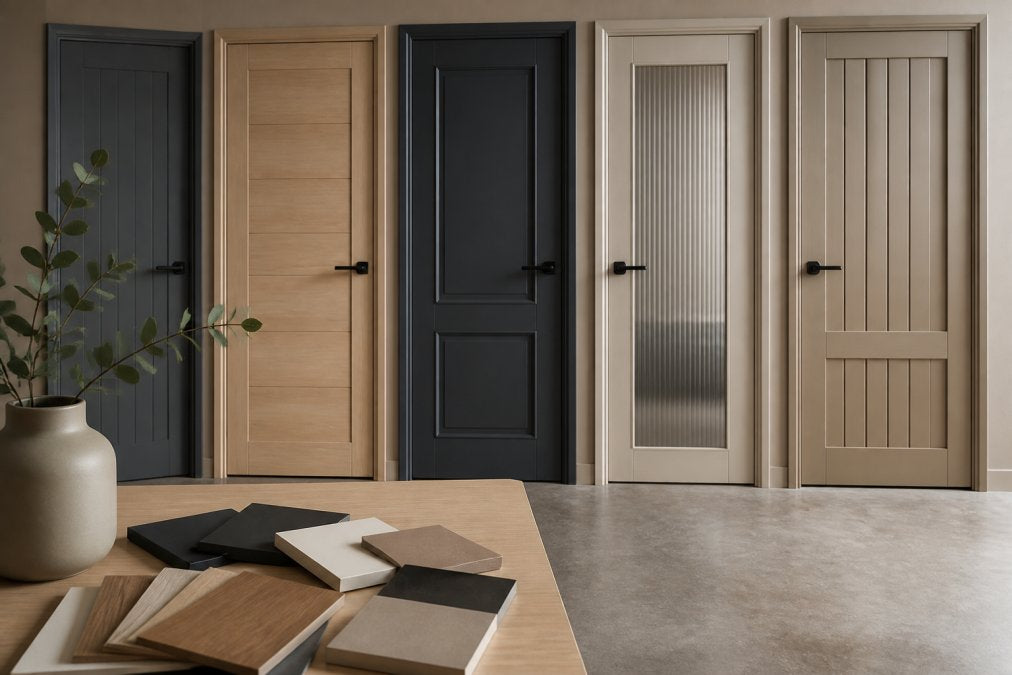
The defining characteristic of 2026 interior design is a shift toward architectural cohesion, where doors are no longer just openings but integral components of the wall itself. This year’s trends favour clean silhouettes, bold contrast, and natural materials that create a seamless flow between spaces, moving away from ornate panelling toward simplicity and texture.
1. Minimalist Flush and Jib Doors
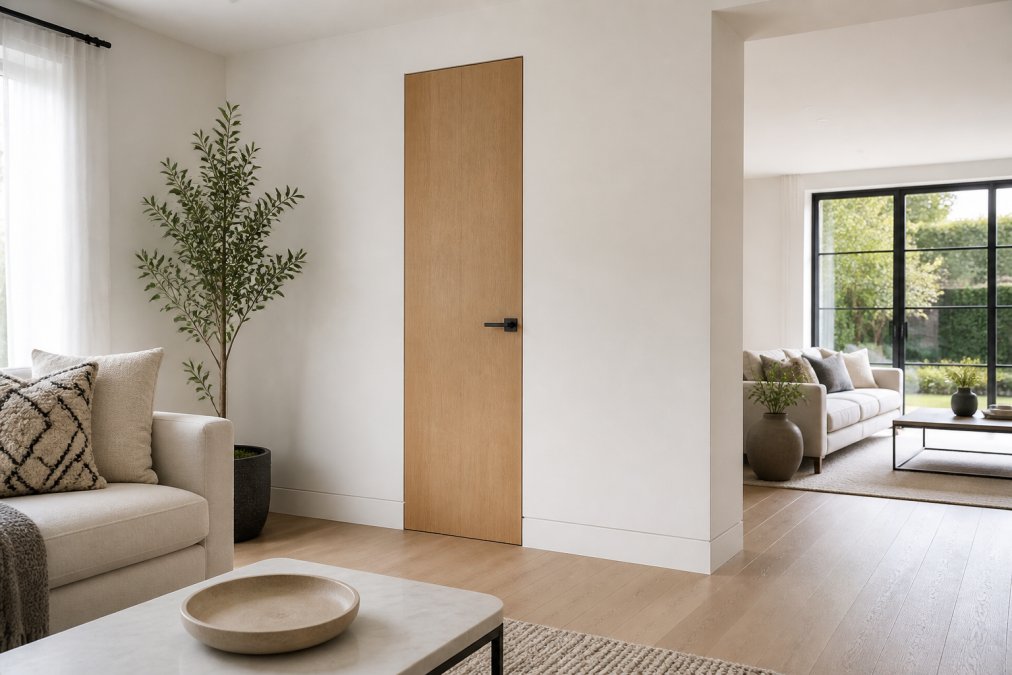
Flush doors are the purest expression of the minimalist aesthetic, offering a completely flat surface that recedes into the wall. The most advanced iteration is the jib door, finished to match the surrounding wall exactly, often without architraves, creating a hidden entrance. These designs are perfect for achieving a gallery-like atmosphere in hallways and living spaces. For a practical starting point, a prefinished white primed option like the Sierra Blanco White Primed Long Light Glazed at £248.50 offers a sleek, modern look that brightens a space, though true jib doors typically require bespoke joinery to achieve that invisible finish.
2. Black-Framed and Glazed Panels
The industrial-chic trend shows no sign of slowing down, with black-framed glazed doors remaining a top choice for dividing living spaces while maintaining natural light flow. These doors act as statement pieces, providing a high-contrast architectural frame that defines doorways without blocking sightlines. Reeded glass is a particularly popular update, offering privacy while diffusing light beautifully, making it ideal for home offices or ground-floor bathrooms. The Black Soho Reeded Glazed Internal Door at £246.99 exemplifies this trend.
3. Bold Colour Palettes: Charcoal and Navy
For those seeking depth without the maintenance of natural wood, bold, moody colours are defining modern interiors. Charcoal, anthracite, and deep navy finishes create a striking contrast against pale walls and light flooring, anchoring a room with a sophisticated, grounded feel. These darker hues are particularly effective at hiding daily wear and tear, making them a practical choice for high-traffic areas. The Montreal Dark Grey Ash Glazed FSC Internal Door at £306.75 offers a prefinished ash veneer in a dark grey tone, providing the durability of a factory finish with the texture of natural wood grain.
4. Natural Wood Tones and Texture
In contrast to painted finishes, there is a growing appetite for authentic materials that bring warmth and tactility into the home. Natural oak, with its visible grain and organic variations, remains the gold standard, celebrated for its ability to complement both minimalist and industrial settings. The trend is moving toward lighter, crown-cut oaks that brighten interiors and showcase clean lines. The Valencia Prefinished Oak Internal Door at £223.50, with its horizontal panels and aluminium inlays, demonstrates how natural timber can be enhanced with contemporary detailing.
5. Curved Forms and Arched Doorways
Softening the hard lines of modern architecture, curved forms are making a significant comeback in 2026. Arched doorways and doors with curved or geometric panelling introduce a sense of movement and elegance, softening the transition between rooms. This trend requires a careful eye, as the curvature must complement the proportions of the room rather than overwhelm them. The Astoria Black Clear Glazed door at £264.99 is a perfect example, combining on-trend curves with geometric panelling to create an elegant, stand-out feature.

Modern Internal Door Hardware Trends to Pair With Them
Choosing the right internal door trends hardware is as crucial as the door leaf itself; the handle is the primary tactile interaction you have with the architecture daily. The current trend favours architectural hardware in matte black and brushed brass, with long, slim lever handles that add a contemporary, linear aesthetic. These finishes should match the door’s hinges and any glazing bars for a cohesive look.
Bespoke Internal Door Designs for a Unique Finish
While off-the-shelf doors offer convenience, a truly unique finish often requires bespoke internal door designs tailored to the specific architecture of your home. This is particularly relevant for period properties with non-standard openings, where a standard door would leave unsightly gaps or require extensive modification. Bespoke joinery allows for the perfect replication of existing styles or the creation of entirely new concepts, ensuring the door is an exact fit for the space.
Space-Saving Solutions: Sliding and Pocket Doors
In modern homes where square footage is at a premium, the classic hinged door is often a liability, consuming valuable floor space with its swing arc. Sliding and pocket doors are the definitive space-saving solution, disappearing neatly into the wall or gliding along an external track to maximise usable area. Beyond their functional benefits, these mechanisms are increasingly chosen for their aesthetic benefits, creating a seamless integration between rooms when open. For larger openings, a Malvern 6 Black Room Divider at £864.50 offers an industrial-style solution, using slim black profiles and clear glazing to divide spaces while maintaining light flow.

How to Choose Internal Doors for Modern Homes
Choosing the right internal doors for your modern home requires balancing aesthetic preferences with practical performance criteria. While the visual trends above are important, the true measure of a door's quality is often invisible. The most significant gap in most design-led guides is acoustic performance, a critical factor in open-plan homes where noise travels freely. This section bridges that gap.
Understanding Acoustic Performance (Rw Ratings)
Sound insulation is measured using the Weighted Sound Reduction Index (Rw), expressed in decibels (dB). A higher Rw value means better sound blocking. A standard hollow-core interior door might achieve an Rw of around 20-25 dB, offering minimal privacy. In contrast, a solid-core door with a high-density particleboard core can achieve an Rw of 30-35 dB, making a noticeable difference in reducing conversational chatter and TV noise.
For a home office or a bedroom adjacent to a living room, look for doors with a solid or engineered core. The difference is not just in the core; the door's seals and the gap around the frame are equally important. A solid door with a 3mm gap underneath will leak far more sound than a lighter door with an acoustic drop-seal that lowers to the floor when closed.
Fire Safety: A Non-Negotiable Technical Criterion
Fire resistance is another technical specification that often gets overlooked in aesthetic guides. Building Regulations require internal doors to be fire doors (typically FD30, offering 30 minutes of protection) if they open onto a staircase or connect a habitable room to a garage or loft conversion (gov.uk). An FD30 door is not just a heavier leaf; it is a complete system that includes the frame, intumescent strips (which expand when heated to seal the gap), and certified hinges and latches.
The Practicalities of Trimming and Fitting
A common point of failure in door installation is the trimming allowance. Most quality prefinished doors offer around 15-16mm of trimming allowance on each edge, but this is not uniform across all doors. Some budget doors may only offer 5mm, which is insufficient for non-standard openings. Before purchasing, always check the manufacturer's technical datasheet for the maximum permissible trim, as exceeding this limit can compromise the structural integrity of the door.
Budget vs. Bespoke: A Realistic Framework
Finally, the decision between a stock door and a bespoke one is often driven by the opening size. Standard UK door sizes are typically 1981mm x 686mm, 762mm, or 838mm (6'6" x 2'6", 2'8", or 2'9") (diydata.com). If your opening is within these dimensions, a high-quality prefinished stock door is the most cost-effective route to a premium look. However, if you have a period property with non-standard openings, the cost of altering the structural opening to fit a stock door can quickly exceed the cost of a bespoke door. A common pattern is to spend on a premium prefinished door leaf, plus on an engineered frame and ironmongery. Bespoke joinery, by contrast, typically starts at £600-£800 per door, but it eliminates the need for unsightly packers and architrave modifications.
Sustainability and Eco-Friendly Materials
Sustainability is no longer a niche concern but a core requirement for many homeowners undertaking renovations. While most guides stop at mentioning FSC® certification, a truly sustainable choice goes far beyond the source of the timber. The most environmentally responsible door is the one that lasts the longest without needing replacement, which is why the construction method and finish are as important as the wood species.
Beyond FSC: The Full Lifecycle
The Forest Stewardship Council (FSC®) certification remains the gold standard for verifying that timber comes from responsibly managed forests (fsc.org). However, a door's environmental impact is determined by its entire lifecycle: raw material extraction, manufacturing energy, transportation, lifespan, and end-of-life disposal. A solid oak door might seem like the most 'natural' choice, but solid timber is prone to movement, warping, and twisting in centrally heated homes, especially when used in large, single-piece slabs, leading to premature failure and replacement.
The Case for Engineered Cores and Prefinished Surfaces
Manufacturers are increasingly addressing this by using engineered cores, layers of timber or high-density fibreboard bonded together. This construction is dimensionally stable, meaning it is far less likely to warp or twist than a solid timber slab. This stability is a key sustainability feature: a door that remains true for a long time is more eco-friendly than a 'natural' door that needs replacing prematurely. Furthermore, a factory-applied prefinished surface is more durable and resistant to scratches and moisture than a site-applied paint or lacquer, as it is cured under controlled conditions to create a harder, more resilient surface.
When evaluating the environmental credentials of a door, ask two questions: What is the core made of, and how is it finished? An engineered core with a factory-applied finish is often the most sustainable option because it maximises durability and minimises the likelihood of premature replacement, which is the single biggest environmental cost of any joinery product.
Maintenance: The Key to Longevity
A sustainable door is one that is easy to maintain. Prefinished doors require virtually no ongoing maintenance beyond occasional cleaning with a damp cloth. Site-finished doors, on the other hand, will require periodic repainting or re-lacquering, which involves sanding, dust, and the application of solvent-based products. For a truly low-impact choice, select a prefinished door with a durable lacquer or a laminate surface that resists fading and scratching.
The Role of Glazing in Energy Efficiency
Finally, consider the glazing. Double-glazed units are now standard in high-quality glazed doors, providing better thermal insulation than single glazing. While internal doors do not separate the home from the outside, improved insulation in glazed doors helps maintain consistent temperatures between rooms, reducing the load on your heating system. Look for doors with low-emissivity (Low-E) glass or argon-filled units for the best thermal performance.
Conclusion: Choosing the Right Door Trend for Your Home
Selecting the right internal door trends for your home is a balance between following the aesthetic that inspires you and making sound technical choices that will last decades. Whether you are drawn to the minimalist perfection of flush doors, the bold statement of black-framed glazing, or the timeless warmth of natural oak, the key is to ensure the door’s construction and hardware match the demands of the room it serves. At Arborfield Joinery, we combine traditional craftsmanship with a vast range of premium stock and full bespoke manufacturing capabilities, offering expert advice to help you navigate these choices. With free UK mainland shipping on orders over £900, getting the right door for your project is straightforward. Get started with Arborfield Joinery and find the perfect entrance to your next room.
Frequently Asked Questions
What are the top internal door trends for 2026?
The top internal door trends for 2026 centre on minimalist flush designs, black-framed glazed panels, and bold colours like charcoal and navy. Natural wood tones and curved or arched doorways are also growing in popularity. These trends focus on creating seamless integration with the interior design, maximising natural light, and making a statement with architectural hardware. The focus is on functional design that complements a modern home's aesthetic.
Are minimalist internal doors still popular in 2026?
Yes, minimalist internal doors are a defining trend for 2026, but the style is evolving. The focus has shifted from purely flat surfaces to flush doors with subtle textural interest, such as fine inlays or natural wood grain. Jib doors, which are concealed within the wall and painted to match, remain popular for achieving a truly seamless integration. These designs create a clean, uncluttered backdrop that lets other interior design elements stand out.
What hardware finishes complement modern internal door trends?
Modern internal door hardware trends for 2026 favour matte black and brushed brass finishes. These complement the popular black-framed glazed doors and dark colour palettes, offering a high-contrast look. Minimalist lever handles on slim backplates are preferred over ornate designs. For a cohesive look, ensure your hinges, handles, and locks all share the same finish. This attention to detail is key to achieving a polished, contemporary aesthetic.
How do I choose internal doors for a modern home?
Start by considering the architectural style of your home and the amount of natural light in your hallways. For a consistent look, choose flush doors in a bold colour like black or a dark grey ash. If you need to brighten a dark corridor, select a door with glazed panels. Always check the door core construction; a solid or solid engineered core offers better acoustic performance and durability than a hollow core.
Share:
Pocket Door Systems: The Ultimate Guide to Space-Saving Joinery
Is Bespoke Joinery Worth It for Home Renovations?