
Table of Contents
- What Adds the Most Value When Renovating a House?
- The Real Cost of Bespoke Joinery vs. Off-the-Shelf Alternatives
- Durability and Material Quality: Why Timber Grade Matters
- Maximising Awkward Spaces with Fitted Storage and Built-In Cabinetry
- Joiner vs Carpenter Skills: Who Should You Hire?
- Project Timelines: What to Expect from Bespoke Joinery Installation
- The Verdict: Is Bespoke Joinery Worth It for Your Renovation?
- Frequently Asked Questions
Last Updated: September 9, 2026
What Adds the Most Value When Renovating a House?
Most renovation guides start with kitchens and bathrooms, but the data on property value tells a more nuanced story. When homeowners ask us whether bespoke joinery is worth it for home renovations, the answer usually depends on one factor: how well the work integrates with the architecture it joins.
Bespoke joinery is the design and manufacture of custom-made furniture, cabinetry, and timber elements built to fit a specific space. Unlike mass-produced alternatives, it is measured, cut, and installed for your exact dimensions.
The real value driver is space utilisation. A fitted wardrobe that turns an unusable alcove into storage adds more practical value than a standalone unit that leaves gaps around it. This matters most in period properties, where non-standard openings and awkward corners are common. The Royal Institute of Chartered Surveyors guidance on home improvements notes that renovations which improve the flow and function of a home tend to hold their value better than purely cosmetic upgrades.
The Real Cost of Bespoke Joinery vs. Off-the-Shelf Alternatives
The upfront cost difference between custom and off-the-shelf work is significant. A mass-produced internal door might cost £100, while a made-to-measure equivalent from a specialist supplier typically costs two to three times more (nhbc.co.uk). But comparing those numbers alone misses the point.
The cost of bespoke joinery must be measured against its lifespan and fit. A cheap door that warps within two years or leaves draughts around an irregular opening costs more in the long run than a correctly fitted custom door installed once.
Consider the OTIF Steel Hinged Door at £1,045.00, a fully customisable doorset made to your exact specification. That price includes a precision-engineered steel frame that suits both residential and commercial interiors.

For internal doors, the Shoreditch White Primed Urban Internal Door at £219.50 offers a solid softwood core with a primed finish, ready to hang without planing or adjustment. The white primed range demonstrates that bespoke does not always mean premium-priced.

A common mistake is budgeting only for the product itself. Installation, ironmongery, decoration, and disposal of old units all add up. Build a contingency of roughly 10-15% into your construction budget for unexpected issues during joinery installation (rics.org).
Durability and Material Quality: Why Timber Grade Matters
Timber quality is the single biggest determinant of how long your joinery lasts, and it is the area where cost-cutting hurts most. In bespoke joinery, the three main options are solid wood, plywood, and MDF, and each behaves very differently over a decade of use in a British home.
Solid wood is the traditional choice for bespoke work. Hardwoods like oak, ash, and walnut offer the greatest structural strength and a unique grain that ages gracefully. Softwoods like pine and spruce are more affordable but still outperform engineered boards for certain uses, such as window frames. The trade-off is its reaction to humidity: it expands and contracts across the grain seasonally. A well-made solid wood door or cabinet is designed with this movement in mind.
Plywood is the engineered workhorse of bespoke joinery. Made from cross-laminated veneers, it offers excellent dimensional stability, it will not warp or twist the way a poorly seasoned solid board might. Baltic birch or marine-grade plywood is exceptionally strong for its weight and holds screws and hinges far better than MDF. It is the material of choice for carcasses, shelving, and built-in cabinetry.
MDF (medium-density fibreboard) is the budget option that still has a place in bespoke work. It is cheap, perfectly smooth, and takes paint beautifully, making it ideal for painted shaker-style doors or decorative mouldings. However, MDF has two critical weaknesses: almost no structural strength and high susceptibility to moisture. In a kitchen or bathroom, an unsealed MDF edge will swell and crumble within months. Many joiners will use MDF for painted, non-structural panels but will always specify plywood or solid wood for anything load-bearing or moisture-exposed.
A common pattern is the 'all-MDF' fitted wardrobe sold by high-street retailers. It looks acceptable on day one, but the shelf edges begin to fur after a few damp winters, and the door hinges loosen. A bespoke joiner, by contrast, will typically build the carcass from plywood and use MDF only for the painted facings. That hybrid approach costs more upfront but explains why a bespoke wardrobe can last thirty years while a flat-pack equivalent is replaced within a decade.
The finish also determines durability. A sprayed lacquer or hard-wax oil protects the timber surface far better than a single coat of brushed paint. For internal joinery, a two-pack polyurethane finish is the most durable option. For external timber, the specification must include a microporous paint or stain that allows the wood to breathe while repelling water.
Sustainability metrics also favour a considered material choice. Locally sourced British hardwoods, such as oak from certified sustainable forests, carry a significantly lower carbon footprint than imported tropical hardwoods or flat-pack furniture shipped to the UK. Specifying FSC-certified British oak or ash from a regional sawmill is one of the most responsible choices available.
Ultimately, the material specification is where the value of bespoke joinery is won or lost. A well-designed piece in the wrong material will fail; a simple piece in the right material will outlast the renovation trend that inspired it.
Maximising Awkward Spaces with Fitted Storage and Built-In Cabinetry
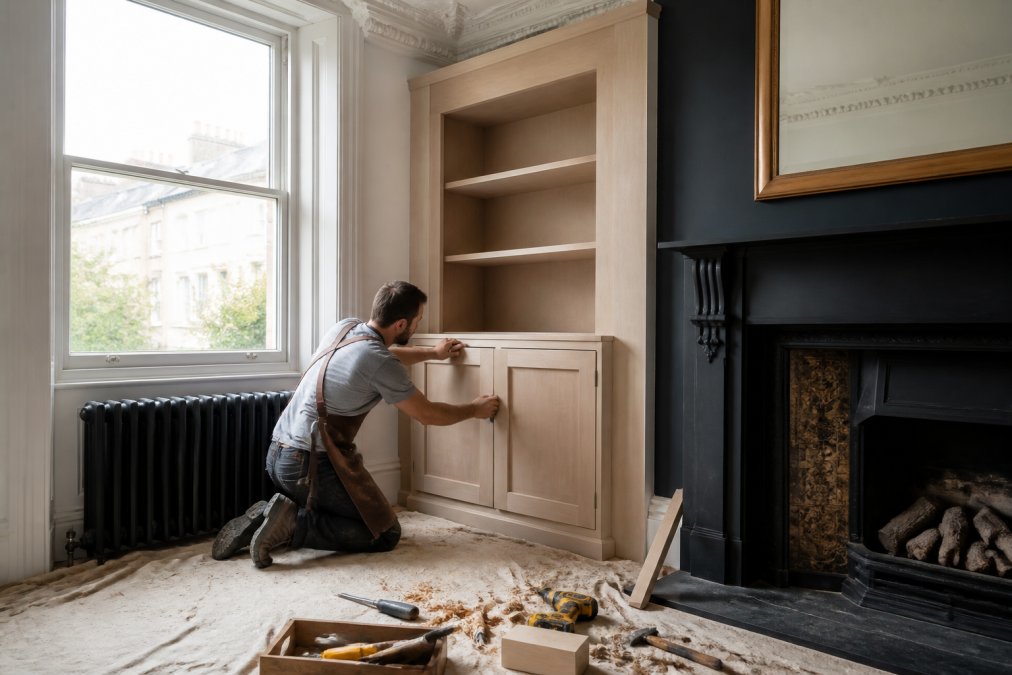
Period homes are full of spaces that standard furniture cannot serve. Chimney breast alcoves, sloping ceilings under eaves, and stairwell landings all present challenges that off-the-shelf cabinetry simply cannot solve. This is where bespoke joinery earns its keep.
A fitted wardrobe built into an alcove converts dead space into usable storage. Under-eaves bespoke shelving turns a loft room from a storage dump into a bedroom. Built-in cabinetry around a chimney breast creates a feature while hiding clutter. Each of these additions improves the daily function of a home, not just its appearance.
The aesthetic appeal matters too. Fitted storage looks intentional, as though the house was designed around it. The architectural detail of a well-made cabinet signals quality in a way that freestanding furniture cannot match.
Space utilisation is particularly valuable in urban properties where square footage comes at a premium. Converting an awkward corner into a home office or a dressing area adds functionality without extending the footprint. restoring historic woodwork.
Joiner vs Carpenter Skills: Who Should You Hire?
Many homeowners assume any carpenter can handle joinery work, but the skill sets differ more than most realise. A carpenter typically works on structural framing, roofing, and basic installation. A joiner works in a workshop, manufacturing the precision components that a carpenter later installs.
The distinction matters for quality. Joiners use specialist machinery to cut accurate joints, create bespoke cabinetry, and manufacture windows, doors, and staircases to exact tolerances. When you commission bespoke joinery, you are paying for this manufacturing precision.
For a bespoke kitchen, fitted wardrobes, or a staircase, a joiner's workshop capability is essential. For hanging doors or fitting skirting boards, a carpenter suffices. Knowing which you need saves money and prevents disappointment.
The most successful renovation projects involve both trades working together. A joiner manufactures the bespoke stair parts or door frames; a carpenter handles the structural preparation and final fitting.
Project Timelines: What to Expect from Bespoke Joinery Installation
Patience is a prerequisite for custom work. Unlike buying off the shelf, bespoke joinery requires a design phase, manufacturing time, and careful installation. Realistic expectations prevent frustration.
A typical bespoke internal door order takes several weeks from measurement to delivery. More complex items, such as custom staircases or steel doorsets, take longer. The Shoreditch range, for example, carries a 12-14 week delivery period because each door is manufactured to order rather than pulled from stock.
Homeowners on a tight renovation timeline should plan joinery early. Order your doors, windows, and staircases before demolition begins, not after.
A realistic project timeline for a full renovation with bespoke joinery looks like this:
| Stage | Duration | Notes |
|---|---|---|
| Design and quoting | 1-2 weeks | Measurements, material selection, final spec |
| Manufacturing lead time | 4-14 weeks | Varies by complexity and product type |
| Site preparation | 1 week | Structural work, opening preparation |
| Joinery installation | 2-5 days | Fitting, hanging, final adjustments |
| Finishing | 1-2 weeks | Priming, painting, ironmongery |
What most guides omit is what happens after installation. The 'buy' decision is only the beginning of the relationship with your bespoke joinery. Proper maintenance protects your investment over the long term.
Seasonal care for solid wood. Solid timber responds to the changing humidity of British homes, central heating in winter dries the air, while summer humidity rises. You should expect minor movement in solid wood doors and frames. A small gap that appears around a door panel in January will close by July. This is normal and not a defect. Maintaining a relative humidity of 45-55% in your home will prevent most issues.
Finishes need refreshing. A painted or lacquered surface does not last forever. Internal joinery with a quality sprayed finish will typically need re-coating every 8-12 years, depending on wear. External timber is more demanding: a microporous stain should be inspected annually and re-coated every 4-6 years. Ignoring this leads to water ingress, the primary cause of rot in window frames and external doors.
Hardware requires occasional attention. Hinges on heavy solid wood doors will eventually need adjustment as the timber settles. A simple hex-key adjustment on concealed hinges every couple of years keeps doors aligned. Door catches and locks should be lubricated with a dry PTFE spray, not oil, which attracts dust and gunks up the mechanism.
Cleaning methods matter. Bespoke joinery with a lacquered finish should be cleaned with a damp cloth and mild detergent, never abrasive cleaners or solvent-based products that strip the protective layer. For waxed or oiled finishes, use a specialist furniture cleaner and reapply the oil annually.
A maintenance schedule for bespoke joinery:
| Frequency | Task |
|---|---|
| Monthly | Wipe down with damp cloth; check for sticking or loose hardware |
| Quarterly | Lubricate hinges and locks with PTFE spray |
| Annually | Inspect external timber for finish wear; check for water pooling on sills |
| Every 2-3 years | Re-oil waxed or oiled internal surfaces |
| Every 4-6 years | Re-coat external microporous stain or paint |
| Every 8-12 years | Re-spray or re-paint internal lacquered surfaces |
The Verdict: Is Bespoke Joinery Worth It for Your Renovation?
After weighing cost, durability, and the value added to your home, the answer comes down to your priorities. If you are renovating a period property with non-standard openings, or you want fitted storage that maximises every square metre, then bespoke joinery is clearly worth the investment. It delivers a precise fit, superior materials, and a finish that mass-produced alternatives cannot match.
If your project uses entirely standard openings and you are working to a tight budget, quality off-the-shelf products may serve you well. But choose carefully, because the cheapest options often fail quickly.
For most renovations, a hybrid approach works best. Commission bespoke joinery for the elements that define a home's character, such as the staircase, the kitchen cabinetry, or the front door. Use quality stock items elsewhere. This targets your budget where it delivers the most value.
Arborfield Joinery has supplied bespoke timber products since 1953, and our experience shows that well-made joinery is a long-term investment in your property's value and your daily enjoyment of it.
Choosing whether bespoke joinery is worth it for home renovations ultimately comes down to how you value quality, fit, and longevity against upfront cost. The homeowners who regret their decision are usually those who bought cheap and paid twice, or those who commissioned custom work without understanding the lead times involved. Get the specification right, plan your timeline properly, and work with an experienced supplier, and the result is joinery that serves your home for decades. Get started with Arborfield Joinery and see how bespoke craftsmanship transforms your renovation.
Frequently Asked Questions
Is bespoke joinery expensive compared to flat-pack alternatives?
Bespoke joinery costs more upfront than flat-pack alternatives. For example, a mass-produced internal door might cost around £100, while a custom-made primed door like the Shoreditch range starts at £219.50. The price difference reflects solid timber cores, precise fitting to your openings, and construction that lasts decades rather than years. When you factor in replacement costs and the potential increase in property value, the long-term investment often works out comparable.
Does bespoke joinery add significant value to a property?
Yes. Bespoke joinery adds value in two ways: it increases usable floor space through fitted storage and built-in cabinetry, and it improves aesthetic appeal through architectural detail. Estate agents confirm that well-executed custom woodwork signals a well-maintained home, supporting resale potential. While the exact return varies by project, quality joinery is a long-term investment that typically recoups a meaningful portion of its cost at sale, unlike many other renovation expenses.
How long does a bespoke joinery project typically take?
A typical bespoke joinery project takes 8 to 14 weeks from survey to installation. This timeline includes the initial site visit to measure non-standard openings, the manufacturing period in the workshop, and the installation day itself. Items with specialist glazing or specific finishes, such as the Shoreditch tinted glass door, sit at the longer end of that range. For a renovation on a tight schedule, confirm lead times before ordering and plan your project management timeline around them.
Is a joiner more skilled than a carpenter?
A joiner and a carpenter have different skill sets rather than one being universally more skilled. Carpenters work on site, installing items like roofs and floor joists. Joiners work in a workshop, manufacturing precision components such as windows, doors, staircases, and fitted furniture. For bespoke joinery that must fit exact openings and withstand daily use, you need a joiner's skills. Their work involves precise measurement, machining, and assembly that produces the tailored solutions carpenters then install.
Share:
Top 5 Modern Internal Door Trends for 2026
Timber Casement Windows UK: The 2026 Homeowner’s Buying Guide