

Why should the door that protects your family's life be the one that ruins your hallway's aesthetic? For too long, the necessity of fire safety has felt like a compromise, forcing homeowners to choose between industrial-looking slabs and the elegant, natural grain of traditional timber. It's a common frustration; you've spent years perfecting your home's interior, only to find that building regulations demand a bulky installation that breaks the visual flow. If you've been searching for internal oak fire doors that offer high-end craftsmanship without looking like a piece of commercial hardware, you aren't alone.
We understand that navigating the technicalities of FD30 versus FD60 ratings and the latest 2026 British Standards can feel overwhelming. You want a safe home that meets insurance requirements, but you also want a consistent look across all your joinery. This expert guide will clear the confusion, explaining how precision-engineered oak doors provide a life-saving barrier whilst remaining indistinguishable from your finest furniture. We'll explore the transition to European testing standards, the importance of the "golden thread" of safety information, and everything you need to know about selecting the right door for your space.
Key Takeaways
- Modern internal oak fire doors are precision-engineered to mirror standard joinery, ensuring your safety features blend seamlessly with your home's existing aesthetic.
- Identify whether your renovation requires FD30 or FD60 protection by understanding the specific fire resistance durations mandated by 2026 building regulations.
- Learn how to maintain the "golden thread" of safety information and stay compliant with the latest British Standards for domestic fire protection.
- Understand why a fire door leaf is only effective when installed as a complete system, including the essential role of intumescent strips and fire-rated hardware.
- Discover how to achieve a consistent, high-end finish across your home by sourcing compliant products from a heritage specialist with over 70 years of expertise.
The Essential Role of Internal Oak Fire Doors in Modern Homes
Since 1953, we've guided homeowners through the shifting landscape of British joinery, watching trends come and go whilst our commitment to quality remains fixed. We know that choosing the right internal oak fire doors is about more than just ticking a box for a building inspector. It's about finding that rare balance where a life-saving piece of engineering feels like a natural part of your home's character. These doors act as a silent sentinel, offering a critical fire barrier that buys your family precious time, all whilst enhancing the warmth and elegance of your interior design.
Why Oak Remains the Favourite Choice for Fire Safety
Why does oak remain the favourite choice for homeowners and architects alike? It starts with the sheer density of the timber. Oak is naturally robust, providing a sturdy foundation that lends itself to the rigorous demands of fire safety. When we examine fire door components and ratings, the integrity of the core is paramount. Modern veneer techniques allow us to offer doors with consistent, beautiful grain patterns that flow seamlessly across an entire floor. Unlike cheaper softwood alternatives that might warp or degrade, a high-quality oak door offers longevity and a timeless colour that matures gracefully over the decades. It's a premium investment that pays dividends in both safety and property value.
When is an Internal Fire Door Legally Required?
Navigating the 2026 UK Building Regulations doesn't have to be a headache. Generally, fire doors are a legal requirement in specific high-risk locations to create protected escape routes. If you're planning a loft conversion or your property spans three or more storeys, every door serving the stairwell must be fire-rated. Similarly, any door connecting an integral garage to the main dwelling must provide a certified fire barrier. These rules exist for a reason, and compliance is vital for your home insurance validity. We've spent over seventy years perfecting our craft, and we understand that a safe home is only truly comfortable when it also looks exactly the way you envisioned. Choosing internal oak fire doors ensures you meet these stringent legal standards without sacrificing the sophisticated aesthetic of your living space.
Understanding Fire Ratings: FD30 vs FD60 Oak Doors
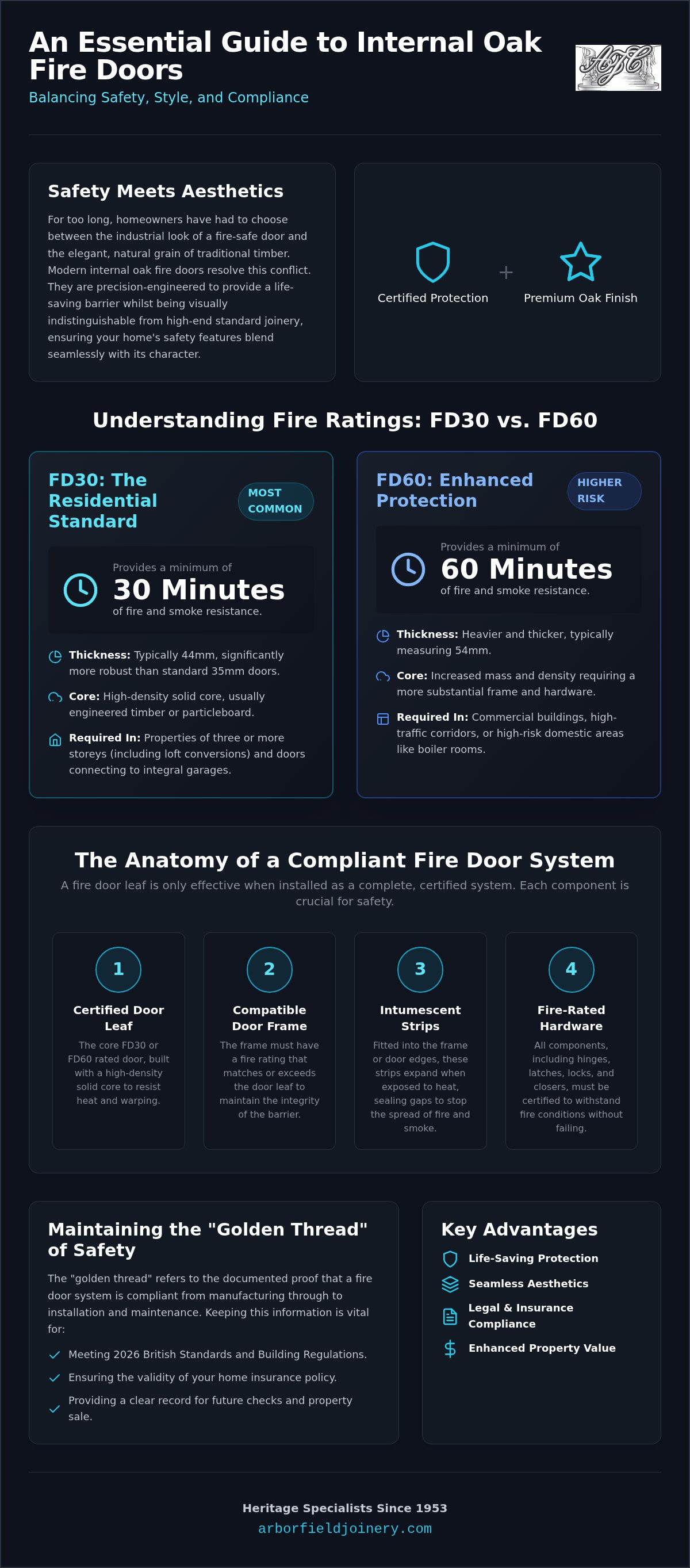
When you handle a standard internal door, it often feels light; this is because many modern domestic doors utilise a hollow-core honeycomb structure. In contrast, certified internal oak fire doors are built with a high-density solid core, usually manufactured from engineered timber or particleboard. This density provides the necessary resistance to heat and prevents the door from warping or failing prematurely during a fire. It's a precision-engineered safety device that happens to look like a premium piece of joinery. To ensure your home remains safe and compliant with 2026 regulations, you need to understand the technical differences between the two primary ratings.
The Anatomy of an FD30 Oak Fire Door
The FD30 rating is the most common specification for UK residential properties. These doors are typically 44mm thick, which is a significant step up from the 35mm standard found in non-fire-rated internal doors. This extra depth allows for a robust solid timber or high-density particleboard core that can withstand intense temperatures. An FD30 rating identifies a life-saving barrier that prevents the spread of flames and toxic smoke for a minimum of half an hour. This thirty-minute window is crucial, as it provides the time needed for occupants to evacuate safely and for emergency services to arrive. If you are refurbishing a standard family home, you can view our full range of certified oak doors to find an FD30 option that matches your interior style.
FD60: When Extra Protection is Mandatory
Whilst FD30 is sufficient for most domestic renovations, certain scenarios demand a higher level of protection. FD60 doors provide 60 minutes of fire resistance and are often required in commercial buildings, high-traffic corridors, or areas of significant risk, such as boiler rooms or flat entrance doors in high-rise blocks. These doors are noticeably heavier and thicker, usually measuring 54mm. This increased mass requires more substantial frames and high-performance hinges to support the weight. For most three-storey domestic extensions or loft conversions, the FD30 specification remains the industry standard, offering a perfect balance between safety and ease of installation.
A fire door leaf is only one part of a safety system. To be truly effective, the door must work in conjunction with intumescent strips. These strips are fitted into the frame or the door edge and contain a material that expands when exposed to heat, sealing the gap between the door and the frame to block smoke and flames. Regular fire door safety checks are essential to ensure these strips are intact and that the door closes firmly against the stop. Without a proper seal, even the highest-quality oak door cannot perform its life-saving function.
Matching Style and Safety: Choosing Your Oak Design
One of the biggest hurdles homeowners face is the misconception that fire doors must look industrial or clunky. In the past, a fire-rated door was a functional necessity that often clashed with the delicate joinery of a living room or bedroom. Today, the manufacturing process for internal oak fire doors has evolved to the point where they are visually identical to their standard counterparts. This means you can maintain a flawless aesthetic throughout your home, using fire-rated versions where the law requires them and standard doors elsewhere without anyone noticing the difference.
If you are curious about the broader benefits of this material, our Ultimate Guide to Internal Oak Doors explores why oak remains the gold standard for British homes. When selecting your design, you'll also need to decide between pre-finished and unfinished options. Pre-finished doors arrive with a professional factory coating, saving you time and ensuring a consistent sheen across every room. Unfinished doors allow you to apply your own oils or stains, which is perfect if you need to match a specific existing floor or a bespoke staircase.
Traditional vs. Contemporary Oak Fire Door Styles
For period properties or rustic cottages, the Suffolk style remains a perennial favourite. Its vertical panelling evokes a sense of heritage and traditional craftsmanship that complements older architecture. If your home leans towards the minimalist, designs like the Verona or Palermo offer sleek, horizontal grooves that suit a contemporary palette. For those seeking an industrial edge, our Urban designs provide a striking, modern look that remains fully compliant with safety standards. We often recommend premium brands like Deanta because they offer matching fire and non-fire versions for almost every style in their collection. This allows you to organise your home's interior with total consistency, knowing that every door shares the same grain pattern and finish.
Glazed Oak Fire Doors: Safety Without Losing Light
Dark hallways are a common problem in UK homes, particularly in older terraces. Glazed fire doors solve this by using specialised fire-rated glass, often known as pyropane. This allows light to flow between rooms whilst still providing the necessary 30-minute barrier. It's vital to remember that glazed fire doors must be purchased as factory-certified units. You cannot simply swap the glass in a standard door for fire-rated panes; the beading and the glass must be tested and certified together as a single system to ensure compliance with 2026 safety standards. This factory certification provides the peace of mind that your home remains both bright and secure.
Installation and Compliance: Creating a Complete Fire Door System
A door leaf on its own is not a fire barrier. It is a single component in a precision-engineered safety system. For internal oak fire doors to perform their life-saving function, they must be installed within a specific assembly of certified parts. This is where many domestic projects encounter issues; fitting a heavy fire door into an existing, standard frame often voids the safety certification and puts the property at risk. Whilst we provide the premium doors and necessary hardware to meet these standards, it's important to remember that Arborfield Joinery does not offer installation services. We recommend hiring a certified professional who understands the nuances of fire safety compliance.
One critical rule often overlooked is the limit on trimming. Unlike standard doors, which offer more flexibility, fire doors are strictly limited in how much timber can be removed from the edges to fit a frame. Usually, this is restricted to just 3-5mm per side. Shaving off more than this can compromise the solid core or remove the section intended to hold the intumescent strips, effectively rendering the door useless in an emergency. Precision is everything. You must measure your openings accurately before ordering to ensure the door fits within these narrow tolerances.
The Importance of Fire-Rated Frames and Linings
Standard door frames are generally too thin or made from low-density timber that cannot support the weight of a 44mm or 54mm oak door. More importantly, they lack the "intumescent groove" required to house the seals that expand under heat. For a cohesive and safe installation, you should pair your door with a matching fire-rated lining set. If you're unsure about the relationship between these components, The Complete Guide to Internal Doors and Door Frames provides a deeper look at selecting the right pairings for your home.
Essential Ironmongery: Hinges, Closers, and Handles
The hardware you choose is just as vital as the timber itself. Every fire door requires at least three Grade 13 stainless steel hinges to prevent the door from warping or dropping under intense heat. Additionally, most domestic settings, especially those leading to stairwells or garages, require a self-closing mechanism. Whether you choose a discreet jamb closer or a more traditional overhead version, the door must be able to close reliably from any angle. When selecting handles, ensure they are fire-compliant and won't melt or fail, whilst still matching the elegant grain of your oak.
To ensure your renovation meets every legal requirement and protects your family, browse our collection of fire-rated hardware and doors to build a system that lasts.
Why Source Your Oak Fire Doors from Arborfield Joinery?
Selecting the right internal oak fire doors is an investment in your home’s safety and its long-term value. Since 1953, Arborfield Joinery has operated as a family-run specialist, providing a steady hand for homeowners navigating the complexities of modern building regulations. We don't believe in high-pressure sales; instead, we act as a "Quality Curator," hand-selecting only the finest products from premium brands like Deanta and XL Joinery. By focusing on high-quality oak veneer and robust solid core constructions, we ensure that every door we supply meets our exacting standards for both durability and aesthetic appeal. This heritage allows us to offer the authoritative confidence of a veteran business whilst maintaining the personal, helpful atmosphere of a family enterprise.
Expert Guidance from a Trustworthy Veteran
Whilst our digital storefront offers efficiency, we understand that nothing replaces the experience of seeing craftsmanship in person. Our Berkshire showroom features over 120 doors on display, allowing you to appreciate the natural grain and the substantial weight of a solid-core fire door before making a decision. This personalised service is invaluable for both trade professionals and retail customers. Our experts help you avoid costly ordering mistakes, such as miscalculating the necessary thickness for an FD60 rating or choosing a style that doesn't offer a matching non-fire version for other rooms. We also maintain a deep commitment to sustainability, ensuring our timber is sourced responsibly so that your home improvement project respects the environment as much as it respects your design vision.
Seamless National Delivery for Your Renovation
Shipping heavy, solid-core doors requires specialised logistics to ensure they arrive in pristine condition. We've perfected this process over decades, providing reliable national UK delivery for every order. To help you manage the costs of a major renovation, we offer free mainland shipping on all orders over £900. This threshold is easily reached when outfitting multiple rooms with internal oak fire doors and their accompanying hardware systems. By coordinating your order to include linings, hinges, and handles, you can take full advantage of this saving whilst ensuring every component of your fire safety system is fully compatible. If you have questions about bespoke joinery or need clarity on how to coordinate your delivery, our team is always available to offer patient, expert advice. We value long-term relationships over quick transactions, and we are here to help you curate a living space that is as safe as it is beautiful.
Secure Your Home with Timeless Oak Craftsmanship
Protecting your property doesn't have to mean sacrificing the warm, natural beauty of premium timber. As we've explored, modern internal oak fire doors offer a sophisticated solution that meets the rigorous demands of 2026 building regulations whilst maintaining a seamless aesthetic throughout your home. By selecting the correct FD rating and ensuring every component, from the intumescent strips to the Grade 13 hinges, works as a unified system, you can enjoy peace of mind without compromising on design.
Since 1953, our family-run team has helped homeowners and trade professionals navigate these technical requirements with confidence. Whether you're outfitting a loft conversion or a heritage renovation, our expert technical support is here to ensure you make the right choice for your specific space. We take pride in being a steady hand for our customers, offering the reliability that only decades of experience can provide. With free mainland UK delivery on orders over £900, investing in high-quality joinery is a straightforward and rewarding process.
Explore our full range of Internal Oak Fire Doors and secure your home today. We look forward to helping you curate a living space that is as safe as it is beautiful.
Frequently Asked Questions
Can I trim an internal oak fire door to fit my existing frame?
Trimming an internal oak fire door is strictly limited by its safety certification. Most manufacturers allow for a reduction of only 3mm to 5mm per edge. Exceeding these tolerances can compromise the solid core or remove the section designed to hold intumescent strips. This effectively voids the door's fire rating. We recommend measuring your openings precisely before ordering to ensure the door fits within these narrow margins without the need for excessive adjustment.
Do I need to replace my door frames when installing fire doors?
In most cases, you will need to replace existing frames. Standard domestic frames are often only 35mm thick and made from softwood; they cannot support the weight or heat-resistance requirements of a 44mm fire door. A certified fire-rated lining or frame is essential because it includes the necessary groove for intumescent seals. Without a compatible frame, the door leaf cannot form the airtight seal required to block smoke and flames during a fire.
What is the difference between FD30 and FD60 fire ratings?
The primary difference is the duration of fire resistance. FD30 doors provide a minimum of 30 minutes of protection and are the standard for most UK domestic renovations. FD60 doors offer 60 minutes of resistance and are typically reserved for commercial settings or high-risk areas. FD60 doors are also thicker, usually measuring 54mm compared to the 44mm of an FD30 door. They require much heavier frames and high-performance hardware to function correctly.
Are glazed oak fire doors as safe as solid ones?
Glazed oak fire doors are entirely safe provided they are factory-certified. They utilise specialised fire-rated glass, such as pyropane, which is tested to withstand intense heat for the rated period. It is vital that the glass and beading are installed by the manufacturer as a complete, tested system. You should never attempt to retro-fit fire glass into a standard door. This will not provide the necessary protection or meet legal safety standards.
Do I legally need a self-closing device on my internal fire doors?
Current UK building regulations often require self-closing devices in specific domestic settings. These are mandatory for doors leading from an integral garage into the main home and for doors serving protected stairwells in three-storey properties or loft conversions. The device ensures the door remains closed during an emergency to prevent the spread of fire. Whether you choose a concealed jamb closer or an overhead version, it must close the door firmly against the stop.
How can I tell if an existing oak door is fire-rated?
You can identify a fire-rated door by looking for a certification mark. Most modern doors feature a coloured plastic plug or a label on the top edge of the leaf. A yellow core in the plug typically indicates an FD30 rating, whilst a blue core denotes FD60. You might also find a manufacturer's stamp or a fire safety certificate number etched into the timber. If no markings are visible, the door should be treated as non-fire-rated.
Is it possible to paint or stain a pre-finished oak fire door?
We do not recommend painting or staining a pre-finished door. The factory-applied coating is designed for longevity and consistency; applying further treatments can cause the finish to peel or react poorly. If you wish to match a specific interior palette, it is better to purchase an unfinished internal oak fire door. This allows you to apply your chosen oils or stains directly to the raw timber whilst ensuring the integrity of the fire-rated core remains intact.
Do fire doors require special hinges and handles?
Fire doors must be fitted with certified, fire-rated hardware to remain compliant. This includes at least three Grade 13 stainless steel hinges, which are designed to withstand high temperatures without melting or warping. Handles and locks must also be fire-tested to ensure they don't fail under heat. Using standard domestic ironmongery on a fire door is dangerous. The hardware could fail long before the timber door leaf does, compromising your escape route.
Share:
Best Timber Window Suppliers 2026
Bespoke Staircase Design for Small Hallways