
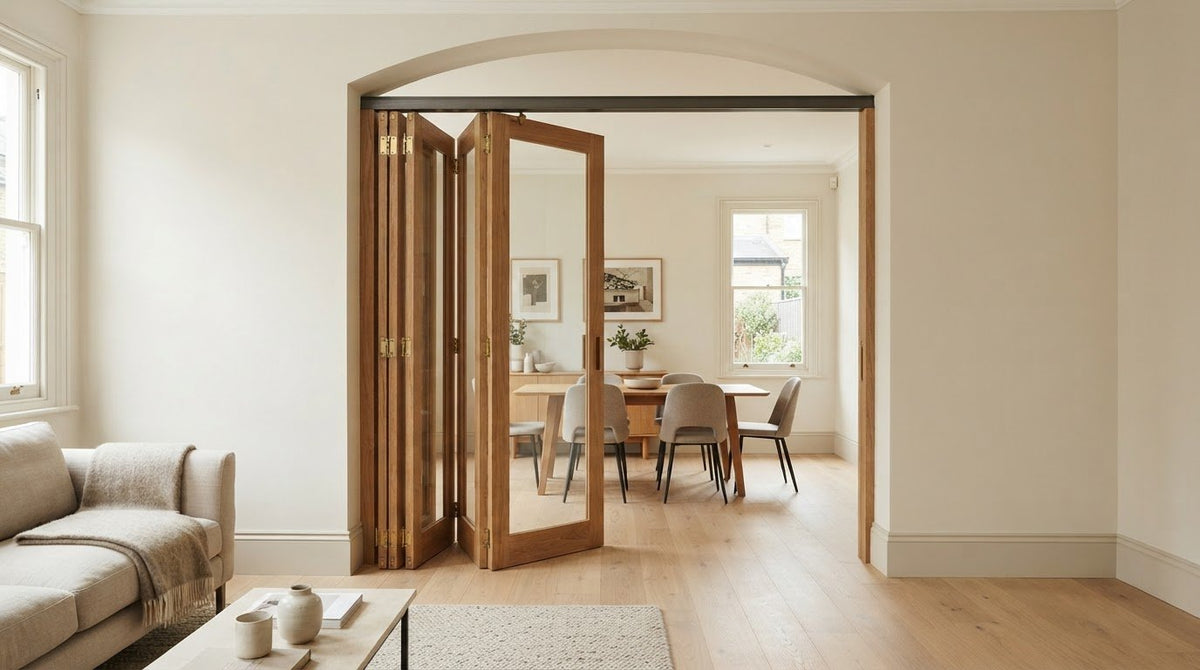
A wooden folding door can save valuable swing space, but it won’t necessarily create the wide, clear opening you have in mind. If you’re considering internal concertina doors wood is only part of the decision: the number and width of the panels, how they fold and the track arrangement all affect how the door works in your room.
It’s easy to see why concertina-style doors appeal. They bring warmth and character to an interior while folding neatly to one side. Yet “concertina” and “bi-fold” are often used interchangeably, and panel layouts can vary. The best option depends on your measurements, the space beside the opening and how you want the rooms to connect.
This guide explains how wooden concertina-style doors operate, compares them with bi-fold, pocket, sliding and hinged options, and sets out what to consider when assessing construction, finish and hardware. Use the practical steps to build a shortlist around your opening and interior, rather than appearance alone.
Key Takeaways
- See how internal concertina doors wood can save swing space, and why the folded panels still take up room beside the opening.
- Compare solid timber, engineered construction and veneer by checking what the door is made from, not just how it looks.
- Compare concertina, bi-fold, sliding and hinged doors by their opening action, floor clearance and visual effect.
- Follow a measuring and shortlisting sequence to match the opening, layout, configuration and finish.
- Explore Arborfield Joinery’s internal bi-fold doors and folding systems, and compare styles in a showroom displaying more than 120 doors.
What Are Wooden Internal Concertina Doors, and How Do They Work?
A hinged door needs clear floor space to swing open. In a compact room, that arc can conflict with furniture, a walkway or another door. A folding design changes the movement: connected panels fold together and gather beside the opening, rather than sweeping across the room. They still take up space when open, so plan where the folded leaves will sit.
Wooden internal concertina doors can divide spaces such as a living and dining area, or separate a study when you want a boundary between rooms. Open them to reconnect the spaces; close them to create separation. The opening action and amount of access depend on the system and panel arrangement. For a general overview of folding-door forms and materials, see What Are Wooden Internal Concertina Doors.
How Does a Concertina-Style Wooden Door Fold?
A folding door is made from connected leaves, or panels, joined by hinges. As you open it, the leaves pivot against one another and move along a guided track. The track directs their movement, while the hinged joints let the panels fold into a compact stack at one side of the opening.
The arrangement varies by system. Check how the leaves are grouped and which way they fold, then picture the gathered panels in your room. A folding door reduces the clearance needed for a wide swinging arc, but it doesn’t disappear into the wall. Before choosing, consider whether the folded stack will narrow a route or sit in the way of furniture.
Concertina, Bi-Fold or Accordion Door: What Do the Terms Mean?
Product listings don’t always use “concertina” and “bi-fold” consistently. Both can describe hinged panels that fold together, although “bi-fold” often refers to fewer, larger leaves, while “concertina” may describe a sequence of narrower panels. Treat this as a guide rather than a guaranteed naming rule.
Look beyond the label. Compare the number of leaves, how they connect, the direction they fold and how the track guides them. “Accordion door” can also refer to lightweight products made from materials such as fabric or plastic, which differ from a timber or timber-faced internal door. If you’re searching for internal concertina doors wood, read the product description and focus on construction and mechanism, not just the listing title.
That distinction matters because doors with similar names may create different folded stacks and usable openings. The mechanism, rather than the name alone, shows how the door will behave day to day. Compare it with the shape of your opening and the space available at either side before deciding whether a folding layout suits the room.
How to Compare Wood, Construction and Finish in Concertina Doors
A convincing wood-grain image doesn’t tell you what a door is made from. When comparing internal concertina doors wood, check the written construction and surface details as well as the finish. These details affect the door’s appearance and help you understand what preparation or care may be needed.
What Should You Check About the Timber Door Construction?
Read the full specification, not just the headline material. “Solid timber” describes a door made from timber, which may be formed from joined pieces. An engineered door uses a constructed core, which may include timber layers or faces. A veneer is a thin layer of real wood applied to a supporting material: it gives the door a genuine wood surface, but it isn’t solid timber throughout.
Look for details about the core, faces and visible timber. A label such as “oak” alone may not explain whether oak is used throughout or as a surface veneer. Compare those details across the options you’re considering, including the stated finish and care guidance. For more context on timber appearance and construction, read this guide to internal oak doors.
Which Finish and Glazing Suit Your Interior?
A natural timber finish brings the grain and variation of the wood into view, whilst a painted finish creates a more uniform colour. Primed doors have a prepared surface intended for painting, while unfinished doors generally need a suitable finish applied. Ready-finished doors arrive with a surface treatment already applied. Follow the product instructions for preparation and finishing, rather than assuming every door is ready to hang or paint.
Glazing changes the balance between light and separation. Glazed panels can help light pass between rooms and preserve a visual connection, while a solid panel creates a more continuous screen. Consider how that choice relates to privacy and the way you use the adjoining spaces.
Then look at the wider scheme. Compare the door’s colour and grain with nearby doors, flooring, skirting and furniture. A close match can create continuity; a deliberate contrast can make the folding door a feature. To compare styles alongside other internal door options, explore Arborfield Joinery’s internal door range.
Wooden Concertina Doors Compared with Bi-Fold, Sliding and Hinged Doors
Choosing a door is a question of movement as much as material. A folding design can free up the floor area needed for a door swing, but it doesn’t vanish: its panels gather to one side and may reduce the clear opening. How much space remains depends on the system and configuration, so consider the folded stack as well as the open doorway.
| Door type | Opening action | Floor clearance | Visual effect |
|---|---|---|---|
| Concertina-style folding | Connected panels fold together and gather at one side. | No wide swing arc, but allow for the folded panels and any floor track specified by the system. | A row of panels creates a defined room divider when closed. |
| Bi-fold | One or more pairs of hinged leaves fold to the side. | No broad swing arc; folded leaves take up space beside the opening. | Folding panels remain visible when open, with the arrangement shaped by the configuration. |
| Sliding | A panel slides alongside or into a wall, depending on the design. | No swing arc, but the wall layout must accommodate the moving panel. | Can leave a simple, uninterrupted panel across the opening when closed. |
| Hinged | A single leaf swings open on hinges. | Needs clear space for its swing. | A familiar, straightforward doorway with the door leaf visible when open. |
When Is a Folding Concertina-Style Door a Practical Choice?
Consider folding panels if a door swing would clash with furniture, narrow a route through the room or compete with another doorway. They can also suit a room that alternates between open and divided layouts, such as a shared living and dining area. For broader inspiration on zoning open-plan spaces, design specialists like Chicsense illustrate how wooden room dividers can create definition and atmosphere without closing a space off entirely. Check where the panels stack and how the track guides them: these details affect the space they occupy and the opening you can use.
Don’t assume a folding format creates a completely clear span. The gathered leaves may remain within the doorway, and different systems can leave different amounts of usable access. Compare the open position with the way you’ll move between rooms, not just how the closed door looks.
When Might a Sliding or Hinged Door Suit You Better?
A hinged door may be the natural choice if you prefer a familiar single-leaf action and have enough room for its swing. A sliding door avoids that arc, but needs a suitable wall area for the panel to travel alongside, or a design that allows it to slide into the wall.
Start with your priorities: frequent passage, privacy, furniture placement or the widest practical opening. Then consider the room layout and the look you want when the door is open and closed. There’s no universal winner. The best fit is the one whose movement and visual presence work comfortably in your home.
How to Measure and Shortlist Wooden Internal Concertina Doors
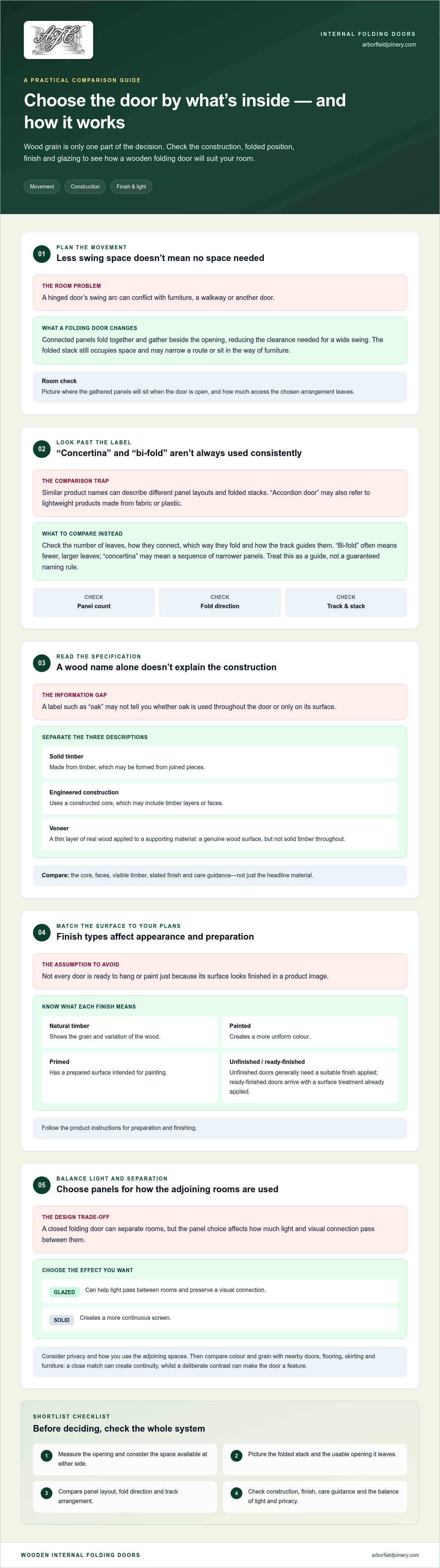
A useful shortlist starts with the opening, not the door image. Before comparing internal concertina doors wood, record the key measurements and layout details. This helps you judge whether the panel arrangement and finish suit both the space and the way you’ll use it.
Which Measurements and Layout Details Should You Record?
Measure the opening width and height at several points, as walls and floors aren’t always perfectly even. Record each measurement and note the smallest width and height, along with whether the opening appears square. Check for obstructions such as skirting, switches and nearby furniture, and consider the route people use through the room. For broader context on door sizing, see this internal doors and door frames guide.
Use this sequence to organise your shortlist:
- Measure: Record the opening’s width and height at several points, noting any unevenness.
- Assess the layout: Identify which side has room for the leaves to gather. Check that handles, skirting and furniture won’t obstruct the door or access route.
- Choose a configuration: Compare how the panels fold with the opening you want to use. Consider how much of the doorway the gathered leaves may occupy.
- Compare the finish: Once the layout works, weigh up timber appearance, colour, glazing and how the door will sit alongside nearby details.
These notes help you compare like with like. They don’t replace the selected door’s measuring and fitting instructions, which should guide final checks and explain any product-specific requirements.
How Do You Narrow Down the Right Folding Configuration?
Start with the side where the panels can gather without blocking a route or striking furniture. Then consider how much clear access you want when the door is fully open. A configuration that suits the opening on paper may feel awkward if the folded leaves occupy the space you need to pass through.
Finally, bring the practical and visual choices together. Think about whether glazed panels suit the room’s need for light or privacy, and whether the finish complements the surrounding interior. Comparing these details together makes it easier to rule out options that look appealing but don’t fit your layout.
Ready to compare styles against your measurements? Explore Arborfield Joinery’s internal bi-fold doors as you refine your shortlist.
Choose Your Wooden Internal Folding Door with Arborfield Joinery
A considered choice follows a practical order: start with the opening and room layout, then compare construction and finish. This helps you judge whether a folding arrangement will work day to day before narrowing down the look. When researching internal concertina doors wood, focus on how the panels gather, what the door is made from and how its style fits the room.
Arborfield Joinery sells internal bi-fold doors and folding systems for customers comparing options in this category. The family-run business has supplied doors since 1953, bringing joinery experience to a decision where both function and finish matter.
What to Look for When Browsing the Range
Keep your measurements and notes about the opening to hand as you browse. Compare the folding arrangement with the space available for the leaves to gather, and consider how much access you want when the door is open. Then assess the product details, including the stated construction, finish and any glazing, against the way you’ll use the room.
Look at the door as part of the interior, too. A timber tone may echo nearby flooring or furniture, whilst a painted finish can coordinate with other doors and trim. Glazing can alter the balance between light and privacy. Reviewing these choices together makes it easier to shortlist an option that feels cohesive rather than selecting a finish in isolation.
See Door Styles and Finishes in Person
Photographs are useful for an initial comparison, but seeing doors in person can help you judge colour, grain and detail more clearly. Arborfield Joinery’s showroom displays more than 120 doors, giving you the chance to compare styles as you develop your shortlist. Bring your recorded opening measurements and notes on the room’s colours, furnishings and preferred level of privacy.
Set the practical fit alongside the visual details, then choose a door that supports the way you want the space to work. Explore internal doors and folding systems as you shape a shortlist for your home.
Make a Confident Choice for Your Home
The right folding door starts with the opening and room layout, then comes down to construction, finish and the way you want the space to feel. Compare the folding mechanism as well as the material: “concertina” and “bi-fold” labels can vary, so the panel arrangement and gathered position matter. With internal concertina doors wood, a little planning helps balance practical access with a finish that complements your interior.
Arborfield Joinery’s range includes internal bi-fold doors and folding systems. As a family-run business supplying doors, windows and stairs since 1953, it offers a range of joinery products to explore. The showroom displays more than 120 doors, making it possible to compare styles in person and picture them at home.
Bring your measurements and interior preferences as you consider the options. Explore Arborfield Joinery’s internal doors and folding systems to find a style that suits your space.
Frequently Asked Questions
Are wooden concertina doors the same as bi-fold doors?
They can describe similar folding mechanisms, but the terms aren’t used consistently across product listings. Both types usually have hinged leaves that fold together, whilst “concertina” may refer to a set with more, narrower panels and “bi-fold” often to fewer, larger leaves. Check the number of panels, how they fold and where they gather. The mechanism and configuration give you a clearer comparison than the label alone.
Do wooden concertina doors save space?
They save the floor clearance needed for a conventional door swing, which can make furniture planning easier. However, the panels don’t disappear: they fold together at one side of the opening and take up space there. The folded stack may also affect how much of the doorway remains clear. Before choosing, consider the room layout, the folding direction and the access you want when the door is open.
Are wooden concertina doors suitable for a living room?
They can work well in a living room when you want the choice of separating or opening up adjoining spaces. For example, they can divide a living and dining area whilst allowing flexible access between them. Consider how often you’ll open the door, where the folded panels will sit and whether you want a solid or glazed appearance. The best choice balances the room’s layout, privacy needs and interior style.
How do I measure for internal concertina doors?
Measure the opening’s width and height at several points, recording each measurement rather than assuming the opening is perfectly even. Note whether it appears square and check for obstructions such as skirting, switches and nearby furniture. Also record the space beside the opening where the panels will gather. Use the chosen door system’s measuring instructions for final checks, as requirements can vary between products.
Can wooden concertina doors be fitted to any opening?
No single folding door suits every opening. Fit depends on the opening’s dimensions and condition, the system’s configuration and whether there’s room for the leaves, track and hardware to operate without obstruction. An uneven opening or limited space at the stacking side may affect the options. Compare your measurements with the specific product details and follow its measuring and fitting instructions before settling on a design.
Are concertina doors better than sliding doors?
Neither is automatically better; each suits different room layouts. Folding doors gather their panels beside the opening, so they don’t need a wide swing arc but do occupy space at the side. Sliding doors also avoid a swing, but need room for the panel to travel alongside the opening or into the wall, depending on the design. Compare the usable access, wall space, privacy and appearance you want.
What should I compare when buying a wooden folding door?
Compare the opening dimensions, panel arrangement and direction of travel first. Then review how much access remains when the leaves are folded, and check the stated construction, surface material and finish. Searches for “internal concertina doors wood” can return varied products, so look beyond images and listing labels. Consider glazing and how the colour or grain will sit with nearby doors, flooring and furnishings before creating your shortlist.
Share:
Best Wood Sealants for Moisture Protection: UK Guide
Expert Advice for Home Renovation Joinery