
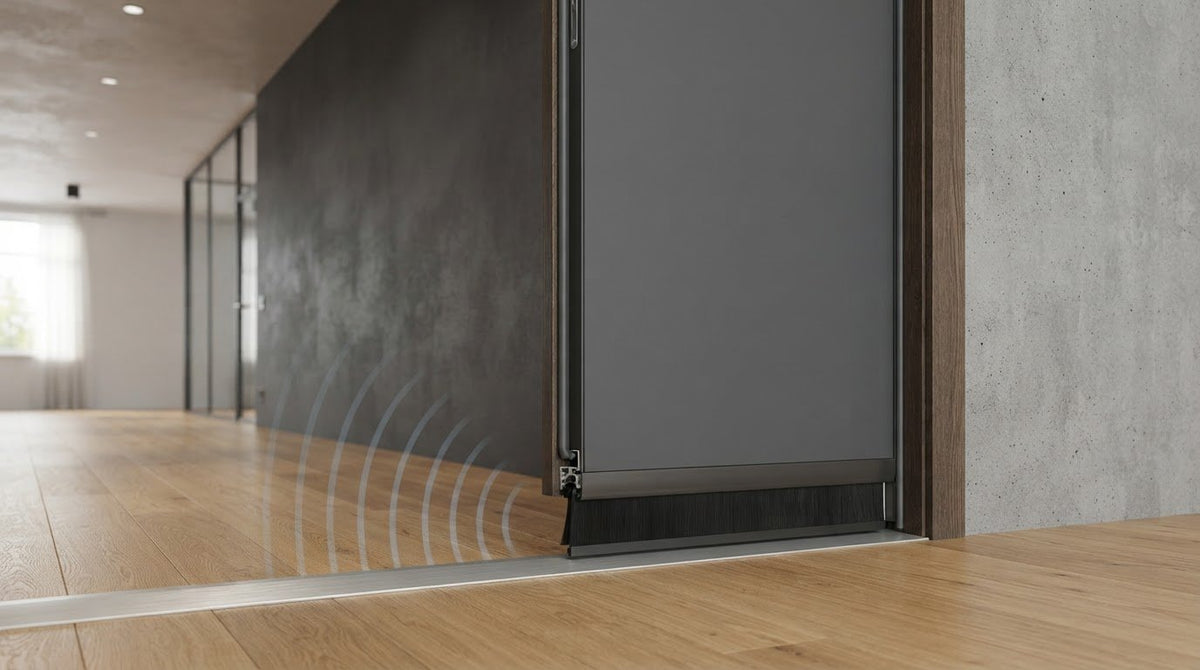
The quietest fix may not be a seal at all. If sound seems to travel through the gap beneath a closed door, drop down acoustic door seals can be a sensible place to start. However, they can’t compensate for every weakness in the door assembly. The door leaf, frame, perimeter gaps and threshold all affect how much sound gets through.
It’s understandable to focus on the visible gap under the door. A drop-down seal lowers when the door closes to meet the floor or threshold, then lifts as the door opens. The key is choosing one that suits the door, floor and fitting arrangement, and understanding what manufacturers’ acoustic test information does and doesn’t show.
This guide explains how the mechanism works, what to compare before buying, and why a seal’s performance depends on the wider assembly. You’ll also find practical checks to make before modifying a door, plus signs that a better-suited replacement door or a broader upgrade may be the more proportionate next step.
Key Takeaways
- Understand how a drop-down seal addresses the gap beneath a closed door, and why it won’t block every route sound can take.
- Compare drop down acoustic door seals with other options by checking how they contact the floor, suit your gap and fit your door.
- Before buying, inspect the door and measure carefully, then check compatibility and follow the manufacturer’s fitting instructions.
- Read acoustic test information in context: results apply to the specific door and seal configuration tested, not automatically to yours.
- If sound may also pass around the frame, through glazing or through the door itself, consider whether assessing the whole door and frame is a more useful next step.
What Is a Drop Down Acoustic Door Seal, and What Gap Does It Address?
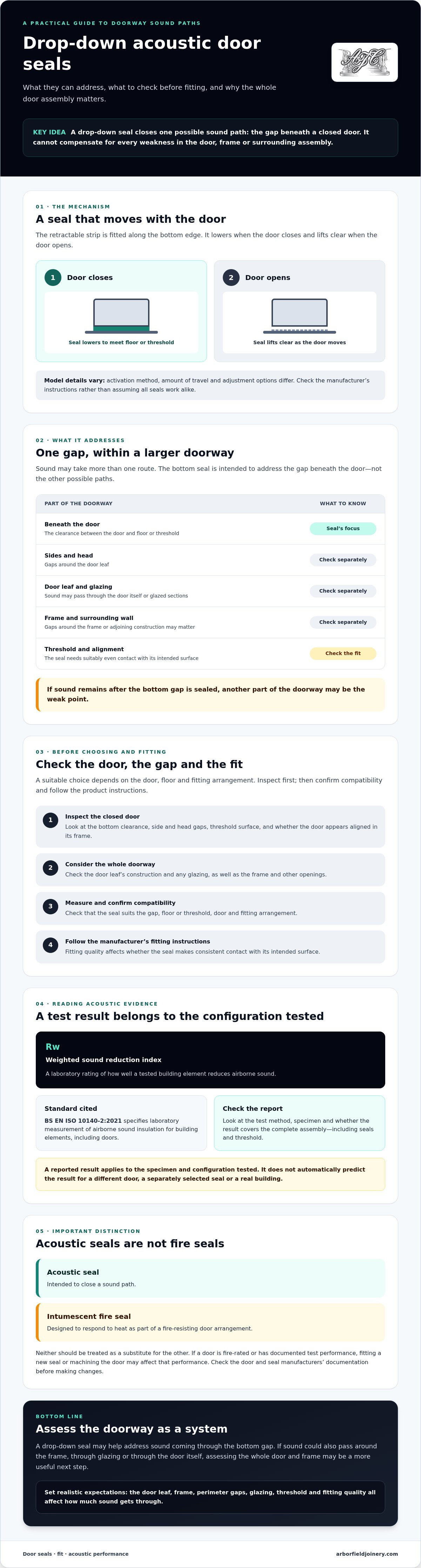
A drop-down acoustic door seal is a retractable strip fitted along the bottom edge of a door. When the door closes, the mechanism lowers the sealing element to meet the floor or threshold, helping to close the gap beneath the door. When the door opens, the seal retracts to clear the surface. It’s one form of Weatherstripping, used to seal an opening, but its purpose here is specific: to address the space under the door as a route for sound.
That distinction matters. A seal may reduce the sound you notice coming through the bottom gap, but a perceived change isn’t the same as a tested acoustic rating. Don’t rely on a performance figure unless the manufacturer provides evidence for the product and tested configuration. Laboratory testing to BS EN ISO 10140-2:2021 measures airborne sound insulation of building elements, so check which door assembly the reported result relates to.
How does the automatic drop-down mechanism work?
Closing the door activates a mechanism that lowers the sealing element against the floor or threshold. When the door opens, the seal lifts clear, helping to prevent it from dragging as the door moves. The activation method, amount of travel and adjustment options vary by model. Check the manufacturer’s instructions rather than assuming every seal operates in the same way.
Why can sound still pass around a sealed door?
Sound may also travel through gaps at the sides or top, through glazing, around the frame or via adjoining construction. A drop-down seal addresses only the bottom gap. Its contact with the floor or threshold also needs to be suitably even for the intended fit. If sound remains after that gap is sealed, another part of the doorway may be the weak point.
The door itself matters, too. A lightweight or poorly fitting door leaf, gaps between the frame and surrounding wall, or other openings can limit the overall result. Fitting quality also affects whether the seal makes consistent contact with its intended surface. A product’s performance in a test shouldn’t be treated as a guarantee of the same result in a different doorway.
A drop-down seal can close one sound path, but acoustic performance depends on the complete door assembly. Before choosing one, identify where sound seems to pass and consider the door, frame, glazing and threshold together. This helps set realistic expectations and avoids asking a bottom seal to solve a problem elsewhere.
How Drop Down Acoustic Door Seals Affect the Whole Door Assembly
A doorway is a system, not just a door leaf with a seal at the bottom. Sound may pass through the leaf itself, through gaps at the sides or head, beneath the door, around the frame or through glazed sections. The threshold and the way the door sits in its frame matter as well. A seal can address one route, but it can’t improve the performance of other parts.
Which parts of a doorway should buyers assess?
Start with a visual check of the closed door. Look at the bottom clearance, the gaps at the sides and head, the threshold surface and whether the door appears aligned in its frame. Then consider the leaf’s construction and any glazing. Sound that seems strongest in one place doesn’t prove that it has only one route, so check the whole doorway before choosing a fix.
What do acoustic ratings and test reports tell you?
In the UK, Rw means weighted sound reduction index. It’s a laboratory rating of how well a tested building element reduces airborne sound. BS EN ISO 10140-2:2021 specifies laboratory measurement of airborne sound insulation for building elements, including doors. A report’s result applies to the specimen and configuration tested, not automatically to a different door with a separately selected seal.
Before relying on a quoted figure, check the test method, the specimen tested and whether the report covers the complete assembly, including its seals and threshold. Confirm that the seal is compatible with your door and fitting arrangement, too. A component rating doesn’t guarantee the same acoustic result once fitted to a different door or in a real building.
Acoustic seals and intumescent fire seals have different purposes. An acoustic seal is intended to close a sound path; an intumescent fire seal is designed to respond to heat as part of a fire-resisting door arrangement. Neither should be treated as a substitute for the other. If a door is fire-rated or has documented test performance, fitting a new seal or machining the door may affect that performance. Check the door and seal manufacturers’ documentation before making changes.
Choosing between drop down acoustic door seals starts with understanding the complete assembly and what evidence applies to it. If inspection suggests the door or frame may be limiting performance, Arborfield Joinery’s internal door and frame guidance can help you explore whether a wider door choice is worth considering.
Drop Down Seals Compared with Brush, Threshold and Perimeter Seals
Different sealing approaches address different parts of a doorway. A threshold is a surface at the base of the opening, not necessarily a seal in its own right. A drop-down seal lowers to meet the floor or threshold when the door closes, then retracts on opening, depending on the model’s design. Brush seals use bristles to contact a surface, while perimeter seals are fitted around the sides and top of the door or frame.
| Option | Contact and movement | Gap it may suit | Fitting and upkeep |
|---|---|---|---|
| Drop-down seal | Lowers to meet the floor or threshold; retracts as the door opens, depending on design. | A bottom gap within the model’s stated adjustment range. | Check door compatibility, fitting method and adjustment; inspect the mechanism and contact edge as directed. |
| Brush seal | Bristles stay in contact with the adjoining surface as the door moves. | May suit some clearances where flexible contact is useful. | Check bristle length, fixing method and wear. Don’t assume it gives the same acoustic performance as a tested drop seal. |
| Threshold | Provides a fixed surface at the bottom of the opening. | May offer a suitable landing surface for a door-bottom seal. | Check its height, floor finish, door swing and effect on access before changing it. |
| Perimeter seal | Compresses or contacts the door around its sides or head, depending on type. | Gaps at the jambs or top of the door. | Check the seal suits the frame and closes consistently without preventing the door from latching. |
When might a drop-down seal suit the doorway?
Consider a drop-down option if inspection points to a consistent bottom gap and you want the seal to lift clear during normal door movement. Measure the clearance across the door and note any changes in floor level. Check carpet thickness, threshold shape and the product’s stated dimensional range. Suitability depends on matching those measured conditions to the manufacturer’s requirements, not simply on the product label.
When should buyers compare another sealing approach?
If light or air is visible at the jambs or head, compare suitable perimeter seals rather than focusing only on the bottom edge. A threshold change may provide a landing surface, but consider the floor finish, access and door swing before altering it. If several gaps or a weak door remain, assess the complete doorway before selecting a single seal.
How to Choose and Fit a Drop Down Acoustic Door Seal
Measure and check the doorway before choosing a model. Drop down acoustic door seals aren’t interchangeable by default: door construction, available fitting space and the floor beneath it can all affect compatibility. Use this pre-purchase sequence to narrow your options without relying on a product label alone.
- Inspect the doorway. Check the bottom clearance, floor or threshold condition, door alignment and whether gaps elsewhere may also need attention.
- Measure the door and gap. Record the door width and bottom clearance, including any variation across the opening. Follow the manufacturer’s stated measurement points rather than assuming one method suits every model.
- Check compatibility. Compare the door’s thickness, material and swing with the product requirements. Check the available fitting space, and note whether carpet, an uneven floor or the threshold could affect the seal’s travel.
- Confirm the fitting method. Read the instructions and template before ordering. Check whether fitting requires routing, trimming, specialist tools or changes to the door.
- Review the evidence. Look for test information that identifies the method and complete configuration tested. Confirm that the product is suitable for your door and the performance you’re seeking.
What should you measure before ordering?
Measure the door width and bottom clearance as the selected manufacturer directs, checking across the opening if the floor or threshold isn’t level. Compare the door’s thickness and material, its swing and the available fitting space with the model’s stated limits. Include carpet and threshold shape in your checks: either may affect how far the seal can lower or whether it meets the surface evenly.
What should buyers verify before installation?
Check the fitting template against the door before making any cuts. Routing or trimming can alter the door, so ask the seal or door manufacturer for guidance if the instructions leave room for doubt. For a fire-rated or tested door, get manufacturer advice before modifying the assembly. If specialist tools or experience are needed, consider a suitably qualified professional. Arborfield Joinery sells joinery products rather than offering installation services.
If your checks suggest the door itself may need changing, explore Arborfield Joinery’s internal door range as a possible next step. A different door may be worth considering when a bottom seal alone won’t address the issue.
When a Drop Down Acoustic Seal Is Not Enough: Consider the Door and Frame
A new bottom seal may be a proportionate fix if inspection shows that the main issue is the clearance beneath an otherwise sound, well-fitting door. But if noise still seems to come through with that gap closed, or you can see openings at the sides or top, the bottom is unlikely to be the only path. A loose or poorly aligned leaf, gaps around the frame or glazed sections may also affect the result.
Think of drop down acoustic door seals as one possible part of a solution, not a substitute for checking the doorway as a whole. Where several weak points remain, assess the door leaf, frame, glazing and fitting together before expecting a single component to make a noticeable difference.
How can you decide between sealing and replacing a door?
Compare the likely cost and disruption of adjusting the existing door, fitting a seal and considering a broader door upgrade. The right choice depends on the door’s condition and fit, its construction, the source of the noise and any performance documentation available. A well-kept door with a localised gap may call for a different response from one that is damaged, poorly aligned or unsuitable for the intended use.
Before committing, list the sound paths you’ve identified and decide which can be addressed by a seal or adjustment. If the leaf or frame is also a concern, investigate those issues first. Otherwise, a new component may leave the main problem unchanged.
What door and frame information can support the next decision?
Check the door’s dimensions, how it sits in the frame, and whether the frame itself is secure and in good condition. Arborfield Joinery’s internal doors and door frames guidance offers context for considering fit and door choice. If you’re specifically weighing up a timber door, its internal oak door guidance may also help you understand that material and construction.
Arborfield Joinery is a family-run UK retailer supplying doors, windows and stairs since 1953. If replacing the door is part of your plan, you can explore its range of internal doors. Take time to match the door and frame to the opening, and verify any performance claims against documentation for the complete assembly.
Choose the Next Step for Your Doorway
A drop-down seal can help address a gap beneath a door, but it can’t correct every weakness in the assembly. Before choosing one, check the door, frame, threshold and other gaps, then compare the seal’s fitting requirements and test evidence with your actual doorway. The right choice depends on the measured fit, not the product description alone.
If the door is poorly fitting, damaged or otherwise limiting performance, a wider door and frame assessment may be the more useful next step. Arborfield Joinery is a family-run business supplying doors, windows and stairs since 1953, with more than 120 doors displayed in its showroom. If replacement is worth considering, you can explore Arborfield Joinery’s internal door range.
Take a measured approach, verify compatibility before modifying a door, and choose the solution that addresses the sound paths you’ve identified. For help exploring door options, browse Arborfield Joinery’s internal door range.
Frequently Asked Questions
Do drop down acoustic door seals reduce noise?
Yes, drop down acoustic door seals can reduce sound travelling through a gap beneath a door, provided the seal fits and makes suitable contact. They won’t address sound passing through the door leaf, around the frame or through glazing. The outcome depends on the whole doorway and fitting quality. Treat a product’s acoustic rating as evidence for the tested configuration, not a promise of the same result in your home.
How do I measure for a drop down acoustic door seal?
Measure the door width and the clearance beneath it, checking for changes across the floor or threshold. Also note the door’s thickness, material and swing, plus the fitting space available. Follow the chosen manufacturer’s measurement points and template, as requirements vary by model. Include carpet and threshold shape in your checks, then compare every measurement with the product’s stated compatibility and adjustment range before ordering.
Can I fit a drop down seal to an existing internal door?
Possibly, if the seal is compatible with the door’s construction, dimensions and available fitting space. Some models may require routing, trimming or specialist tools, which can alter the door. Read the fitting instructions and check the template against the door before making any changes. If the door is valuable, tested or difficult to modify, seek advice from the door or seal manufacturer, or consider a suitably qualified professional.
Are drop down acoustic seals better than brush seals?
Not in every situation. A drop-down seal lowers to meet the floor or threshold when the door closes and usually retracts as it opens, depending on the model. A brush seal uses bristles that remain in contact with the adjoining surface. Which approach suits your doorway depends on the gap, floor conditions, door movement and product evidence. Don’t assume brush and drop-down designs deliver equivalent acoustic performance without relevant test information.
Will a drop down door seal work without a threshold?
Some models may be designed to meet the floor directly, while others may require a suitable threshold as their contact surface. Check the manufacturer’s instructions for the specific seal. The floor needs to provide a suitable, consistent landing surface across the door’s width; uneven flooring or thick carpet may affect contact and travel. Confirm the model’s requirements before buying or adding a threshold, especially if that could affect access or door movement.
Can I fit an acoustic seal to a fire door?
Don’t modify a fire-rated door until you’ve checked the door manufacturer’s guidance and confirmed that the proposed seal and fitting method are suitable. Routing, trimming or changing components may affect the documented performance of the door assembly. Acoustic seals and intumescent fire seals serve different purposes, so one shouldn’t be treated as a replacement for the other. If documentation is unclear, ask the manufacturer or a suitably qualified professional before proceeding.
What should I check if sound still passes through a sealed door?
Inspect the door’s sides and top, its alignment in the frame, the threshold and any glazed sections. Sound may also travel through the door leaf or adjoining construction, so the bottom gap may not be the only route. Look for visible gaps, but don’t rely on where the sound seems loudest as a diagnosis. If several parts could be contributing, assess the door, frame and seals together before changing another component.
Share:
Customisable Timber Windows & Doors: Bespoke Fitting
5 Best Wood for Staircase Treads UK: Expert Guide 2026