
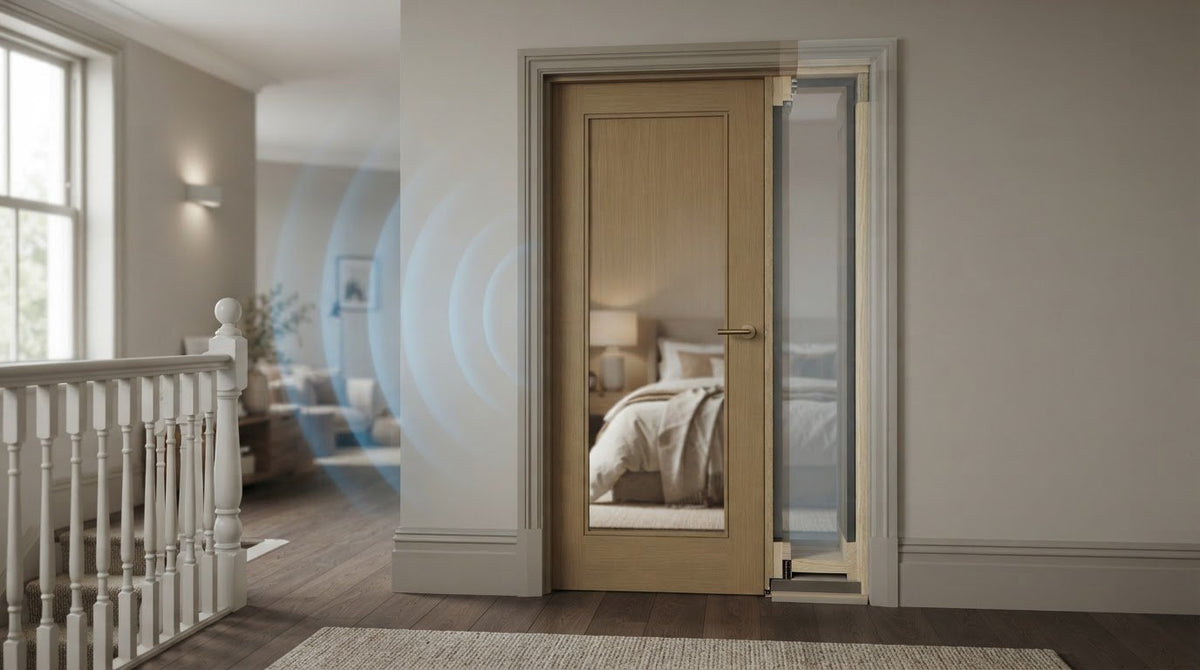
Could a bedroom door that looks solid still let unwanted noise through? The doors with best acoustic rating for bedrooms aren’t chosen by appearance alone. Compare the tested sound reduction rating, then check how the complete door set is designed to fit and seal.
If acoustic claims seem inconsistent, look beyond the headline figure. The Rw rating, expressed in decibels, helps compare sound reduction, but a result for a door leaf alone doesn’t tell the whole story. Gaps around the frame or threshold can affect the performance you experience at home.
This guide explains what an acoustic rating means, how to compare evidence for the door, frame and seals, and what to consider when choosing a style. You’ll find practical pointers for balancing sound privacy with the look of your bedroom, whether you prefer oak, walnut, white primed or another interior style. The aim is to help you choose based on performance, fit and finish, rather than appearance alone.
Key Takeaways
- Start with the noise you want to reduce, such as conversation, television or activity in an adjoining room.
- Look for a clear Rw rating and check which product and test configuration it applies to.
- Compare evidence for the complete door set, including the frame and seals, rather than judging a door by its appearance.
- When comparing the doors with best acoustic rating for bedrooms, treat untested or non-comparable claims with care.
- After considering performance and fit, explore styles such as oak, walnut, white primed, urban, laminate and glazed doors.
Why bedroom doors need more than a solid-looking leaf to reduce noise
Conversation from the landing, a television in the next room or late-night activity in an adjoining bedroom can all disturb sleep. But the noise you hear may not be travelling through the door itself. It can pass through gaps around the opening, the frame, a shared wall or other parts of the building. Choosing doors with best acoustic rating for bedrooms starts with understanding the route the sound takes, not just the door’s appearance.
A bedroom door can help limit sound travelling through or around its opening, but it can’t address every route into a room. Soundproofing principles and materials provide useful background on how sound moves and why a complete approach matters. Compare documented performance and construction with the fit of the whole assembly, then decide which style suits your home.
Which bedroom noises are you trying to limit?
Voices, television dialogue and music are airborne sounds. They travel through the air and can pass through openings or building elements. Impact noise is different: footsteps, a closing door or furniture moving may cause vibrations that travel through floors, ceilings or walls before reaching the bedroom. A new door may have limited effect if the main route is structural.
Notice where the noise comes from, when it occurs and whether it seems strongest near the doorway or along a shared wall. Does conversation become clearer when you stand beside the door? Is the disturbance mainly low-level thudding from above or next door? These observations help you set realistic priorities. A door can only make a difference to sound travelling through or around its opening; noise taking another route may remain audible.
Why a substantial-looking door is not proof
A thick-looking leaf, a timber finish or a description such as “solid” may suggest quality, but none gives you a measured acoustic result. Material and construction can inform your comparison, yet they don’t establish how much sound a particular door will reduce. Look for documented test performance and check what was tested, including whether the result relates to the leaf alone or a complete assembly.
A product description tells you what a door is made of; documented test performance tells you how a specified assembly performed. Results can’t automatically be transferred from one configuration to another. The frame, seals, threshold and installation details all affect how closely a fitted door matches a tested arrangement.
Even a well-specified leaf may disappoint if there are open gaps at the sides, head or threshold. Sound can pass through these weak points, reducing the benefit you hoped to gain. Before choosing by finish alone, consider the opening and how the door will close against its frame. A sensible starting point is to identify the noise, assess the evidence and fit, then explore styles that complement your bedroom.
How to read an acoustic rating for a bedroom door
An acoustic rating gives you a more useful basis for comparison than a description such as “heavy” or “soundproof”. The key figure to look for is Rw, the weighted sound reduction index, expressed in decibels (dB). Under the references used for this rating, sound reduction is measured using BS EN ISO 10140:2010 and rated using BS EN ISO 717-1:2013.
That figure is helpful, but it isn’t a promise of silence. It describes performance under defined test conditions, not necessarily the sound reduction you’ll experience in a finished bedroom. A poorly fitting frame, gaps at the threshold or sound travelling through a wall can all affect the result you notice at home.
What does an Rw figure tell a buyer?
Rw combines sound-reduction measurements across different frequencies into one weighted figure, making results easier to scan. A higher Rw indicates greater tested sound reduction, but compare figures only when the test context and assembly are comparable. A rating for one door configuration can’t automatically be applied to another. There’s no single bedroom target that suits every room and noise source.
For example, two figures may look directly comparable while referring to different test arrangements. One could describe a door leaf tested on its own, while another may relate to a complete doorset. The number alone doesn’t reveal that difference. Read the accompanying details before deciding which result is more relevant to your home.
Which evidence should accompany an acoustic claim?
Look for a documented test report, the stated Rw rating and a clear description of what was tested. Useful details include the door leaf, frame, seals and threshold arrangement. These components work together: a result from a sealed assembly may not represent a door fitted with a different frame or without the same perimeter and threshold details.
As you compare options, check whether the report identifies:
- The exact door or doorset configuration tested.
- Whether the frame, seals and threshold were part of the test.
- The stated rating and the relevant test and rating references.
- Any conditions that limit how the result applies to another installation.
Laboratory testing provides a controlled comparison, while a finished home has its own openings, surfaces and sound paths. Even a relevant test result shouldn’t be read as a guarantee of identical on-site performance. Treat it as evidence about the tested configuration, then consider how closely the proposed door and its fit match that arrangement.
This evidence-first approach helps you assess the doors with best acoustic rating for bedrooms without mistaking an impressive claim for a comparable result. Once you understand what a rating covers, weigh it alongside fit and appearance. Explore internal door styles with those criteria in mind, so the finish complements your room as well as your priorities.
Solid, glazed or lightweight: compare bedroom-door options realistically
Door construction can help you decide what to investigate, but it can’t establish a sound-reduction result by itself. A solid or heavier-looking leaf, a glazed design and a lightweight option each bring different considerations for bedroom privacy, light and appearance. Compare acoustic figures only when they relate to the particular door assembly you’re considering. If a rating or test scope isn’t supplied, treat performance as unknown rather than guessing from the material.
The table is a starting point, not a performance ranking. “Not stated” means there’s no verified, comparable rating in the information available here; it doesn’t mean the door has no acoustic benefit.
| Door option | Acoustic evidence to look for | Bedroom considerations |
|---|---|---|
| Solid or heavier construction | No rating can be inferred from weight or material alone. Compare a documented result for the exact leaf and doorset. | May suit a preference for a substantial appearance and a more enclosed feel; check light and visual impact. |
| Glazed design | Rating unavailable unless test information covers the relevant glazed door and assembly. Don’t assume glazing type establishes performance. | Can share light between rooms and create a more open look; consider sightlines and bedroom privacy. |
| Lightweight option | Rating unavailable unless documented for the specific construction and configuration. Don’t use a different door’s result as a substitute. | May suit the desired look or everyday handling; balance those preferences against the evidence available. |
When does a solid or heavier design make sense?
A solid or heavier design may be worth considering if its appearance and feel suit the room, but treat construction as a reason to examine evidence, not as an acoustic specification. Prioritise documented results for the exact door, frame and sealing arrangement. For material and style context, explore this guide to internal oak doors, then assess any acoustic claim separately.
Can a glazed or lightweight door meet the brief?
It may be an option, but only product-specific evidence can show how the relevant glazed or lightweight assembly performed. Compare like with like: a result for a solid leaf doesn’t establish the performance of a glazed design. Light transfer, appearance and privacy are separate choices, so consider whether you want daylight beyond the bedroom or a greater sense of enclosure.
For any style, the tested configuration matters. A door leaf paired with a different frame, seals or threshold may not reproduce the reported result. Keep the comparison focused on matching assemblies, and treat missing or non-comparable figures as unknown rather than filling the gap with assumptions. This makes it easier to weigh the doors with best acoustic rating for bedrooms against the look and everyday character you want.
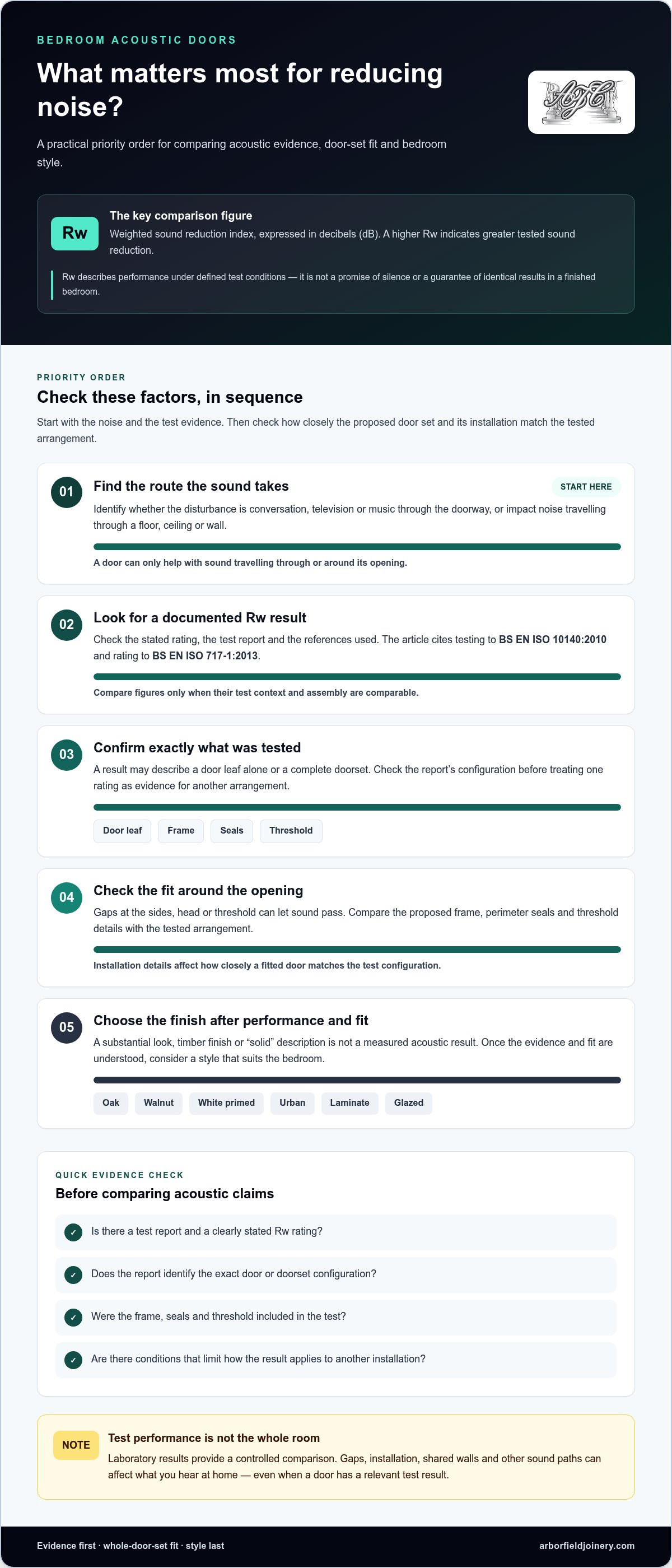
Use this bedroom acoustic-door checklist before you buy
A useful comparison starts with your room, not a product label. Work through the points below to narrow your options and spot where a rating or specification needs closer scrutiny. The aim is to match the door to your noise priorities and doorway, while keeping the bedroom’s appearance and everyday use in view.
- Identify the main noise source. Note whether the disturbance is voices, television sound, activity through the doorway or noise that seems to travel through a wall or floor. Decide which sounds matter most and when you need greater privacy or quiet.
- Set your bedroom priorities. Consider how much light you want to pass between rooms, the level of visual privacy you prefer and how the door will be used day to day. These needs help you decide which styles suit the room before comparing acoustic claims.
- Compare ratings on a like-for-like basis. Record the stated rating and test reference for each option. Check that the test scope and assembly details match. If a report is missing or describes a different configuration, mark the result as unknown rather than estimating it.
- Check the door dimensions and frame. Measure the existing opening and door, then consider the frame’s condition and compatibility with the chosen configuration. A door that doesn’t suit the opening may leave clearances that compromise the intended fit.
- Review seals and threshold details. Check how the tested assembly addresses seals at the sides and head, and how the bottom edge or threshold is treated. These details matter because sound can pass through fitting gaps even when the door itself has documented performance.
- Keep the finish in the decision. Once you understand the evidence and fit, weigh material, colour and design against the room. The doors with best acoustic rating for bedrooms are only a useful choice if their appearance and practical arrangement also suit your home.
Match the specification to your doorway
Before settling on a door, compare its dimensions and frame arrangement with the existing opening. Look for details on the tested assembly’s clearances, seals and threshold, then consider whether those details can be matched in your doorway. For more context on coordinating a door with its frame, see this guide to internal doors and door frames.
Compare claims without overpromising
Keep a short record of each option’s rating, test reference and included components. A product description without supporting test information, or a report for a different assembly, can’t provide a fair comparison. Complete-assembly evidence makes comparisons fairer because it shows how the specified door, frame and sealing details performed together. Even then, the result relates to the tested arrangement, not a promise of identical performance in every finished home.
With the practical checks complete, explore Arborfield Joinery’s internal door range to consider styles that suit your bedroom as well as your priorities.
Choose a bedroom door with evidence, comfort and style in mind
The most considered choice is not automatically the heaviest door or the one with the boldest acoustic claim. Start with relevant, documented test performance, then consider how the door will fit your opening and whether its design suits the room. This keeps the decision grounded in evidence without losing sight of the comfort and character you want from your bedroom.
There isn’t one answer for every home. Your priorities may include limiting conversation from a landing, preserving natural light or creating a more private, restful feel. Keep those needs in view as you compare the available product information.
Balance acoustic priorities with the room’s design
Oak and walnut bring distinctive timber character, while white primed doors offer a clean finish that can be styled to suit the interior. Laminate and glazed doors provide other visual possibilities, with glazing also affecting how light moves between spaces. These are style considerations, not acoustic ratings: a material or category alone can’t tell you how a particular door will perform.
Keep any sound-reduction claim tied to evidence for the specific product and tested configuration. Then look at the door in context. Does its colour sit comfortably with the walls and flooring? Would a glazed design support the room’s light, or would a more enclosed appearance better suit your privacy preference? A well-chosen bedroom door should feel at home in the interior as well as meet your practical brief.
Use that same care when comparing the doors with best acoustic rating for bedrooms. A relevant test result can inform your shortlist, but it doesn’t replace checking the frame, fit and details of the proposed assembly. Style and acoustic evidence answer different questions, so weigh each on its own merits.
Take the next step with Arborfield Joinery
Arborfield Joinery is a family-run supplier with a heritage dating back to 1953. Its showroom showcases more than 120 doors, giving you a broad view of different finishes and designs. Oak, walnut, white primed, urban, laminate and glazed doors sit alongside other internal-door styles for a range of interiors.
As you explore, keep your priorities in mind: the noise you want to address, the information provided for the particular door, and how its configuration relates to your doorway. Compare product details thoughtfully, without assuming that a finish or material guarantees a particular acoustic result.
Explore Arborfield Joinery to discover door styles for your home. Consider the evidence, fit and design together to choose a door that balances bedroom privacy with a finish you’ll be pleased to live with.
Make your next bedroom-door choice with confidence
Use your bedroom as the final test. Picture the door in place: how it will look with the flooring and furnishings, whether its finish feels right in the room, and how it will work as part of your daily routine. The doors with best acoustic rating for bedrooms are worth considering only when the supporting evidence relates to the product and setup you’re choosing.
Now turn your notes into a shortlist. Keep the product information beside your doorway measurements and the priorities that matter most to you. That makes it easier to weigh a door’s documented performance against its fit and design, without expecting one choice to solve every source of household noise.
Arborfield Joinery’s internal-door range offers a starting point for finding a style that feels at home in your space. Explore Arborfield Joinery’s internal doors and take the next step towards a bedroom door that brings together thoughtful selection, everyday comfort and lasting style.
Frequently Asked Questions
What does an Rw rating mean for a bedroom door?
Rw is a single-number rating, expressed in decibels, that summarises a tested door’s sound-reduction performance. It helps you compare products when their test arrangements are alike, but it isn’t a percentage and doesn’t predict exactly how quiet your bedroom will feel. Check what the figure applies to: a test of a door leaf alone may not represent a complete door and frame in your home.
Can I improve the sound insulation of an existing bedroom door?
Often, you can address obvious weak points before replacing the door. Check whether it closes evenly, whether there are visible gaps at the sides or top, and whether sound passes beneath it. Suitable perimeter seals or a threshold arrangement may help reduce sound leakage, but the right approach depends on the existing door and frame. If the door is fire-rated, don’t alter it in a way that could affect its certification.
Does an acoustic bedroom door also need to be a fire door?
Acoustic performance and fire performance are separate properties, so one doesn’t automatically mean the other. Whether a fire door is needed depends on the door’s location and the building’s fire-safety requirements. Flat entrance doors, for example, can have specific fire-safety considerations, while requirements for a bedroom door within a home may differ. If a door is already fire-rated, modifying it, including adding seals, could affect its certification.
Do bedroom doors need a threshold for better sound reduction?
Not every bedroom door needs a raised threshold, but the bottom edge needs consideration if sound is escaping through a gap beneath the door. A threshold or suitable drop seal may help close that route, depending on the tested door arrangement and floor clearance. Consider everyday use too: a raised strip may affect ease of movement, and a drop seal needs enough clearance to operate properly without catching on the floor.
Can ventilation gaps affect a bedroom door’s acoustic performance?
Yes. An intentional undercut or ventilation gap can provide a route for sound to pass, even if the door leaf itself is well specified. Don’t block a ventilation opening without considering the room’s ventilation needs and any relevant building requirements. Instead, identify why the gap is there and whether an alternative arrangement is appropriate. Acoustic performance depends on the whole opening, so a seal must suit both the door and the room.
How much does an acoustic-rated bedroom door cost?
There isn’t one reliable price for every acoustic-rated bedroom door. The specification can vary according to the door, frame, seals and threshold, and whether the quoted figure covers a leaf alone or a complete doorset. Fitting and any changes needed to the existing opening can also affect the total. Compare the product details and configuration included in each price, rather than judging cost without checking what is covered.
Will an acoustic bedroom door block all noise?
No door can be assumed to block every sound. Noise may still travel through a shared wall, floor, ceiling or another opening, and sounds within the room can remain audible. A door can help with sound passing through or around its doorway, but the result depends on the complete assembly and the routes noise takes. Set a realistic goal, such as reducing disturbance from an adjoining room, rather than expecting silence.
Share:
Double Glazing vs Secondary Glazing for Noise
Is Custom Joinery Good for Period Property Restoration?