

What if a door with a traditional reputation could feel at home in a clean-lined, contemporary interior? Many homeowners associate tongue and groove internal doors with cottage or farmhouse rooms and wonder whether their pronounced vertical lines will feel too rustic elsewhere. That’s a fair concern: the construction creates a distinctive look, but it doesn’t dictate the character of the whole room. The finish, proportions and surrounding details all influence the result.
This guide explains how interlocking boards form the door, what sets the style apart from flush and other panelled designs, and how to weigh its texture against your home’s architecture, colours and existing finishes. We’ll also cover practical fit, so appearance isn’t the only consideration when comparing internal doors. Arborfield Joinery is a family-run business with a wide range of internal doors to explore online and more than 120 doors on display in its showroom. The aim is simple: choose a door that feels considered, not themed.
Key Takeaways
- Understand how the tongue-and-groove joint connects adjoining boards and creates a distinctive lined appearance.
- Separate the door’s visible detailing from its core and other construction choices, which can vary between doors.
- See how tongue and groove internal doors can suit traditional, pared-back or contemporary interiors, depending on the styling around them.
- Use a practical checklist to consider your room, existing finishes, desired look and the door’s exact dimensions before ordering.
- Compare styles online or among more than 120 doors on display to help refine your choice.
What Are Tongue and Groove Internal Doors? Understand the Detail Behind the Style
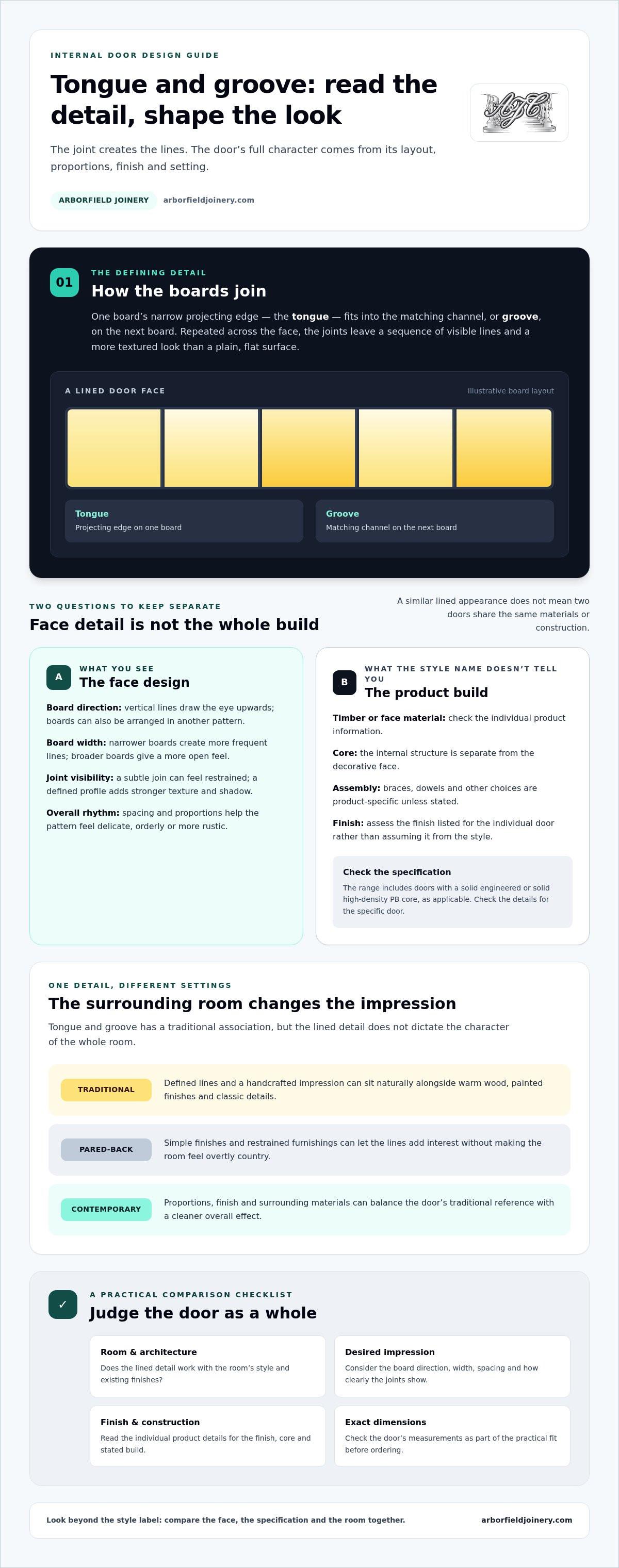
A tongue-and-groove joint connects adjoining boards: one board has a narrow projecting edge, or tongue, which fits into a matching channel, or groove, on the next. Repeated across a door face, these joints create a sequence of visible lines and a more textured, panelled look than a plain, flat surface. Boards can be arranged vertically or in another pattern, so the direction, spacing and width of the detail all help shape the door’s character.
In simple terms, tongue and groove describes how boards join, not the door’s complete construction. It identifies the meeting edges, but doesn’t by itself tell you the timber species, core, frame or method used to assemble the finished door. For a broader overview of the joint and its uses, Tongue and groove is a method of fitting similar objects together, edge to edge, used mainly with wood, in flooring, parquetry, panelling, and similar constructions.
How the tongue-and-groove joint creates a panelled face
Look closely at the face of a tongue-and-groove door and you’ll see how the repeated joints create its defining rhythm. Each projecting edge fits into the next board’s groove, bringing the pieces together while leaving a narrow line that gives the surface depth. Those lines might be subtle or pronounced, close together or more widely spaced. These details affect whether the result feels delicate, orderly or more rustic.
The board layout matters too. Vertical lines draw the eye upwards and give the door a clear sense of height, whilst wider boards can make the pattern feel calmer and less busy. The joint itself doesn’t mean every door uses the same materials or assembly. Treat it as a visible design feature, then consider the individual door’s other construction details separately.
Why tongue and groove doors are associated with cottage interiors
Repeated boards have a familiar connection with traditional joinery, cottage rooms and farmhouse interiors. Their defined lines bring texture and a handcrafted impression, which can sit naturally alongside warm wood, painted finishes and other classic details. That association is useful when you’re considering the look, but it isn’t a rule about where the style belongs.
The same linear detail can read differently in a more pared-back setting. Against simple finishes and restrained furnishings, it can add interest without making the room feel overtly country. In a contemporary interior, the door’s proportions, finish and surrounding materials can balance its traditional reference with a cleaner overall effect. Judge the whole composition rather than deciding by the label alone.
When comparing tongue and groove internal doors, separate two questions: how are the boards joined, and what overall design does the finished door create? That distinction makes it easier to assess the face detail on its own merits, without assuming a particular timber, core or decorating style.
Tongue and Groove Internal Door Construction: What the Details Tell You
The visible pattern is only one part of a door’s specification. Tongue-and-groove describes how boards meet at their edges; it doesn’t identify the door’s core, the material used across the whole construction, or how the components are assembled. The style tells you about the face detail, whilst the product information explains what lies behind it and how the door is made.
This distinction matters because doors with a similar lined appearance can differ in their materials and build. Don’t assume that a particular timber, solid construction, bracing or joining method comes automatically with the tongue-and-groove look. Treat each door as an individual product, and use its description to understand the stated specification rather than relying on the style name alone.
Boards, joints and visible design details
Start with what you can see. Board width affects the rhythm of the face: narrower boards can create more frequent lines, whilst broader boards usually give the pattern a more open feel. Joint visibility also varies. A close, subtle join can look restrained; a clearly defined profile adds stronger texture and shadow. The direction and arrangement of the boards contribute to the overall impression, so compare the full face rather than judging by the words “tongue and groove”.
Specific product descriptions can illustrate this variety, but shouldn’t be mistaken for a universal recipe. A V-joint, for example, is a detail used in some designs, not a defining feature of every tongue-and-groove door. Likewise, boards, braces, dowels and other assembly choices are product-specific unless the description states otherwise. When comparing doors, look for those details in the individual product information rather than inferring them from the style.
Core, finish and product information are separate decisions
The core is the internal structure of a door, distinct from its decorative face. A grooved or lined appearance doesn’t tell you whether the core is solid, engineered or another construction; the product specification should. Arborfield Joinery’s internal doors have a solid engineered or solid high-density PB core, as applicable. Check the details for the individual door rather than assuming one core applies across the range.
As you compare options, look for the stated face material, core type, finish and any construction details provided. These answer different questions: what creates the visible design, what forms the door’s inner structure, and what finish you’ll see in the room. Arborfield Joinery’s internal doors use environmentally friendly timber and are fully finished and ready to install. Listed doors have a 10-year manufacturer’s guarantee, subject to its conditions. Check each product’s details for the applicable specifications.
A useful way to compare the wider internal door range is to note the appearance you prefer, then read each product’s construction information separately. That keeps the choice grounded in both the look of the door and the details provided for that specific design.
Are Tongue and Groove Internal Doors Only for Cottage Homes? Compare the Looks
No. The association with cottages comes from the style’s traditional character, but tongue-and-groove detailing doesn’t dictate the mood of a room. Its visual effect depends on how prominent the lines are and what surrounds the door: colour, flooring, skirting, wall finishes and furnishings all play a part. A strongly textured face can feel charmingly rustic in one setting and crisp or architectural in another.
Use this comparison as a starting point, not a set of rules. The same door can read differently as the palette and nearby details change.
| Styling approach | Details that shape the look | Overall impression |
|---|---|---|
| Traditional | Pronounced lines, warm or muted colours, classic surrounding joinery and tactile furnishings | Familiar, characterful and at home in cottage-inspired interiors |
| Pared-back | Quieter colours, simple furnishings and uncluttered finishes around the doorway | Textured but restrained, with the door adding detail without dominating |
| Contemporary | Clean-lined surroundings, deliberate colour contrast and repeated, considered finishes | Graphic and architectural, with the grooves acting as a strong design feature |
Traditional character or a cleaner, more contemporary finish?
Consider visual weight first. Deeply defined lines or a busy board arrangement naturally draw attention, especially against plain walls. That can be desirable if you want the door to become a feature. If you’d rather keep the room calm, a more restrained finish and simpler surroundings can soften the effect. It’s the relationship between the face detail and its setting that counts, not a label such as “cottage”.
Colour can shift the impression too. A warm, natural-looking finish may reinforce traditional character, whilst a light or understated palette can make the same linear detail feel more subtle. In a contemporary room, contrast can make the door a focal point; repeating its finish elsewhere can help it feel connected to the scheme. Neither approach is automatically better. Choose the balance that suits the room’s existing character.
How the door style relates to the rest of the home
Look beyond the room where the door will sit. From a hallway, several door faces may appear together, so their finishes and visual weight can influence the overall impression. Matching every door can create a steady rhythm through the home; a considered contrast can give one room distinction. Either can work if the change feels intentional alongside the flooring, skirting and other visible joinery.
Material can be part of that comparison. If you’re weighing a textured face against a simpler wood look, compare its tone and grain with internal oak doors and the other finishes already in your home. For tongue and groove internal doors, judge the full view from nearby spaces as well as the close-up detail. A choice that feels coherent in the sightline is more likely to sit comfortably within the wider interior.
How to Choose Tongue and Groove Internal Doors for Your Home
A good choice balances the room’s character with the practical requirements of the opening. Work through this checklist in order, so the look you want is considered alongside the details that affect fit and finish.
- Start with the room and adjoining spaces. Note the existing colours, flooring, skirting and other visible joinery. Decide whether you want the door to blend in or create a noticeable feature, and consider how its face will look from the hallway and nearby rooms.
- Choose the visual weight. Think about how prominent you want the lines and board pattern to feel. Strong detailing can draw attention; a quieter finish and simpler surroundings can make it feel more restrained.
- Consider light and privacy. If glazing is offered on the door you’re considering, weigh how it might suit the room’s natural light and the privacy you need. The right choice depends on how the space is used and what you want the doorway to contribute.
- Measure the opening and compare dimensions. Record the opening’s height and width, along with the existing frame requirements, then compare these with the exact listed door dimensions. Don’t rely on an approximate size or assume the current door is a precise guide.
- Read the product details before ordering. Check the stated finish, core, guarantee conditions and any product-specific requirements. Trimming allowance can vary, so only plan to alter a door in line with the allowance given for that individual product.
Match the design to the room and adjoining spaces
Natural light can affect how a finish appears, while surrounding colours and materials influence whether the door feels prominent or settled into the scheme. Consider the view through the doorway as well as the room itself. In a run of doors, consistent finishes can create visual continuity; a deliberate contrast may give one space distinction without making the transition feel accidental. If you are coordinating new doors with wider home upgrades, working with a specialist like Custom Carpentry Solutions can ensure tailored joinery and surrounding woodwork complement each other perfectly.
Frames matter to the finished opening too. Keep the frame’s appearance and proportions in mind alongside the door, particularly if you’re updating an existing doorway. Reviewing broader internal doors and door frames can help you think about how these elements work together.
Check dimensions, finish and product-specific requirements
Compare your measurements against the exact dimensions listed for the door, and account for the frame and opening rather than focusing on the door leaf alone. Arborfield Joinery’s internal doors are fully finished and ready to install, with a solid engineered or solid high-density PB core, as applicable. They use environmentally friendly timber, and listed doors have a 10-year manufacturer’s guarantee, subject to its conditions. These details are specific to the applicable product, so don’t assume every specification or trimming allowance is identical.
A considered door choice balances the style you want with the product specification and the measured fit of your opening. Explore Arborfield Joinery’s internal door range to compare styles and finishes with your checklist in mind.
Explore Internal Door Styles with Arborfield Joinery
Choosing an internal door is easier when you can compare its appearance with the details that matter to your home. Arborfield Joinery is a family-run business established in 1953, with a wide range of internal door styles and finishes to explore. There’s no need to settle on a style name alone: consider the character you want, then compare the door’s finish, construction and dimensions.
Browse internal doors with personal guidance
Take your checklist with you as you browse online. Note the look you’re drawn to, the finish that works with your existing joinery and the measurements of the opening. If you’re considering tongue and groove internal doors, compare their distinctive face detail with other designs in the wider range rather than assuming a particular style is the only route to a characterful interior.
For a closer look, the showroom displays more than 120 doors, giving you an opportunity to compare different styles in person. Seeing doors alongside one another can make it easier to judge differences in colour, visual weight and finish. The display also offers a useful reference when you’re weighing a more detailed design against a simpler look for adjoining rooms.
Broader guidance can help you think about the door and its frame as parts of one opening. Explore Arborfield Joinery’s internal door range online, or visit the showroom to view a wide selection of doors together.
What to review before placing an order
Before choosing, return to the product information and check that the specification matches your needs. A short review can help keep the decision grounded in the details of the individual door:
- Dimensions: Compare the listed door measurements with your opening and frame requirements.
- Construction: Read the product description for its stated core and other construction details rather than inferring these from the face design.
- Finish: Consider how the listed finish will sit with your flooring, skirting and nearby doors.
- Guarantee: Listed doors have a 10-year manufacturer’s guarantee, subject to its conditions. Review the applicable product information for its stated solid engineered or solid high-density PB core.
Arborfield Joinery’s internal doors are fully finished and ready to install, with the relevant core details varying by product. Use the selected door’s own product information for its dimensions, finish and specification.
A thoughtful comparison can help you move from inspiration to a door choice that suits your home and opening. Explore the internal door range online and compare the available styles at your own pace.
Make Your Next Door Choice with Confidence
Let the room guide your shortlist. Before settling on tongue and groove internal doors, picture the doorway from the hall and from inside the room, then consider how its finish will sit beside the flooring, skirting and other visible details. A door can bring welcome texture without becoming the room’s defining feature, or make a stronger statement if that’s the effect you’re after.
Give yourself time to compare. Browse different internal door styles and note which finishes, proportions and details feel most at home with your existing interior. Keep your measurements close as you explore, so visual preference and practical fit stay part of the same decision.
Arborfield Joinery’s online range offers a place to begin that comparison. Explore Arborfield Joinery’s internal door range and find a style that feels right for your home. With a considered choice, the details can come together beautifully.
Frequently Asked Questions
Are tongue and groove internal doors old-fashioned?
Not necessarily. Their traditional associations don’t determine how they’ll feel in your home. A pronounced, characterful face may complement period-inspired furnishings, while a quieter colour and simpler surroundings can give the room a more restrained feel. Look at the door alongside your flooring, wall colours and nearby joinery, rather than judging it from a product label or cottage-style image alone.
Can tongue and groove doors be painted?
That depends on the particular door’s material and supplied finish, so don’t assume every design can be painted in the same way. Check the product information and follow its finishing guidance before applying paint. If the door is supplied fully finished and ready to install, consider how its existing finish works with your room before planning a colour change. A chosen colour should also sit comfortably with surrounding joinery.
Do tongue and groove internal doors provide more privacy?
Not by themselves. The board detail doesn’t establish how much sound a door will block or guarantee visual privacy. For a bedroom or study, consider the specific design’s construction and whether it includes glazing; a solid, unglazed option may suit a need for visual privacy, but it isn’t a promise of sound insulation. Compare the product information with how the room is used. The joint alone cannot answer that question.
Can tongue and groove internal doors be used in a modern home?
Yes. The style can work in a modern home if it fits the room’s overall scheme. In a simply furnished hallway, a door with defined lines could provide a deliberate point of interest; in a more detailed room, a quieter finish may feel less dominant. Decide whether you want the door to stand out or recede, then compare it with the finishes visible from the doorway.
Are tongue and groove doors available with glass?
Glazing belongs to particular door designs; it isn’t an automatic feature of tongue-and-groove construction. If you’re considering a glazed internal door, think about the view through it as well as the light it may share between rooms. A door facing a private space may call for a different choice from one between two shared living areas. Read the selected product’s description for its actual glazing and finish details.
How do I keep tongue and groove internal doors looking their best?
Use care guidance suited to the door’s specific material and finish. For routine cleaning, avoid soaking the surface and take care around the joints, where excess moisture can linger. A soft cloth used gently is a sensible starting point, provided the product’s instructions allow it. Arborfield Joinery’s doors are for internal use only, so don’t use them in wet-area settings. Follow the individual product guidance for ongoing care.
Share:
5 Best Soundproof Internal Doors for Home Offices
Benefits of Triple Glazed Timber Windows