
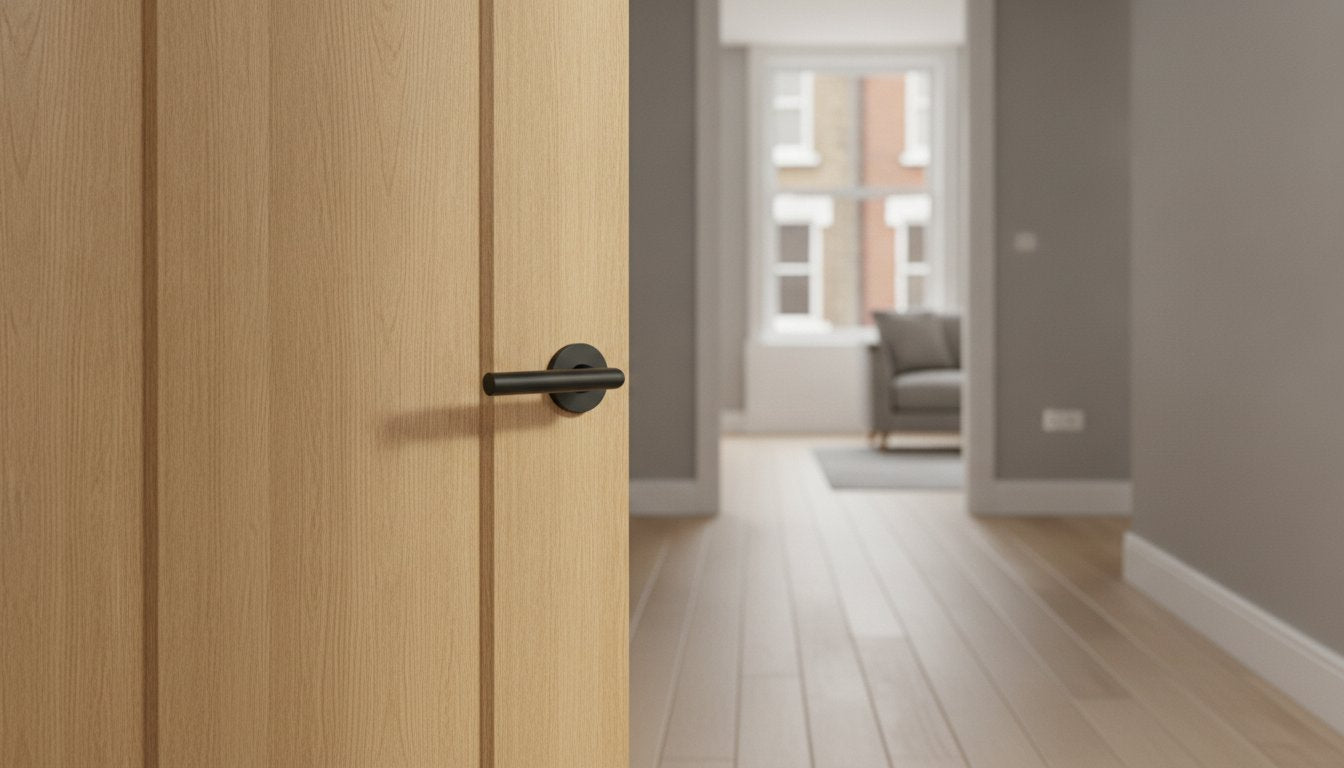
Can a single design element truly bridge the gap between a 19th-century terrace and a contemporary minimalist apartment? In the world of British joinery, the four panel door has achieved exactly that, remaining the undisputed gold standard for homeowners for over 150 years. You likely recognise its balanced geometry and sturdy presence; yet, choosing the right version for your specific renovation often feels more complex than it should.
We understand the challenge of balancing period authenticity with modern performance. It's common to feel uncertain about whether a new door can be safely trimmed to fit an eccentric, aged frame, or which core material will provide the longevity your home deserves. This guide will clarify those technical details, helping you choose between solid timber and engineered cores whilst ensuring your new joinery honours your property's heritage. We will explore the enduring appeal of oak and walnut finishes, provide expert fitting advice, and show why this classic style remains the definitive choice for those who value quality that lasts. From Victorian roots to modern durability, you'll discover everything needed to select a door that fits your home perfectly.
Key Takeaways
- Learn why the four panel door is considered the versatile "chameleon" of British architecture, suited to both Victorian restorations and modern builds.
- Identify the ideal material for your interior by exploring the unique aesthetic and functional benefits of oak, walnut, and white primed timber.
- Master the technical essentials of door replacement, including how to measure for a precise fit and the safe limits for trimming doors to suit older frames.
- Discover the stylistic differences between traditional raised and fielded mouldings and the clean, minimalist lines of contemporary Shaker designs.
- Benefit from the professional insights of a heritage joinery specialist with over 70 years of experience in supplying premium timber products across the UK.
What is a Four Panel Door and Why is it a British Favourite?
A four panel door is defined by its clear architectural layout: four distinct sections, usually arranged in two pairs, recessed or raised within a frame of vertical stiles and horizontal rails. This specific configuration, often called the '2-over-2' design, creates a sense of structural balance that the human eye finds naturally pleasing. It isn't just about aesthetics; the symmetry suggests stability and order, qualities that have made it a staple in British property design for generations. Whether it's a modest rural cottage or a grand Victorian townhouse, this layout provides a reliable visual anchor for any room.
The design's rise to prominence began in earnest during the 19th century. As joinery techniques evolved and mass production became possible, the four panel door replaced more complex Georgian designs as the standard for middle-class homes. It offered a cleaner look that was easier to maintain whilst still providing the depth and character expected of quality timber work. Today, it remains a British favourite because it respects these historical roots without feeling dated or out of place in a modern setting.
The Evolution of the 4-Panel Design
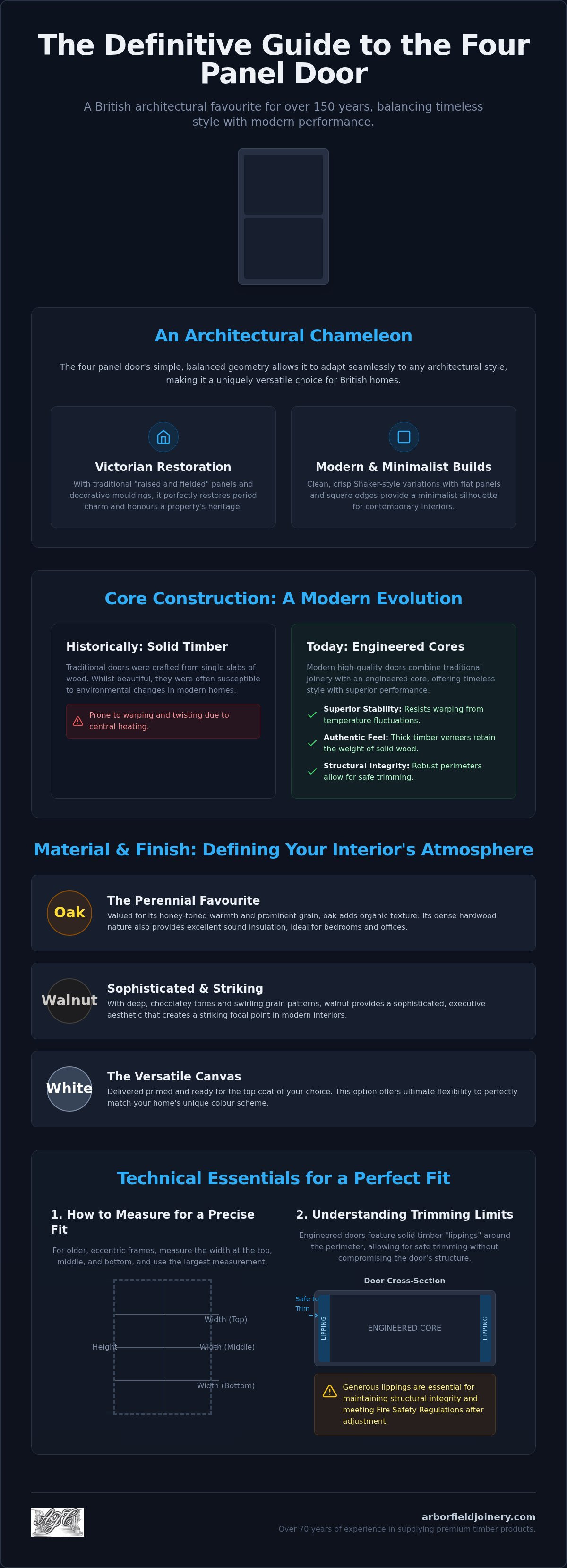
Whilst the basic layout remains constant, the execution has shifted to meet changing tastes. Traditional versions often feature "raised and fielded" panels with decorative mouldings, perfect for restoring period charm. In contrast, modern Shaker styles utilise flat panels and square edges to create a crisp, minimalist silhouette. This adaptability allows the four panel door to transition seamlessly from a rustic "modern farmhouse" kitchen to a sleek, contemporary hallway. It is a design that evolves with the home, proving its status as a true architectural chameleon.
Solid Timber vs. Engineered Cores
Modern performance requirements have changed how these doors are built. Historically, doors were crafted from single slabs of solid wood, which were prone to warping as homes adopted central heating. Today, most high-quality options use an engineered core. These semi-solid or solid-engineered centres provide several advantages:
- Superior Stability: They resist the warping and twisting caused by fluctuating household temperatures.
- Authentic Feel: Thick timber veneers ensure the door retains the weight and texture of solid wood.
- Structural Integrity: Robust stiles and timber perimeters allow for precise trimming to fit older frames.
This construction protects against the seasonal expansion and contraction that often plagues older properties. By combining traditional joinery patterns with modern engineering, these doors offer the best of both worlds: timeless style and enduring durability.
Choosing the Right Material and Finish for Your Interior
Selecting a four panel door involves more than just picking a design; the material you choose dictates the atmosphere of your entire home. Oak remains the perennial favourite for British interiors, valued for its honey-toned warmth and prominent grain patterns that add organic texture to any space. It's a versatile choice that feels equally appropriate in a rustic cottage or a formal dining room. Because oak is a dense hardwood, it also provides excellent sound insulation, making it a practical choice for bedrooms and home offices where peace is a priority.
Oak and Walnut: The Luxury of Natural Wood
Whilst oak offers traditional charm, walnut provides a sophisticated alternative for those seeking a more executive aesthetic. Its deep, chocolatey tones and swirling grain patterns create a striking focal point, particularly in modern or minimalist interiors. When you're selecting these premium woods, look for high-quality veneers backed by solid timber lippings. These lippings are crucial because they allow for the necessary trimming to accommodate the Fire Safety Regulations often required in multi-storey renovations. A generous lipping ensures the door's structural integrity remains intact even after adjustment.
For areas prone to heavy use, such as playrooms or busy utility spaces, you might consider laminate internal doors. These offer incredible durability and a consistent finish that resists the knocks and scrapes of daily life without the need for regular oiling or staining. They're a modern solution for homeowners who want the look of timber with significantly lower maintenance requirements.
Pre-Finished vs. Primed Doors
The final decision often comes down to timing and customisation. Factory pre-finished doors arrive with a professional-grade lacquer already applied, meaning they are ready to hang immediately. This is the ultimate convenience for busy households, as it eliminates the mess and odour of on-site painting. However, if you have your heart set on a specific shade from Farrow & Ball or Little Greene, white primed doors are your best option. They provide a smooth, neutral "blank canvas" that ensures your chosen paint adheres perfectly and looks vibrant.
Some homeowners prefer "Ready to Finish" timber, which allows for bespoke oiling or staining on-site. This is ideal if you're trying to match new joinery with existing heritage features or unique floorboards. If you're unsure which material best suits your project, exploring our full range of Oak Doors can help you visualise how different textures and tones will interact with your home's lighting and decor.
Style Variations: From Traditional Moulded to Modern Shaker
The four panel door is often praised for its versatility, but how do you choose the specific profile that suits your home's architecture? The secret lies in the fine detailing. Small changes in the moulding or the depth of the panels dramatically alter how light and shadow interact with the door's surface. A bevelled edge catches the morning sun differently than a sharp, square profile, creating a more dynamic visual experience in hallways where natural light might be limited. Understanding these nuances is key to curating a space that feels intentional and cohesive.
Traditional Raised and Fielded Styles
If you're restoring a period property, the "raised and fielded" design is likely your primary choice. This style features panels that are thicker in the centre and taper towards the edges, creating a three-dimensional effect that adds immediate "gravitas" and depth to a room. It remains the hallmark of Victorian and Georgian elegance, offering a sense of history that flat designs simply cannot replicate. To achieve a truly professional result, we recommend matching these doors with traditional internal doors and door frames. This ensures that the mouldings and architraves align perfectly, preventing the jarring visual clash that occurs when new joinery meets original heritage features.
Modern Shaker and Smooth Finishes
For those favouring a "modern farmhouse" or Scandi-inspired interior, the Shaker-style four panel door is the definitive option. These doors swap ornate, curved mouldings for clean lines and flat panels. The rise of the "Smooth 4-Panel" finish has been driven by a desire for sleek, uncluttered surfaces that are exceptionally easy to clean. These designs provide a quiet elegance that doesn't compete with bold wall colours or busy wallpaper. Pairing these smooth finishes with modern hardware, such as matte black handles or brushed chrome hinges, creates a striking contemporary contrast. It's a design that feels fresh whilst respecting the classic structural balance homeowners have loved for decades.
What if you need to brighten a dark corridor without losing this iconic look? Glazed variations allow you to incorporate toughened glass whilst maintaining the four-panel aesthetic. By replacing the top two timber panels with clear or frosted glass, you can share light between rooms whilst keeping the privacy and sound insulation of the solid lower panels. This hybrid approach is particularly effective in kitchens or home offices, where visibility and light are just as important as style. Whether you choose the deep shadows of a traditional moulding or the crisp edges of a Shaker design, the four panel door adapts to your vision.
Technical Considerations: Measuring, Trimming, and Fire Safety
Standard UK door sizes are generally split into two camps: Metric and Imperial. Imperial sizes, usually 1981mm (6'6") high, are the most common found in older British homes. Newer builds often utilise the Metric standard of 2040mm. Before ordering, always measure the height and width of your existing frame in three places: the top, middle, and bottom. Use the largest measurement to choose your size, but check the frame's squareness by measuring diagonally from corner to corner. If the diagonals don't match, you'll need to account for extra trimming to ensure a flush fit.
Size and Trimming Guidance
Trimming is where many DIY projects encounter difficulty. Most quality four panel door designs feature a timber lipping around the perimeter of the engineered core. This lipping allows you to plane the edges to suit the specific quirks of your home. However, you must verify the thickness of this lipping before you begin work. Many standard doors allow for approximately 6mm to 10mm of trimming from each side. Exceeding this limit can compromise the door's structural integrity or expose the inner core. Amongst period properties, frames are rarely perfectly square, so a steady hand and a sharp plane are essential for achieving that satisfying "clunk" when the door closes.
Fire Rated 4-Panel Doors
Safety requirements don't have to mean sacrificing your home's aesthetic. Fire-rated versions of the four panel door are typically 44mm thick (FD30) compared to the standard 35mm. These are legally required in specific areas, such as doors leading to an integral garage or in multi-storey homes where a room opens onto a protected stairwell. You'll need to pair these with fire-rated frames and intumescent strips that expand when heated to seal any gaps. It's a technical necessity that ensures your household remains protected whilst maintaining a consistent style across all floors of your property.
A successful renovation looks at the hallway as a complete environment rather than a collection of separate parts. Your choice of door should complement your stairs and balustrades. If you've opted for oak doors, matching the timber species on your handrails and spindles creates a powerful sense of architectural continuity. This holistic approach is what separates a basic upgrade from a high-end home improvement project. If you're ready to transform your home with expert-approved joinery, browse our full collection of internal doors today to find your perfect match.
Why Source Your Four Panel Doors from Arborfield Joinery?
Choosing the right supplier is as vital as choosing the door itself. Arborfield Joinery has been a steady hand in the industry since 1953, operating as a family-run business with a deep-rooted pride in craftsmanship. We don't just sell timber products; we act as a knowledgeable consultant for every customer. Whether you are a trade professional or a homeowner embarking on your first renovation, our seven decades of experience ensure you receive expert guidance that is both empathetic and authoritative. We treat every order with the same care we would give to our own family projects.
Craftsmanship and Sustainability
As a "Trustworthy Veteran" of the UK joinery market, we have seen styles evolve and materials change, yet our commitment to quality remains constant. We carefully curate our collection to ensure every four panel door we supply meets our rigorous standards for durability and visual appeal. This means sourcing the finest oak, walnut, and timber materials from sustainable forests. We believe that a greener home improvement journey shouldn't come at the expense of performance. By focusing on sustainable sourcing and robust construction, we provide joinery that is truly built to last. This approach reduces the need for future replacements whilst honouring the natural beauty of the wood.
Seamless National Service
Managing a home renovation involves many moving parts, which is why we've refined our logistics to be as stress-free as possible. We offer national mainland UK shipping, ensuring that premium joinery is accessible whether you're in a busy city centre or a rural village. To help you manage project costs effectively, we provide free delivery on all orders over £900. Every four panel door is handled with the utmost care, organised and packed to ensure it arrives at your doorstep in pristine condition.
We aren't just a retailer; we're your partner in creating a home that reflects your personal style and values. Our team is always on hand to explain the finer details of material quality or to help you understand the technical requirements for a perfect fit. When you're ready to enhance your home with a design that bridges heritage and modern performance, Browse our full range of internal four panel doors today.
Elevate Your Interior with Timeless Design
The four panel door remains an enduring symbol of British architectural balance, offering a versatile solution that respects the past whilst embracing modern performance. Whether you're carefully restoring a Victorian terrace or curating a contemporary living space, your choice of material and profile will define the character of your home for years to come. By prioritising technical precision in your measurements and selecting premium timber finishes, you ensure that your new joinery provides both aesthetic beauty and long-term durability.
Since 1953, we've helped homeowners and trade professionals manage the complexities of joinery with confidence. Quality timber is an investment. Our 5-star rated customer service and national support network mean you're never alone in your renovation journey. We also offer free UK mainland delivery on orders over £900 to ensure your products arrive in pristine condition. Discover our premium range of four panel doors and transform your home today. We look forward to helping you curate your ideal living space.
Frequently Asked Questions
What is the difference between a moulded and a Shaker four panel door?
A moulded four panel door features decorative, curved edges and raised panels, making it the perfect choice for Victorian restorations. In contrast, a Shaker door utilises flat panels and square edges for a cleaner, minimalist aesthetic. Whilst the basic structural layout is the same, the visual impact is very different; moulded designs create deep shadows and traditional charm, whereas Shaker profiles complement contemporary or "modern farmhouse" interiors with their crisp, simple lines.
Can I trim a four panel door to fit my non-standard frame?
Typically, a four panel door from our collection provides enough timber lipping to allow for a 6mm to 10mm reduction on each edge. This is usually sufficient to accommodate the slightly out-of-square frames often found in older British properties. If you plane beyond this lipping, you risk exposing the engineered core and compromising the door's stability. Always measure your frame at the top, middle, and bottom before you start work to ensure a precise fit.
Do four panel doors come with a fire-rated option?
Yes, we supply fire-rated versions of this style that meet FD30 standards. These doors are 44mm thick, which is slightly deeper than the standard 35mm internal door, providing thirty minutes of protection. They are legally required in specific domestic settings, such as doors between a house and an integral garage or in homes with three or more storeys. Pairing them with intumescent strips ensures your renovation remains safe and fully compliant with current regulations.
Should I choose oak or white primed for my four panel doors?
Your choice depends entirely on your desired finish. Oak is the definitive choice for those who appreciate natural grain patterns and organic warmth; it's a premium hardwood that adds immediate character to any room. White primed doors are better if you want a specific paint colour to match your walls or skirting. They offer a smooth, neutral surface that saves you time on preparation, acting as an ideal base for high-end decorative paints from brands like Farrow & Ball.
Are four panel doors suitable for modern new-build homes?
Absolutely. Whilst the design has heritage roots, the clean symmetry of this layout works exceptionally well in modern new-builds. Shaker variations, in particular, provide a sleek silhouette that doesn't overwhelm smaller rooms. Using white primed or urban grey finishes can make these doors feel incredibly current. They offer a more robust, high-quality alternative to the basic hollow-core doors often installed by developers, adding lasting value and better sound insulation to your home environment.
Do your four panel doors come with the glass already installed?
Our glazed doors are supplied with toughened safety glass already securely installed. This ensures the unit is perfectly sealed and meets all relevant safety standards before it reaches your doorstep. You won't need to worry about sourcing or fitting glass separately, which simplifies the installation process significantly. Whether you choose clear glass to share light between rooms or frosted glass for privacy, the door arrives ready for hanging and finishing according to your project requirements.
What size four panel door do I need for a standard UK doorway?
The most common size for a standard UK internal doorway is 1981mm high by 762mm wide, often referred to as a 2'6" door. However, older properties frequently have narrower openings, whilst modern new-builds might use metric sizes like 2040mm by 726mm or 826mm. It's vital to measure your existing frame rather than the old door itself. We stock a wide range of both metric and imperial sizes to ensure you find a suitable match for your home.
How do I maintain my oak four panel door to ensure it lasts?
To keep your oak door looking its best, we recommend finishing it with a high-quality oil, wax, or lacquer. This protects the timber from moisture and prevents it from drying out in centrally heated homes. Avoid using water-based paints on oak, as these can cause the grain to rise. A light dusting and an occasional wipe with a soft, dry cloth will maintain the wood's natural lustre and ensure your joinery lasts for generations, as we have seen since 1953.
Share:
Crittall Style Doors: The 2026 Buyer’s Guide to Industrial Elegance
Premium Timber Entrance Doors: A 2026 Buyer's Guide