
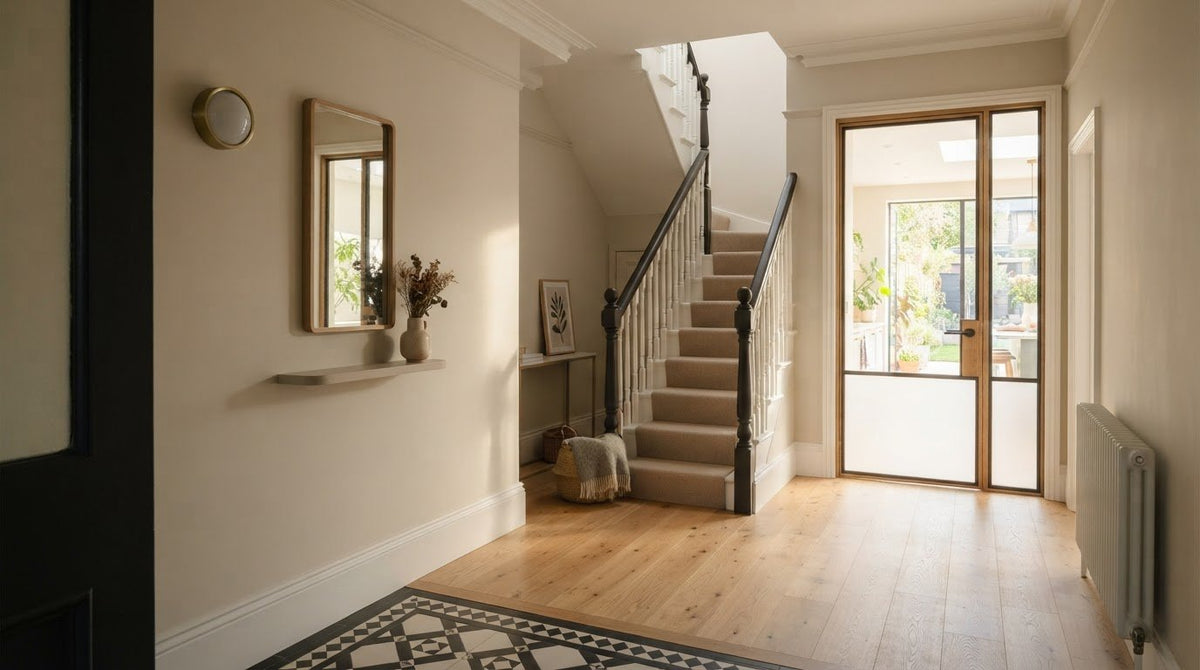
If your hallway feels gloomy even in the middle of the day, you may be wondering how to get more natural light in a dark hallway, especially if it has no window. The cause may not be the hallway alone: daylight could be blocked before it reaches the space, or the layout may not give it a clear route through the home. Looking beyond the hallway can reveal practical ways to make better use of the light you already have.
You don’t necessarily need to begin with major building work. Clearing an obstruction or changing a finish may help, while glazed internal doors can share daylight from brighter adjoining rooms. The right approach depends on where light enters, what stands in its way and how much privacy you need.
This guide explains how to identify why a hallway feels dark and compare practical options, from small adjustments and glazed joinery to a new opening where the home’s layout allows. Treat the hallway as part of a daylight route through your home, then choose changes that suit the way you use the space.
Key Takeaways
- To work out how to get more natural light in a dark hallway, trace where daylight enters and identify what may be blocking its path.
- Clear sightlines and moveable obstructions before considering more involved changes.
- Compare glazed doors, lighter finishes, mirrors and new openings by their likely contribution, privacy and level of disruption.
- Test paint samples in the hallway’s own light before settling on a colour or finish.
- Choose joinery to suit the hallway’s layout and privacy needs, so any changes support a genuine route for daylight.
How to Get More Natural Light in a Dark Hallway: Start by Finding the Cause
A hallway can feel gloomy even when the rooms beside it are bright. Before changing doors or considering a new opening, work out whether the problem is a lack of daylight or whether light is being absorbed, blocked or visually obscured. The distinction matters: a dark paint colour can make a hallway feel less bright, but it won’t explain a corner that receives no daylight at all.
An internal hallway needs a route from a natural source, such as a window, a glazed door or another suitable opening. Borrowed daylight is natural light shared from a brighter space into a room that has little or no direct daylight of its own. This is one principle within daylighting, the broader practice of making considered use of natural light indoors.
Audit the hallway at different times of day
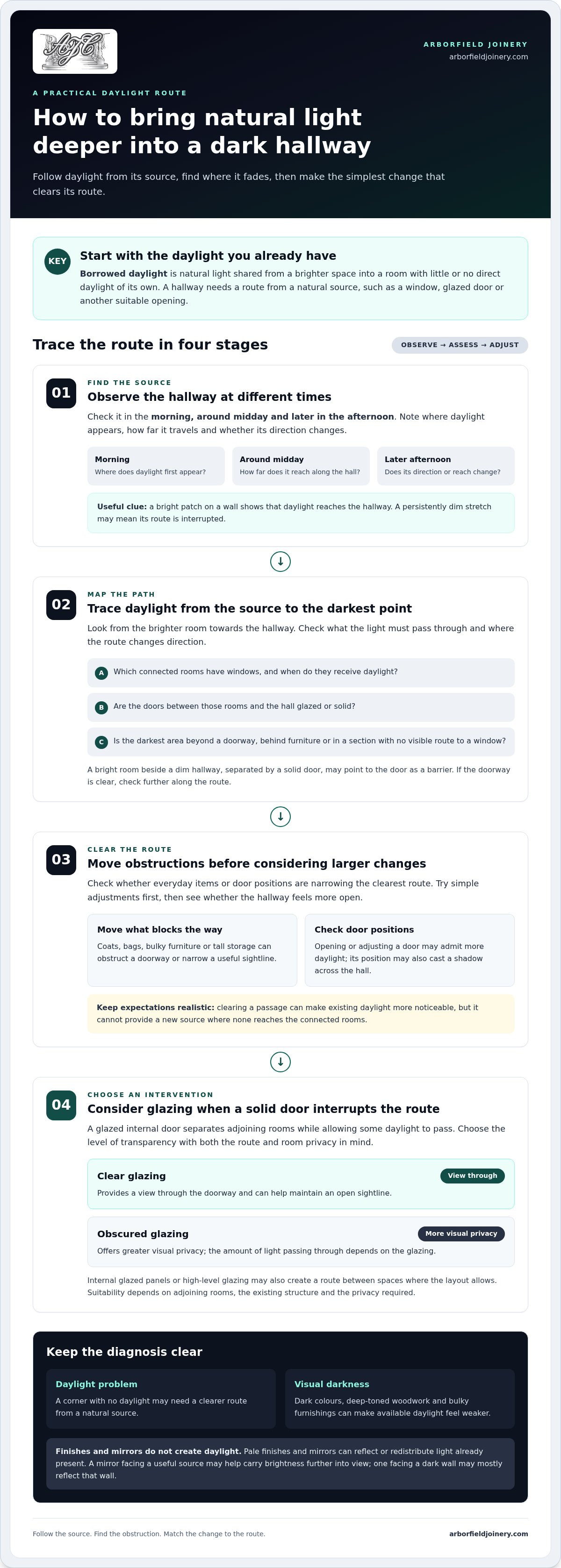
Observe the hall in the morning, around midday and later in the afternoon. Note where daylight appears, how far it travels and whether its direction changes. A bright patch on one wall shows that light reaches the hallway; a persistently dim stretch may indicate that its route is interrupted.
Make a simple note of what you see, then check:
- Which connected rooms have windows, and when do they receive daylight?
- Do the doors between those rooms and the hallway have glazed panels, or are they solid?
- Are furniture, coats, bags or other everyday belongings narrowing the clearest route?
- Does opening a door admit more daylight, or does its position cast a shadow across the hall?
These observations help you identify both a possible source and the path between it and the darkest area. For example, if a bright room sits beside a dim hallway but a solid door separates them, the door may be a more relevant barrier than the hallway’s finishes. If the doorway is already clear, look further along the route for another obstruction.
Separate daylight problems from visual darkness
Dark wall colours, deep-toned woodwork and bulky furnishings can make a modest amount of daylight feel weaker. They don’t necessarily mean the hallway receives no natural light; they can reduce the sense of brightness by absorbing light or covering surfaces where it could spread. Clutter can also interrupt sightlines, making a hall feel closed in even when daylight enters from an adjoining room.
Mirrors and pale finishes can reflect or redistribute light already present, but neither creates daylight. Position matters: a mirror facing a useful source may help carry brightness further into view, while one facing a dark wall may mostly reflect that wall. Before choosing an intervention, stand at each end of the hallway and identify its darkest point. Is it beyond a doorway, behind furniture or in a section with no visible route to a window? That diagnosis gives you a practical starting point.
How to Bring Natural Light Deeper into a Dark Hallway
Once you’ve identified where daylight enters and where it fades, follow its path through the home. The useful question isn’t only how to get more natural light in a dark hallway, but how to let available daylight travel further. Work through the route in order, making simple changes first and considering joinery where it can improve a real path for light.
- Locate the source. Identify windows or other openings in rooms connected to the hall, and note which spaces are brightest during the day.
- Trace the route. Look from the source towards the hallway. Check which doorways, partitions or changes in direction the light must pass through.
- Remove obstructions. Move coats, bulky furniture or tall storage if they block a doorway or narrow a useful sightline. Try adjusting door positions too.
- Consider joinery changes. If a solid internal door interrupts the route, a glazed alternative may allow light to pass between the brighter room and the hall.
This process can show whether a simple adjustment may help or whether the building layout interrupts the route. Clearing a passage can make existing daylight more noticeable, but it can’t provide a new source where none reaches the connected rooms.
Use glazed doors to share daylight between rooms
A glazed internal door separates adjoining rooms while allowing some daylight to pass between them. Clear glazing provides a view through the doorway and can help maintain an open sightline. Obscured glazing offers greater visual privacy, though the amount of light passing through depends on the glazing. Consider how each room is used: a door beside a living space may suit a different level of transparency from one serving a private room. For guidance on door choices and frames, explore this guide to internal doors and door frames.
Where the layout allows, internal glazed panels or high-level glazing may also provide a route for daylight between spaces. Their suitability depends on the position of adjoining rooms, the existing structure and the privacy required. Consider what can be seen from the hallway as well as how light might travel through. A brighter route should still feel comfortable for everyone using the rooms.
Keep the daylight route open
Before choosing a larger change, look again at the whole route from window to hallway. A tall cupboard near a doorway, a chair placed across the line of sight or a door positioned to cast a shadow may limit the effect of existing daylight. Moving removable items is a straightforward way to see whether the hall feels more open.
Open sightlines can make shared daylight more noticeable along the hallway, particularly where several connected doorways align. If the route remains dim because there’s no source nearby, however, rearranging the space won’t solve the underlying lack of daylight. Consider whether glazed joinery or a suitable new opening fits the layout. If a glazed door could suit the route you’ve identified, explore glazed internal doors.
Which Hallway Changes Help Most: Glazing, Finishes or a New Opening?
The best improvement depends on what you found along the daylight route. A glazed door may let light from a bright adjoining room into the hall, while lighter finishes and mirrors can make existing light feel more noticeable. A new window or rooflight may introduce daylight where there is no useful source, but involves a more substantial building change and depends on the home’s layout.
Glazing and new openings can change daylight access; pale finishes and mirrors reflect light already present, while artificial lighting illuminates the hall without adding daylight. Use the comparison below to weigh up the likely role of each option before choosing a change.
| Option | Daylight contribution | Disruption | Privacy | Building changes? |
|---|---|---|---|---|
| Glazed internal door | Can share light from a brighter adjoining room | Moderate, as a door is replaced | Depends on glazing and room use | Changes the route between rooms, without necessarily creating a new source |
| Brighter finishes | Can make existing daylight feel more present | Low to moderate, depending on preparation | Little effect on privacy | No structural change |
| Mirror | Reflects light already reaching the hall | Low | Little effect on privacy | No structural change |
| New window or rooflight | Can introduce daylight through a new opening | Higher, as building work is involved | Depends on position and glazing | Yes |
Choose a low-disruption change or a larger renovation
Start with reversible, lower-disruption improvements: clear visual clutter, try a lighter finish or reposition a mirror to reflect a real source. These changes may improve the hall’s perceived brightness, but they won’t bring daylight into a space that has no route to it. Replacing a solid internal door with a glazed option is a more direct way to change that route, provided a brighter room sits beyond it.
A new window or rooflight may be worth considering where the home’s layout offers a suitable position, but it isn’t a universal quick fix. The work, practical constraints and relationship to surrounding rooms all matter. Match the scale of the intervention to the cause, rather than choosing the most extensive change by default.
Balance brightness with privacy and character
Clear glazing connects adjoining spaces visually as well as allowing light to pass; obscured glazing can soften views where privacy matters. Consider who uses the rooms beside the hall and whether an open sightline feels comfortable. The door’s material and appearance matter too: an internal oak door can bring warmth and character, as explored in this guide to internal oak doors.
For a considered daylight plan, choose the change that addresses the actual barrier, then weigh brightness against the way you want the hallway and adjoining rooms to feel. Explore glazed internal doors as one option for sharing light between connected spaces.
A Practical Plan for Making a Dark Hallway Feel Brighter
A staged approach lets you test simple improvements before committing to more involved work. Start by observing the hallway in daylight, then address the clearest obstacle before deciding whether a joinery change or structural alteration makes sense. This helps you judge how to get more natural light in a dark hallway without mistaking a brighter-looking finish for a new source of daylight.
- Record what you notice. At different times of day, note where daylight enters, where it fades and which parts of the hallway remain dim.
- Check the route. Look for doors, tall furniture or stored belongings that interrupt the path between a window and the hall.
- Try reversible changes. Move removable obstructions and see whether adjusting a door position makes a difference before altering the room.
- Test finishes in place. Paint a sample on the hallway wall and observe it in the light the space actually receives. A colour that looks bright elsewhere may feel different in a shaded corridor.
- Choose an intervention. If the route remains blocked, consider whether glazed joinery or a suitable new opening fits the layout, privacy needs and wider plans for the home.
Prioritise changes by impact and disruption
List possible changes from easiest to most involved, then prioritise the one that addresses the blocked daylight route. Decorative adjustments may help the hall feel lighter, but won’t overcome a solid barrier between the space and its only useful source. Weigh each idea against the hallway’s everyday use: doors need to open comfortably, circulation should remain clear, and added visibility must suit the household’s privacy needs.
Review windows where the hallway has an external wall
If the hallway has an appropriate external wall, a window may provide a direct route for daylight. Its contribution will depend on its position and size, as well as nearby obstructions that could limit the light reaching it. A timber window is one joinery option to consider within a wider daylight plan; this guide to timber windows offers further context on the material and its qualities.
Structural changes, such as creating a new window or rooflight, are best considered as part of wider renovation planning rather than treated as quick fixes. The position of the opening, the layout and the scale of the work all shape whether it is suitable. If you’re already planning other improvements, consider how a new source of daylight could work alongside them.
Once you’ve assessed daylight opportunities, plan artificial lighting to make the hallway practical after dark and on particularly dull days. It complements a daylight plan, but doesn’t replace natural light. For joinery options that can share light between connected rooms or bring daylight in through an external wall, explore glazed doors and timber windows.
How Glazed Joinery Can Support a Brighter Hallway
Joinery can help when it improves a genuine route for daylight. A glazed door won’t brighten a hallway simply because it contains glass: there needs to be a brighter connected room for it to share light from, and the layout must let that light reach the hall. This distinction is useful when deciding how to get more natural light in a dark hallway without expecting one product to solve every cause.
Think of the hallway and the rooms around it as a connected whole. Where does daylight already enter? Which doors or openings separate that source from the hall? What level of privacy do you need? These questions help you judge whether glazed joinery could contribute or whether another part of the daylight route needs attention first.
When glazed internal doors make sense
A glazed internal door is worth considering where a brighter adjoining room can share daylight with the hallway. It keeps the rooms distinct while allowing light through the connection. Clear glazing creates a more open view between spaces; obscured glazing provides greater visual privacy, though the balance between light and screening depends on the particular choice. Consider how the adjoining room is used and whether views into it feel comfortable throughout the day.
Style matters too. A door forms part of the view from the hallway, so its appearance should sit naturally alongside the surrounding woodwork and the character of both rooms. The aim is a considered link, not glazing for its own sake.
Choosing joinery as part of the wider home
Look beyond the hallway when comparing options. A door’s style, the rooms it connects and the position of existing windows all affect how a change may feel within the home. If the hallway has an appropriate external wall, a timber window may offer a direct source of daylight; its contribution will depend on its position, size and any surrounding obstructions.
Arborfield Joinery has supplied doors and windows since 1953, bringing long-standing experience in joinery to choices that form part of a home’s wider design. Glazed doors and timber windows can support a daylight plan, but their contribution depends on the route light can take and the privacy the household needs.
Before settling on a change, picture the view from the hall and from each connected room. A practical choice should work for everyday movement and privacy as well as the home’s style. If you’re considering a new window or another structural opening, treat it as part of the wider project rather than assuming it is a simple adjustment.
Brighter hallways begin with understanding how light moves through the home, then choosing joinery that complements that route. For ideas on doors and windows that may suit your plans, explore Arborfield Joinery.
Make Your Next Step a Considered One
A brighter hallway starts with a clear idea of what you want the space to feel like: more open, more welcoming or simply easier to use during the day. Let that guide your next decision. If you’re exploring how to get more natural light in a dark hallway, focus on the change that fits your home’s layout and everyday needs, rather than choosing joinery on appearance alone.
Seeing different door styles together can help you picture how glazing and finish might sit alongside your existing rooms. Arborfield Joinery’s showroom displays more than 120 doors, offering inspiration as you consider what could complement your home.
Take the next step and explore Arborfield Joinery’s doors and windows for ideas to help plan a thoughtful, welcoming entrance.
Frequently Asked Questions
Do mirrors bring more natural light into a dark hallway?
Mirrors don’t create or bring in daylight, but they can redirect light that already reaches the hall. Position one where it reflects a window or glazed doorway, rather than a blank wall, and consider what it will show from the entrance. A mirror can also make a narrow space feel more open, but if no daylight reaches the hallway, it won’t solve the lack of a natural light source.
Can a skylight brighten a hallway without windows?
Yes, a skylight or rooflight can provide a direct source of daylight in a hallway without a window, if the roof and layout allow for one. Its effect will depend on where it is positioned and whether light can reach the parts of the hall you want to brighten. As it involves changes to the building, consider it alongside wider renovation plans rather than as a quick decorative adjustment.
Will a north-facing hallway always be dark?
No. A north-facing aspect doesn’t automatically mean a hallway will be dark. The amount of daylight also depends on the size and position of nearby windows, the time of day, the season and anything outside that blocks light. A north-facing room may receive a different quality of daylight from a sun-facing one, so assess the hallway at different times before deciding that its orientation is the only cause.
Do glazed internal doors make a hallway brighter?
They can, if they connect the hallway to a room that receives more daylight. For example, a glazed door between a brighter sitting room and a dim hall may allow some of that light to pass through. The result depends on the layout and glazing, and won’t be the same in every home. If the adjoining room is also dark, changing the door alone is unlikely to make much difference.
What colour is best for a dark hallway?
There’s no single best colour, as the hallway’s existing light and finishes affect how paint appears. Pale shades can help a space feel brighter, but undertones may look different in a shaded corridor than they do on a colour chart. Paint a sample on the wall and view it at different times of day before choosing. Consider the woodwork and flooring too, so the overall palette feels balanced.
Can I make a hallway brighter without structural changes?
Yes. If you’re deciding how to get more natural light in a dark hallway without major work, begin with reversible changes: move tall storage away from doorways, clear the route through connected rooms and try a mirror where it can reflect a daylight source. Testing a lighter paint colour may also improve the sense of brightness. These steps can make better use of existing light, but can’t create a source where none reaches the space.
Are glazed doors suitable for a hallway where privacy matters?
They can be, if you choose glazing that suits the rooms on either side and the level of screening you want. Obscured glazing can reduce clear views between spaces, while the amount of light passing through depends on the specific door. Think about sightlines from both the hallway and the adjoining room, including whether everyday activities are visible. A glazed door should feel comfortable for the household as well as complement the home.
Share:
Is Custom Joinery Good for Period Property Restoration?
Bespoke vs Modular Staircases: Which Fits Your Home