
Table of Contents
- Why Do Warped Timber Doors Happen?
- Why Do Internal Doors Warp More Than You Expect
- How to Store Timber Doors Before Installation
- Best Wood Finish for Exterior Doors to Prevent Warping
- Climate-Specific and Seasonal Maintenance for Warped Timber Doors
- How to Fix a Warped Timber Door That Has Already Bent
- Common Mistakes That Cause Warping (and How to Avoid Them)
- Conclusion
Last Updated: August 8, 2026
Why Do Warped Timber Doors Happen?
Warped timber doors are one of the most common frustrations homeowners face. The root cause is almost always moisture. Wood is hygroscopic, meaning it naturally absorbs and releases moisture from the surrounding air. As it does so, it expands and contracts. When this movement is uneven across a door's surface or through its thickness, the door distorts, that's warpage. The key insight is that warping rarely happens from one bad event; it's the result of cumulative, unmanaged moisture exposure over days, weeks, or months.
The Role of Moisture Content and Hygroscopic Movement
Moisture content is the percentage of water held within timber relative to its dry weight. Kiln-dried timber used in quality door manufacturing is typically brought to 10-14% moisture content for UK climates. When a door is exposed to conditions outside this range, wood fibres swell or shrink at different rates depending on grain direction, density, and surface sealing.
UK homes experience considerable humidity variation by season. A door fitted in summer may face drier conditions in winter when central heating runs continuously, causing the timber to contract. This seasonal movement is normal, but without proper finishing and acclimatisation, it becomes permanent distortion. According to the Timber Research and Development Association's guidance on wood and moisture, maintaining stable ambient temperature and humidity around timber products is one of the most effective ways to prevent structural instability.
Visual Diagnostic Guide: Bowing, Cupping, and Twisting
Identifying the type of warp helps you choose the right fix:
- Bowing: The door curves along its length like a gentle arc. Usually caused by uneven moisture exposure across the face.
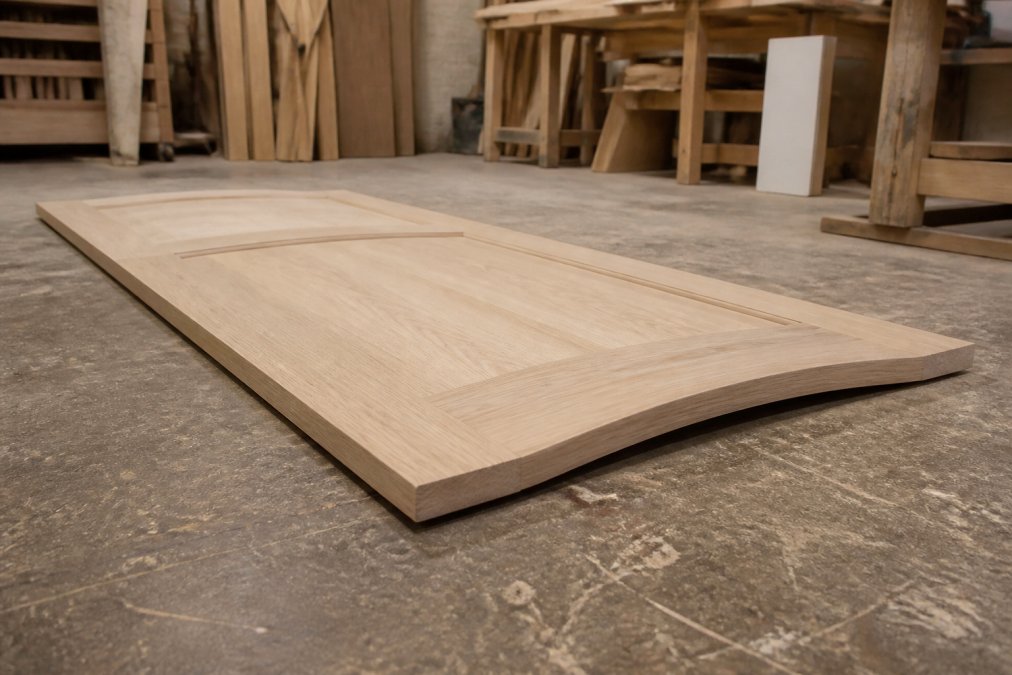
- Cupping: The door curves across its width, with edges higher or lower than the centre. Common when one face dries faster than the other.
- Twisting: The door has diagonal distortion, with opposite corners at different heights. Often caused by uneven support during storage or installation.
Run a straightedge along the door face and across its width to identify the type. Twisting is hardest to correct and may require replacement in severe cases.
Why Do Internal Doors Warp More Than You Expect
Internal doors frequently underperform compared to external doors because they're often underfinished, stored poorly before fitting, and subjected to volatile humidity environments: bathrooms, kitchens, and rooms with inconsistent heating. The result is that internal doors warp at surprisingly high rates.
Door Core Construction and Veneer Stability
Modern internal doors typically fall into three categories:
- Solid timber: Dense and dimensionally stable when properly finished, but highly reactive to large moisture swings if unprotected.
- Engineered or solid core: A timber core with veneer face. Cross-laminated construction resists warping better than solid timber, but veneer delamination can occur if moisture penetrates.
- Hollow core: Lightweight frame with thin skin. Least resistant to moisture and most prone to bowing and cupping.
Veneer stability depends entirely on how well the face and edges are sealed. If the veneer absorbs moisture unevenly, it pulls away from the core or causes cupping.
How to Store Timber Doors Before Installation
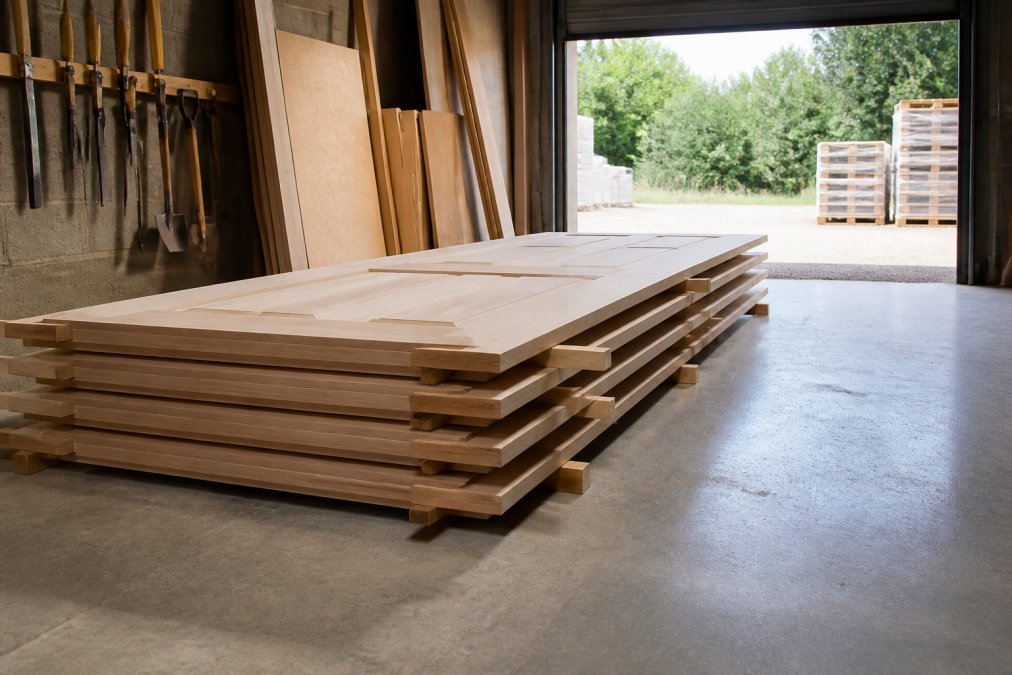
Improper storage is the single biggest preventable cause of warped timber doors. Many doors arrive in perfect condition and warp before hanging, simply because they were left leaning against a wall in a damp garage. Store doors flat, off the ground, and in a stable environment.
Step-by-Step Storage Checklist
- Store horizontally. Lay doors flat on a level surface. Never lean them against a wall. Gravity causes bowing within days.
- Use timber battens. Place at least three evenly spaced battens beneath each door to ensure full support without flex.
- Keep off concrete floors. Concrete draws moisture upward. Raise doors at least 150mm off the ground.
- Stack carefully. Place battens between stacked doors at the same positions to distribute weight evenly.
- Maintain stable conditions. Store in a dry, well-ventilated space with consistent temperature. Avoid garages or outbuildings with large temperature swings.
- Allow acclimatisation. Before installation, bring doors into the room where they'll be fitted for at least 48-72 hours to reach equilibrium with ambient conditions.
- Keep packaging on until fitting. Manufacturer packaging protects against surface moisture. Remove only when ready to work.
Best Wood Finish for Exterior Doors to Prevent Warping
The best wood finish creates a continuous, impermeable barrier across every surface, including top, bottom, and all four edges. Most homeowners finish the face beautifully and leave the top and bottom edges bare, a critical mistake.
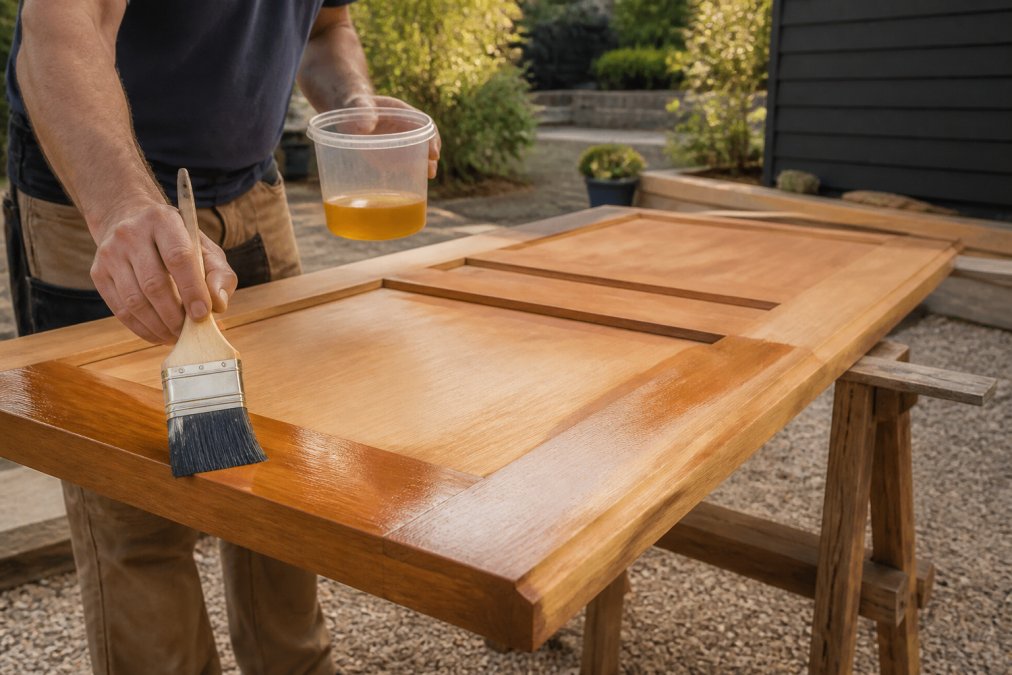
Exterior doors face rain, UV exposure, and temperature extremes. Without adequate finish, moisture penetrates the end grain at the top and bottom, where timber is most absorbent. This causes rapid, uneven expansion and warping.
Sealing Edges, Tops, and Bottoms
Two main finish types suit exterior timber doors in the UK:
Wood oil: Penetrates the timber and nourishes the grain from within. Easier to apply and maintain than varnish, and allows natural movement without cracking. Requires annual reapplication.
Varnish: Forms a hard protective coating. Highly durable and moisture-resistant, but if it cracks, moisture can penetrate beneath and cause lifting. Requires thorough preparation and periodic stripping and recoating.
For most UK homeowners, high-quality exterior wood oil applied in multiple coats is more forgiving. For doors with complex mouldings or glazed panels, varnish may provide better long-term protection if maintained.
Sealing sequence:
- Sand the door to a smooth finish following the grain.
- Apply finish to the top edge, then bottom edge, then side edges.
- Apply to both faces, working in the direction of the grain.
- Allow full cure time between coats as specified by the manufacturer.
- Reapply before the existing finish shows signs of cracking or peeling.
According to the Wood Protection Association's guidance on exterior timber finishes, sealing all six surfaces before and immediately after installation is critical to maintaining timber stability.
Climate-Specific and Seasonal Maintenance for Warped Timber Doors
The UK's climate presents a particular challenge for timber doors. Wet, mild winters followed by dry summers create significant humidity swings. Central heating compounds this by dramatically reducing indoor humidity between October and March.
A maintenance schedule tied to the seasons is most effective:
| Season | Key Risk | Maintenance Action |
|---|---|---|
| Autumn | Humidity rising, heating starting | Check seals, inspect finish for cracks |
| Winter | Low indoor humidity, condensation | Monitor door frame alignment, check for sticking |
| Spring | Humidity rising again | Inspect edges, reapply oil if needed |
| Summer | High outdoor heat and UV | Reapply exterior finish, check glazing seals |
For coastal areas or regions with consistently high rainfall, annual finishing checks are non-negotiable. Salt-laden air accelerates surface finish degradation.
A moisture meter is a worthwhile investment. Checking the door's moisture content periodically, particularly after wet periods, tells you whether the timber is absorbing more water than the finish blocks. Readings consistently above 18-20% in solid timber indicate a finishing problem needing attention before warping sets in.
How to Fix a Warped Timber Door That Has Already Bent
Many warped timber doors can be corrected, particularly if the warp is mild to moderate and the door is solid timber rather than hollow core. Correction takes time and the right approach.
First, identify the warp type using the visual diagnostic guide above. Bowing and cupping are generally correctable. Severe twisting in hollow-core or veneered doors often isn't.
Using a Door Straightener and Clamping Techniques
Door straighteners are purpose-built devices that apply controlled, sustained pressure over days or weeks, gradually persuading timber fibres back toward their original position. They're most effective on solid timber doors with moderate bowing.
For a DIY clamping approach on a bowed door:
- Remove the door from its frame and lay it flat.
- Identify the direction of the bow.
- Place a fulcrum beneath the centre of the bow.
- Apply clamps or weight to the ends to press the bow down toward flat.
- Leave under sustained pressure for 24-72 hours, checking progress regularly.
- Once flat, immediately apply finish to all surfaces to prevent moisture re-entry.
This method works best in a warm, dry environment. Gentle heat can help timber fibres relax and respond more readily.
According to the Building Research Establishment's guidance on timber in construction, sustained mechanical correction combined with moisture management is the most reliable method for addressing moderate warp in solid timber.
For severe warp or engineered or hollow-core doors, replacement is usually more cost-effective. Significant distortion often means the core bond has already failed.
Common Mistakes That Cause Warping (and How to Avoid Them)
Most warped timber doors result from easily avoidable errors:
Finishing only one face. Applying finish to the visible face but leaving the other face, top, and bottom bare creates a moisture imbalance. The door cups toward the unsealed face. Always finish all six surfaces.
Installing before acclimatisation. Fitting a door straight from a cold delivery van into a warm, centrally heated room puts it under immediate moisture stress. Allow 48-72 hours minimum.
Leaving gaps in the frame seal. If the door frame isn't properly sealed where it meets the wall, cold and damp air can circulate behind the architrave and reach the door edge.
Ignoring the top edge. The top edge is frequently left unfinished because it's out of sight, yet it's directly in the path of condensation at ceiling level. Seal it every time.
Using the wrong finish. An interior wood oil used on an exterior door will fail within months in UK conditions. Match the finish specification to the exposure level.
Skipping maintenance. A perfectly finished door at installation won't stay that way indefinitely. Exterior doors need annual inspection and reapplication of protective coating.
The team at Arborfield Joinery, trading since 1953 as the largest independent stockist in the south, regularly advises customers on specification and finishing before purchase, precisely because getting these details right at the start saves significant cost and frustration later.
Warped timber doors are a solvable problem with the right foundations: quality timber, proper storage, thorough finishing across all surfaces, and seasonal maintenance. Arborfield Joinery supplies kiln-dried, premium timber doors alongside expert guidance on specification, finishing, and fitting. Explore the full range of internal and external timber doors, or contact the team directly for advice tailored to your project.
Frequently Asked Questions
How do you prevent wood doors from warping?
Preventing warped timber doors starts before installation. Store doors flat on a level surface in a dry, ventilated space, and allow them to acclimatise to the room's ambient temperature and humidity for at least 48 hours before fitting. Seal all six faces, including the top, bottom, and edges, with a quality wood oil or varnish before hanging. Once installed, maintain consistent indoor humidity levels and inspect the protective coating annually, reapplying as needed.
Does oiling or sealing wood prevent warping?
Yes, sealing timber significantly reduces the risk of warping. Wood is hygroscopic, meaning it absorbs and releases moisture from the surrounding air. Applying a quality wood oil or varnish to all surfaces, including the often-neglected top and bottom edges, creates a protective coating that slows moisture absorption and limits expansion and contraction. Oiling alone offers some protection, but a full varnish or hard-wearing exterior finish provides stronger, longer-lasting moisture resistance, particularly for external doors exposed to the UK's wet climate.
Can you unwarp a wood door once it has bent?
Minor warping in solid timber doors can sometimes be corrected. For slight bowing, a door straightener, which applies sustained pressure across the door using a fulcrum point, can gradually pull the timber back into alignment. Clamping the door flat on a level surface with weight applied over several days also works for mild cases. Severe twisting or cupping in a solid timber door is much harder to reverse and may require professional assessment. Engineered or hollow-core doors with significant warpage usually need replacing.
What causes internal timber doors to warp in UK homes?
Internal doors warp most often because of uneven humidity levels between rooms. In UK homes, this is especially common between heated living spaces and unheated hallways, or near kitchens and bathrooms where steam is generated. Central heating systems lower indoor humidity significantly in winter, causing timber to dry out and shrink on one face faster than the other. Doors that were not properly sealed on all faces before fitting, or that were stored incorrectly on site, are particularly vulnerable to this type of seasonal movement.
This article was written using GrandRanker
Share:
The Homeowner’s How-To Guide: Selecting and Installing a Door and Frame Kit
A Homeowner’s Guide to Internal Folding Systems and Door Hardware