
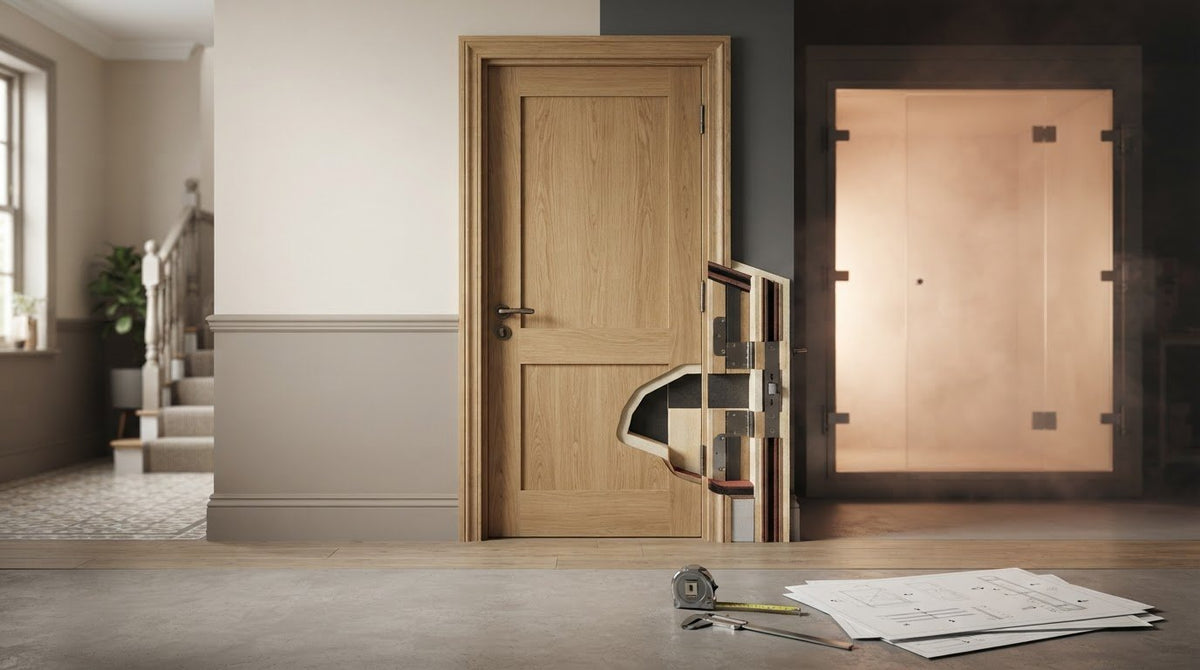
The oak finish may catch your eye, but it can’t tell you whether a fire door is suitable for your opening. With fd30 oak fire doors, the rating and supporting evidence matter just as much as the grain and colour. FD30 indicates that a door has been tested to provide at least 30 minutes of fire resistance under specified conditions. It doesn’t mean every frame, seal or handle will work with it.
It’s understandable to want reassurance that you’re choosing a door that looks right and performs as intended. Check the evidence for the complete assembly rather than relying on the finish or a rating mentioned on its own. The right choice depends on matching the door and compatible components to the opening and its intended use.
In this guide, you’ll learn what FD30 does and doesn’t tell you, which product documents and components to check before ordering, and how to consider fit alongside style. Arborfield Joinery has supplied joinery since 1953. If you’re considering an oak door, confirm current FD30 availability and the applicable supporting documentation before purchasing.
Key Takeaways
- Learn what an FD30 classification tells you, and why it doesn’t automatically make a door suitable for every building or opening.
- When comparing fd30 oak fire doors, look beyond the label to the product evidence and documented limits for dimensions and trimming.
- Check that the leaf, frame, seals and hardware are specified to work together. Don’t assume standard components are interchangeable.
- Before ordering, confirm the requirement, measure the opening and check the specification and supporting documents with a competent professional.
- Ask suppliers which exact model the evidence applies to, which components are compatible and whether the door can be altered. Confirm current availability directly.
What does FD30 mean on an oak fire door?
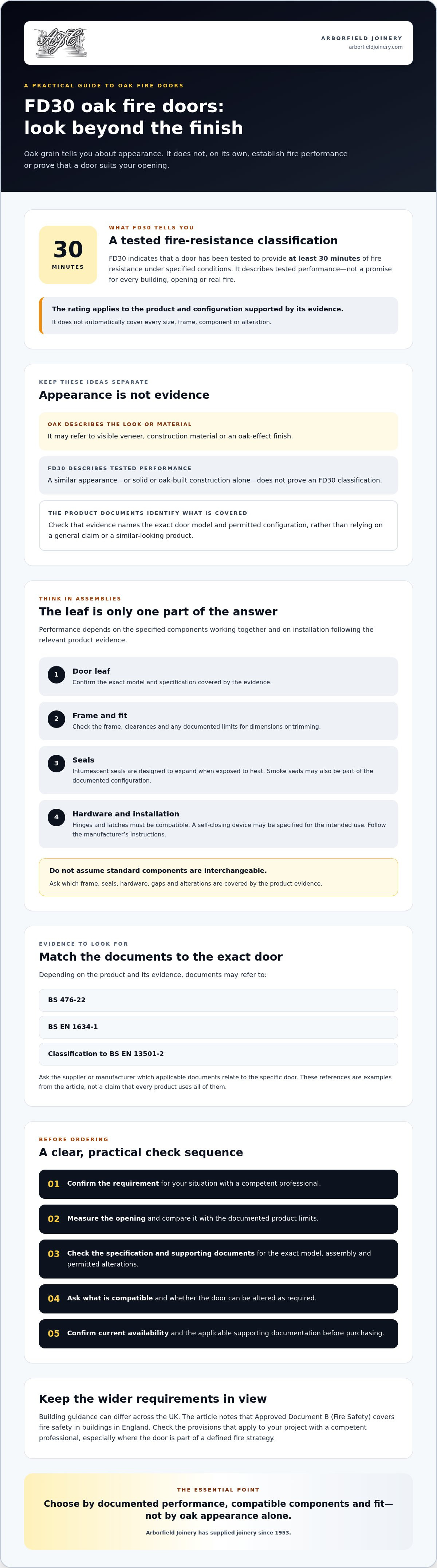
The oak grain may suit your interior beautifully, but appearance can’t confirm how a door performs in a fire. The “FD” in FD30 refers to a fire door classification, while “30” indicates a 30-minute period of fire resistance under specified test conditions. It describes tested performance, not a promise that a door will protect every building or opening for 30 minutes in every real fire.
For fd30 oak fire doors, the rating must relate to the exact door specification and supporting evidence. Check which test or assessment the evidence refers to, and whether the product is classified to the relevant standard. Depending on the evidence and product, documentation may refer to BS 476-22 or BS EN 1634-1, with classification to BS EN 13501-2. Ask the supplier or manufacturer to identify the applicable documents for the specific door, rather than relying on a general statement about fire doors.
What does the 30-minute classification tell you?
In plain English, FD30 describes a door’s tested ability to resist fire, particularly the passage of flames and hot gases, for the stated period under test conditions. Those conditions matter: the result applies to the tested product and configuration, not automatically to every size, frame or alteration. The classification also doesn’t establish that a door is suitable for your building. Confirm the requirements for your situation with a competent professional.
Does an oak finish make a door fire-rated?
No. “Oak” may describe the visible veneer, the material used in a door’s construction or an oak-effect finish. Those descriptions tell you about appearance or materials, not fire performance. Two doors can look almost identical while having different construction and evidence. A veneer or oak-effect surface doesn’t confer an FD30 classification, and solid or oak-built construction alone doesn’t prove one either.
Look for documentation that identifies the exact door model and its permitted configuration. Check that any stated rating applies to that product, not simply to a similar-looking door or a different version. If the evidence covers a complete doorset, it may apply to the leaf, frame and specified components together, rather than to a loose leaf in any frame. A useful introduction to what a fire door is explains its role in passive fire protection, but product-specific manufacturer evidence is what you need to assess a particular purchase.
Think of the leaf as one part of the answer. The complete assembly and its installation must follow the relevant product evidence. A label or attractive oak finish can’t establish that the combination is suitable.
How an FD30 oak fire door assembly works
A fire door’s performance depends on more than the leaf. The door, frame, seals and hardware need to match the product evidence, and the assembly must be installed in accordance with the relevant specification. A door leaf described as FD30 shouldn’t automatically be treated as suitable in any frame or with any set of fittings.
Fire performance depends on the specified assembly, not oak appearance alone. The frame supports the leaf. Intumescent seals are designed to expand when exposed to heat and close gaps. Smoke seals may also form part of the documented configuration. Hinges and latches must be compatible with the door, and a self-closing device may be specified where the intended use requires one. Check the manufacturer’s instructions for the exact components and arrangement rather than choosing replacements by appearance or convenience.
Why the frame, seals and hardware matter
Evidence for a door leaf doesn’t, by itself, prove that the complete installation is suitable. Different frames, seal positions, hardware or clearances can change the assembly from the tested or assessed configuration. Before ordering, ask which frame and components the evidence covers, including any limits on gaps or permitted alterations. Installation should follow the manufacturer’s instructions and the applicable requirements for the building.
Building guidance is part of the wider picture. For England, Approved Document B (Fire Safety) covers fire safety in buildings. Requirements and guidance can differ across the UK. Check which provisions apply to your project with a competent professional, especially if the door is part of a defined fire strategy.
Can an FD30 oak door include glazing?
It can, but the glazing must be covered by evidence for that specific door configuration. Check that the documentation identifies the permitted glass, glazing system and size, as well as the door model it applies to. A similar-looking glazed door isn’t proof that its glass or framing is suitable. Don’t substitute ordinary glass or change an aperture unless the manufacturer’s evidence permits it.
The same principle applies to other apertures and hardware changes. A letter plate, vision panel, additional lock or different hinge may affect the tested configuration. Confirm each proposed feature against the product documentation before buying or altering the door. For fd30 oak fire doors, the details should be traceable to evidence for the precise specification, not inferred from the finish or a general product description.
Arborfield Joinery has supplied doors since 1953 and offers a wide range of oak doors, but current FD30 availability and supporting evidence should be confirmed directly before purchase. You can also explore oak doors while keeping fire performance checks tied to the exact product documentation.
How to compare FD30 oak fire doors without guessing
A shared FD30 label isn’t enough to make two doors equivalent. Compare the evidence and configuration first, then consider finish and dimensions. This helps you work out whether a product suits your opening without assuming that a similar appearance or matching headline rating means the specifications are the same.
Quick checklist: check the product documentation, compatible components and installation instructions before comparing price or appearance.
| What to compare | What to check |
|---|---|
| Evidence | Does the report, assessment or certificate identify the exact model and configuration being offered? |
| Door configuration | Does the evidence cover the leaf alone or a complete doorset, including the specified frame and components? |
| Finish and construction | Is the door described as oak veneer, oak construction or oak-effect, and is that description clear in the product details? |
| Dimensions | Do the documented size range and permitted trimming limits suit your measured opening? |
| Glazing or alterations | Are the proposed glazing, apertures and any changes specifically covered by the product evidence? |
Which product documents should you ask for?
Ask for current documentation that names the exact model, its tested or assessed configuration, and any conditions attached to its use. Check that the instructions identify the compatible frame, seals and hardware, and include glazing details if relevant. Note the report, assessment or classification references, and confirm they apply to the product on your quote, not simply to a related model or generic range.
Oak appearance, glazing and sizing: what can vary?
Supplier descriptions may distinguish veneer, oak construction and oak-effect finishes, but the wording varies. Compare only what each supplier defines, and don’t treat a visual match as evidence of matching construction or fire performance. A glazed option, different finish or bespoke size may have its own limits or configuration, so check each detail against the product documents.
Pay particular attention to size and trimming. A door that appears close to your required dimensions may not be suitable if fitting it would mean cutting beyond its documented limits. Likewise, don’t assume that a glazed version or custom alteration inherits evidence from an unglazed, standard-sized model.
Use the table to compare like for like: the same type of evidence, configuration and intended dimensions. For fd30 oak fire doors, keep a copy of the documentation that supports the specific option you’re considering, and resolve any gaps with the supplier before ordering.
What to check before ordering and fitting an FD30 oak fire door
Before choosing a finish, work through the practical checks in order. That way, you can assess the door against the opening and its intended use rather than judging it by appearance alone.
- Confirm the requirement. Ask a competent professional what fire-door performance and configuration the building needs. Requirements and guidance can differ across England, Wales, Scotland and Northern Ireland, so check the current provisions for the relevant nation and project.
- Measure the opening. Record the opening dimensions and note the existing frame and surrounding details. Check whether the measurement is for the opening or the door leaf, and follow the supplier’s sizing guidance.
- Confirm the specification. Check the exact model, configuration, handing and documented size limits. Make sure any proposed glazing or other features are included in the evidence for that product.
- Check the components. Confirm which frame, seals and hardware are specified for the door. Don’t assume components already in place, or readily available alternatives, are compatible.
- Review the documents. Before ordering, obtain the product evidence and installation instructions. Ensure they relate to the exact door and configuration you intend to use, and keep copies for the project record.
Measure the opening and confirm the intended specification
Measure carefully, then verify the required door size with the supplier and the professional advising on suitability. Handing, frame arrangement, thresholds and surrounding details can affect what is appropriate, so confirm them before placing an order. For a broader overview of styles and frames, see this guide to internal doors and door frames. Use it for general selection advice, not as a substitute for product-specific fire evidence.
Plan fitting, alterations and handover
Arrange for a suitably competent installer to follow the manufacturer’s instructions and the evidence for the specific doorset. Don’t trim, drill or otherwise alter the door unless the documentation expressly allows it. An unapproved change may take it outside the evidenced specification. Keep the product documents alongside installation details and any records needed for future checks.
Arborfield Joinery has supplied oak doors since 1953, but its current FD30-rated oak availability isn’t confirmed here. Before buying, ask about current oak door availability and supporting documentation, and verify that any evidence applies to the exact product you’re considering.
Choosing an FD30 oak fire door supplier and taking the next step
A useful supplier conversation should leave you with details you can verify, not just reassurance that a door is “fire-rated”. Before ordering, ask clear questions about the exact model and the evidence for its intended use. If a supplier can’t identify which documents apply, pause and seek clarification before committing.
Questions to ask before placing an order
- Which exact model is being supplied? Ask whether current evidence supports the required fire performance for that specific oak-finished door and configuration.
- What does the evidence cover? Check whether it applies to the door leaf alone or to a doorset, and request the relevant report, assessment or certificate for verification.
- Which components are specified? Confirm what is included and which frame, seals and hardware are compatible. If the door is glazed, ask for the evidence covering the glass and glazing system too.
- What alterations are permitted? Ask for the documented size range and limits on trimming, drilling or other changes. Don’t assume a modification is acceptable because it seems minor.
- What are the current stock and delivery terms? Confirm availability, delivery arrangements and which product documents will be supplied before placing your order.
Keep the answers with the product paperwork, so the model, specification and evidence remain clear. That matters particularly if you’re comparing fd30 oak fire doors from different suppliers: compare like-for-like configurations, not just similar finishes or headline ratings.
Explore oak doors with the right information in hand
Arborfield Joinery is a family-run UK joinery retailer that has supplied doors, windows and stair components since 1953. Its showroom displays more than 120 doors, offering a broad view of styles and finishes. These are useful points of context when exploring oak doors, but they don’t confirm that a particular product has FD30 evidence.
The guide to internal oak doors can help you consider material and style. Treat it as general oak-door guidance, not proof of fire performance or certification. Current FD30 oak stock isn’t confirmed, so check availability and ask for the applicable documentation for the exact product before ordering.
With that distinction clear, you can explore Arborfield Joinery’s door range and enquire about oak-door options. If fire performance is essential, make the rating evidence and compatible specification part of the conversation from the outset.
Choose with confidence, then make it your own
The right door needs to meet the requirements for its opening and intended use, not simply look the part. For fd30 oak fire doors, check that the evidence applies to the exact model and configuration, and that the frame, seals and hardware match the documented specification. Confirm dimensions and any permitted alterations before ordering, then ensure fitting follows the manufacturer’s instructions.
Arborfield Joinery is a family-run joinery retailer that has supplied doors, windows and stairs since 1953, with more than 120 doors displayed in its showroom. FD30-rated oak availability and supporting documentation aren’t confirmed, so check directly for current stock and product-specific evidence before making a decision.
Explore Arborfield Joinery’s door range and ask about the oak options available. With the right evidence in hand, you can choose a door that suits your interior and is appropriate for your project.
Frequently Asked Questions
What does FD30 mean on a fire door?
FD30 indicates that a fire door has been tested to provide 30 minutes of fire resistance under specified test conditions. The classification relates to the product and configuration covered by the supporting evidence, not every door that looks similar. It isn’t a guarantee of performance in every real-world fire or proof that the door suits every building. Check the exact product documentation and the requirements for its intended use.
Can an oak door be an FD30 fire door?
Yes, an oak-finished or oak-constructed door can be FD30 if evidence supports the exact product and configuration. Oak describes material or appearance, not fire performance by itself. A veneer, oak-effect surface or solid oak appearance cannot establish a rating. For fd30 oak fire doors, ask for documentation identifying the specific model and confirm whether it applies to the door leaf alone or a complete doorset.
Do FD30 fire doors need a special frame and seals?
The frame and seals must be compatible with the fire-door specification. The product evidence or manufacturer’s instructions should identify the relevant frame, intumescent seals and required hardware, such as hinges and latch. Some configurations may also specify smoke seals or a self-closing device. Don’t assume an existing frame or standard components are suitable simply because they fit. Confirm the complete arrangement against the evidence for that door.
Can you trim an FD30 oak fire door to fit?
Only if the manufacturer’s documentation permits trimming, and only within its stated limits. Cutting beyond those allowances, or drilling or altering the leaf without approval, may take the door outside the configuration covered by its evidence. Check the permitted dimensions before ordering and compare them with the measured opening. If the proposed adjustment isn’t clearly covered, ask the supplier or manufacturer and seek advice from a competent professional before proceeding.
Can an FD30 oak fire door have glass?
Yes, provided the specific glazed configuration is supported by appropriate product evidence. Check that the documents cover the exact door model, glass, glazing system and permitted size. A similar-looking glazed door isn’t enough to establish suitability, and ordinary glass shouldn’t be substituted. If you’re considering a different glass size, a new aperture or another change, confirm that the proposed arrangement is expressly permitted by the manufacturer’s documentation.
Who can confirm whether I need an FD30 fire door?
A competent building or fire-safety professional can assess the requirements for your building, opening and intended use. The answer may depend on the building’s layout and fire strategy, and relevant guidance can vary across England, Wales, Scotland and Northern Ireland. Don’t choose a rating based only on a retailer’s general description or another property’s specification. Ask the professional advising on your project which performance and product evidence are appropriate.
What should I check before buying an FD30 oak fire door?
Check the exact model and current evidence for its required performance, then confirm the documented configuration, dimensions and permitted trimming. Ask which frame, seals and hardware are compatible, and verify glazing details if applicable. Review the manufacturer’s installation instructions and clarify stock and delivery terms with the supplier. Keep the relevant documents together, and confirm that the evidence applies to the specific product you intend to order, not merely a similar design.
Share:
Flush Internal Doors: Benefits and Drawbacks
Customisable Timber Windows & Doors: Bespoke Fitting