
Table of Contents
- How to Compare Timber Door Suppliers in 2026
- External Timber Doors: What to Look For and What to Avoid
- Bespoke Timber Doors: When Made-to-Measure Makes Sense
- Timber vs Composite Doors: An Honest Comparison
- Accoya vs Sapele Doors: Which Timber Species Lasts Longer?
- Indicative Prices, Lead Times and After-Sales Support
- Conclusion: Choosing the Right Timber Door Supplier
- Frequently Asked Questions
Last Updated: October 4, 2026
How to Compare Timber Door Suppliers in 2026
Finding the best timber door suppliers UK 2026 has less to do with glossy brochures and more to do with asking the right questions before you pay a deposit. This guide from Arborfield Joinery draws on more than seventy years of supplying doors, windows and staircases to designers, builders and homeowners. Below, we break down the criteria that separate a dependable timber door supplier from one that leaves you chasing replacements.
Selection Criteria That Actually Matter
The most reliable way to judge a timber door supplier is to check four things in order: timber sourcing, manufacturing capability, finishing standards and after-sales support. A supplier that outsources everything can rarely control quality or lead times. One that manufactures in-house, as we do at Arborfield Joinery, can adjust dimensions, species and finishes to suit non-standard openings.
Ask each supplier directly:
- Sourcing: Is the timber responsibly sourced and certified?
- Manufacturing: Do they build bespoke doors themselves or resell?
- Finishing: Is the door supplied finished or unfinished, and who is responsible for sealing it?
- Support: What warranty applies, and who handles a warped or faulty door?
External Timber Doors: What to Look For and What to Avoid
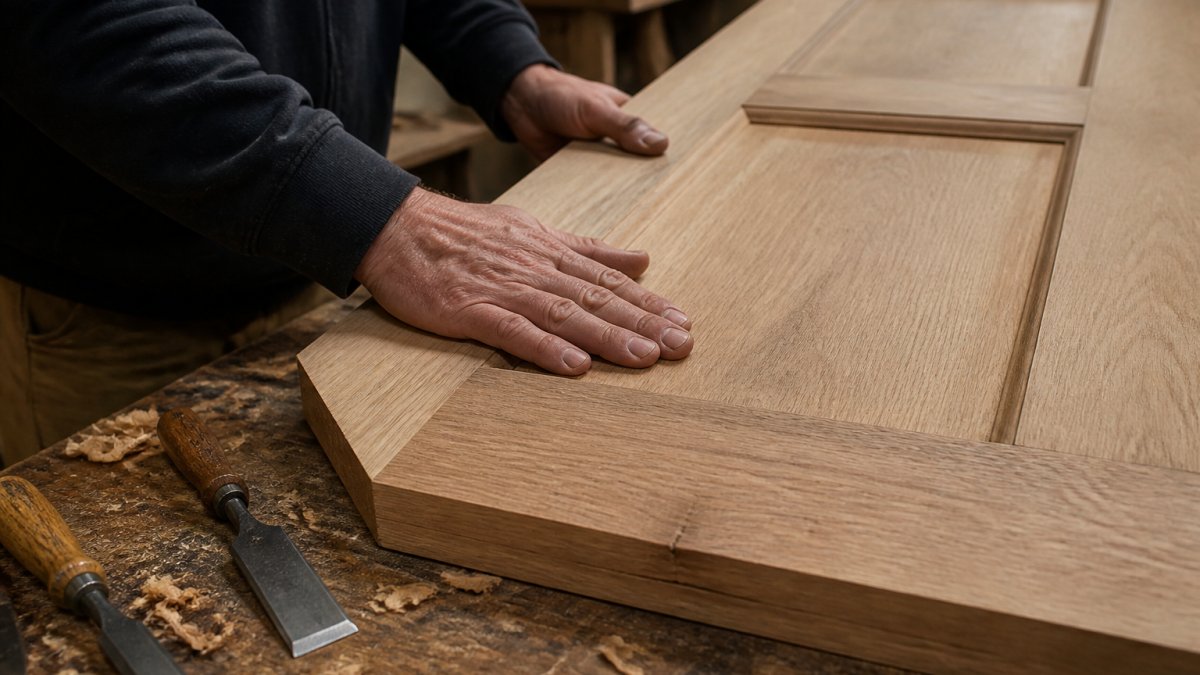
External timber doors need to withstand rain, wind and temperature swings, so weather performance should drive your choice. Look for dowel construction, a solid core and a finish system suited to the exposure of the door's position.
Weather Performance and Finishing Requirements
Every external timber door we supply must be fully finished before installation, and this is not optional. For a garage door such as our Redwood 301 Glazed Garage Door (£498.75), the z-brace reverse adds rigidity, while dowel construction keeps the frame stable over time.

For entrance doors, the Redwood 2XG 1 Panel (£123.15) arrives ready for you to customise with glazing above a square panel. It can be trimmed on site, which matters when an opening is slightly out of square.
Bespoke Timber Doors: When Made-to-Measure Makes Sense
Bespoke timber doors make sense whenever a standard size would leave gaps, require excessive packing or compromise the look of a period property. Victorian terraces, listed buildings and non-standard extensions rarely match stock dimensions.
We manufacture bespoke joinery in-house, so odd window and door openings are routine rather than a problem. For internal projects, a door like the Unfinished Rustic Oak Ledged Internal Door (£172.99) suits rustic and cottage settings, and its braces must be fitted to maintain structural stability.

Timber vs Composite Doors: An Honest Comparison
Timber and composite doors solve different problems, and the right choice depends on your priorities. Timber offers repairability, natural grain and the ability to be refinished over time.
The decision usually comes down to four practical questions: how exposed is the door, how much maintenance will you realistically do, does the opening need bespoke sizing, and how important is a natural grain finish? Answer those honestly and the material choice often makes itself.
How the Two Materials Actually Behave
A composite door is typically a glass-reinforced plastic (GRP) skin bonded to a solid core, often a timber or foam core, with a thermal break and a multi-point locking cassette fitted at the factory.
The trade-off is maintenance. An external timber door needs re-finishing periodically depending on exposure and finish system, whereas a composite door generally needs nothing beyond cleaning. That difference matters most on a south-facing or coastal elevation, where UV and salt spray accelerate weathering.
Performance, Security and Compliance
On thermal performance, both materials can meet current building regulation standards when specified correctly.
On security, the important factor is the locking hardware and the door's resistance to forced entry, not the material alone. Look for a multi-point locking system with a minimum of three locking points, a reinforced strike plate, and cylinders that meet the relevant British Standard for attack resistance.
Cost and Whole-Life Value
Composite doors often look cheaper at the point of purchase, but the comparison is not like-for-like. A composite door usually arrives pre-finished and ready to hang, so the fitted cost is closer to the headline price.
| Factor | Timber Doors | Composite Doors |
|---|---|---|
| Appearance | Natural grain, refinishable | Uniform, factory finish |
| Maintenance | Periodic re-finishing (typically every 2-4 years externally) | Minimal |
| Repairability | Can be sanded, planed and re-coated | Limited; skin damage usually means replacement |
| Bespoke sizing | Fully made-to-measure | Often restricted to a range of sizes |
| Thermal performance | Depends on core, thermal break and sealing | Often good out of the box |
| Security | Depends on lock and hardware specification | Depends on lock and hardware specification |
| Best for | Period and character properties, repairable long-term | Low-maintenance modern builds and rentals |
For heritage properties and anyone who wants a door they can restore rather than replace, timber wins. For a rental or a low-maintenance modern extension, composite has a case. We still recommend timber where longevity and craftsmanship matter most.
Accoya vs Sapele Doors: Which Timber Species Lasts Longer?
Accoya and sapele are both durable choices, but they behave differently. Accoya is an acetylated softwood prized for dimensional stability and resistance to rot, making it a strong pick for exposed external doors.
The honest answer is that species matters less than construction and finishing. A well-built sapele door that is properly finished will outlast a poorly finished Accoya door every time. Match the species to the exposure, then insist on correct finishing.
Indicative Prices, Lead Times and After-Sales Support
Prices vary widely by species, size and specification, so treat any figure as a starting point rather than a final quote. The table below shows indicative door-only prices from our current range, but the number that matters is the total installed cost, which includes delivery, fitting, glazing, hardware and any finishing.
Door-Only Prices vs Total Installed Cost
As a guide, our internal oak doors start at £89.50 for the Belize Oak Unfinished, rising to £159.50 for the Vancouver Oak 5P Solid Internal Door. Fire-rated options sit higher: the Belize Oak FD30/FD60 is £364.50 and the Vancouver Oak 5P FD30/FD60 is £385.00. External and garage doors sit in a different band: the Redwood 301 Glazed Garage Door is £498.75 and the 7'0 Wide Redwood Garage Door is £469.50.

Those are door-only prices. A realistic total installed cost adds:
- Delivery: free mainland shipping on orders over £900; below that, a delivery charge applies.
- Fitting: a joiner's labour, which varies by region and by whether the frame needs altering.
- Finishing: external timber doors must be fully finished before installation, and this is a separate cost if you are not doing it yourself.
- Glazing: if the door is supplied unglazed or you are upgrading to a specific glass specification.
- Hardware: locks, handles, hinges and any security upgrades.
| Product | Door-Only Price | Best For |
|---|---|---|
| Belize Oak Unfinished | £89.50 | Internal, unfinished oak |
| Vancouver Oak 5P Solid Internal Door | £159.50 | Internal, pre-finished |
| Unfinished Rustic Oak Ledged Internal Door | £172.99 | Rustic and cottage interiors |
| Belize Oak FD30/FD60 | £364.50 | Fire-rated internal |
| Vancouver Oak 5P FD30/FD60 | £385.00 | Fire-rated internal |
| Redwood 301 Glazed Garage Door | £498.75 | External garage |
| 7'0 Wide Redwood Garage Door | £469.50 | External garage, wider opening |
Lead Times: Stock vs Bespoke
Lead times depend on whether a door is stock or bespoke. Stock items ship quickly, typically within a few working days once the order is confirmed. Made-to-measure joinery takes longer because it is built to your dimensions, and the lead time starts from the point we have your final measurements and specification, not from the date of enquiry.
A common pattern is that customers underestimate the time needed for bespoke work and then rush the finishing stage. Build the finishing and fitting time into your programme, not just the manufacturing time.
Delivery Coverage and After-Sales Support
We deliver across the mainland, with free shipping on orders over £900. For bespoke or oversized items, delivery is usually a two-person service because the door needs to be handled carefully to avoid damage. If you are outside the mainland or in a remote area, ask for a delivery quote before ordering.
After-sales support is where suppliers are most often judged, and it is worth asking specific questions before you pay a deposit:
- What does the warranty cover? Most timber door warranties cover manufacturing defects, but not damage caused by poor finishing, poor fitting or normal weathering. Ask for the warranty terms in writing.
- Who handles a warped or faulty door? A supplier that manufactures in-house can usually resolve issues faster than one that resells.
- What is the returns process? Bespoke items are often non-returnable, so confirm this before ordering.
- Is there a technical contact? For finishing and fitting queries, a direct line to someone who knows the product is more useful than a general customer service number.
Conclusion: Choosing the Right Timber Door Supplier
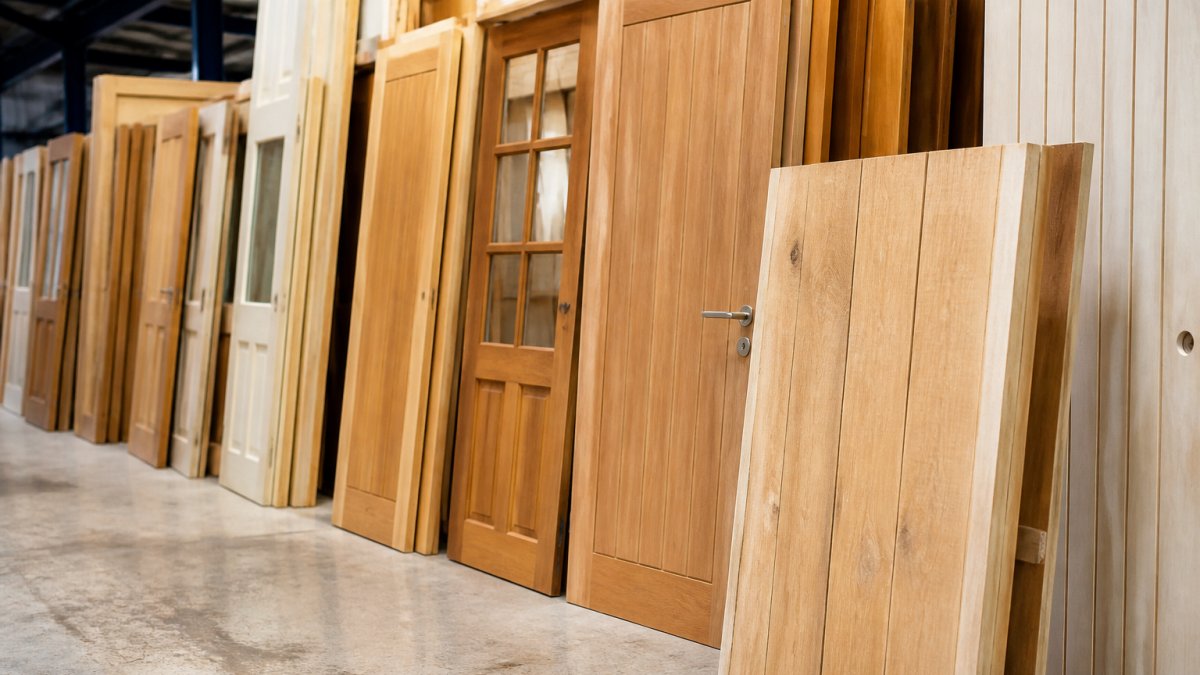
We built Arborfield Joinery on that principle: a family business trading since 1953, with full manufacturing facilities and a huge range of internal and external doors on display. Our customers repeatedly mention accurate measuring, honest advice and products that suit their property.
Frequently Asked Questions
Which is better, Accoya or sapele for external doors?
Accoya is modified wood treated to resist rot and swelling, making it a strong choice for exposed or coastal locations where moisture is a constant concern. Sapele is a dense hardwood with natural durability and a rich reddish-brown tone that takes stain well. Both perform well when finished and maintained correctly. Your choice comes down to budget, appearance preference and how exposed the door will be to wind and rain.
Are bespoke timber doors worth the extra cost?
Bespoke timber doors make sense when standard sizes will not fit, such as period properties with irregular openings, or when you need a specific design to match existing joinery. The cost premium reflects the measuring, design and manufacturing work involved. If your opening is standard and you are happy with an off-the-shelf style, a stock door will save money. For non-standard openings, bespoke avoids the gaps and draughts that come with forcing a standard door into the wrong space.
What should I check before ordering a timber entrance door?
Confirm the exact opening dimensions, including width, height and thickness, and check whether the frame needs replacing too. Ask about the finishing requirements because many external timber doors must be fully finished before installation. Check the warranty terms, lead time and delivery coverage. Also verify whether the supplier offers supply-only or supply and installation, as this affects who handles measuring and fitting.
How do timber doors compare to composite doors?
Composite doors typically offer lower maintenance and consistent thermal performance because of their foam-filled core and GRP skin. Timber doors provide natural appearance, can be repaired and refinished, and suit period properties where composite would look out of place. Timber requires more upkeep, usually re-coating every few years, but it can be sanded back and restored. Composite cannot be repaired in the same way if the surface is damaged.
How long does it take to get a timber door from a supplier?
Lead times vary by supplier and whether the door is stock or bespoke. Stock internal doors are often available for immediate collection or delivery within days. Bespoke external doors and made-to-measure joinery typically take longer because of the design, manufacturing and finishing stages. Always confirm the lead time in writing before ordering, especially if you are working to a renovation schedule with trades booked in.
Choosing a timber door supplier comes down to trust, craftsmanship and support long after delivery. Arborfield Joinery offers bespoke manufacturing, a vast stock range and expert advice on what suits your property, backed by free UK mainland shipping on orders over £900. Get started with Arborfield Joinery and specify timber doors built to last.
Share:
How to Choose Internal Doors for a New Build in 2026
Oak Door Architrave: A Buyer’s Guide to Profiles and Finishes