
Quick Summary
Trickle vents are worth fitting because they supply a steady flow of fresh air through the window frame while it stays shut, which reduces condensation and damp. They are required on new windows under current UK building regulations. They provide background ventilation, not the rapid clearance an opened window gives.
- Trickle vents provide background ventilation, keeping air moving when windows are closed.
- They help reduce condensation and damp when sized correctly for each room.
- Acoustic trickle vents can allow air flow while limiting noise from busy roads or railways.
- Keep vents open in bathrooms, kitchens and bedrooms, where moisture is generated fastest.
- Trickle vents do not fix severe damp, and they cannot replace mechanical extraction in high-moisture rooms.
Table of Contents
- What Trickle Vents Do and How They Work
- Trickle Vents and Condensation: How Continuous Airflow Helps
- The Main Benefits of Trickle Vents for Window Ventilation
- Trickle Vents Pros and Cons: Where They Fall Short
- Heat Loss, Draughts and Seasonal Use
- Trickle Vents Regulations in the UK
- Can You Add Trickle Vents to Existing Windows?
- Getting Trickle Vents Right in Your Next Window Project
- Frequently Asked Questions
Are Trickle Vents Worth Fitting in Your Windows?
Last Updated: November 4, 2026
What Trickle Vents Do and How They Work
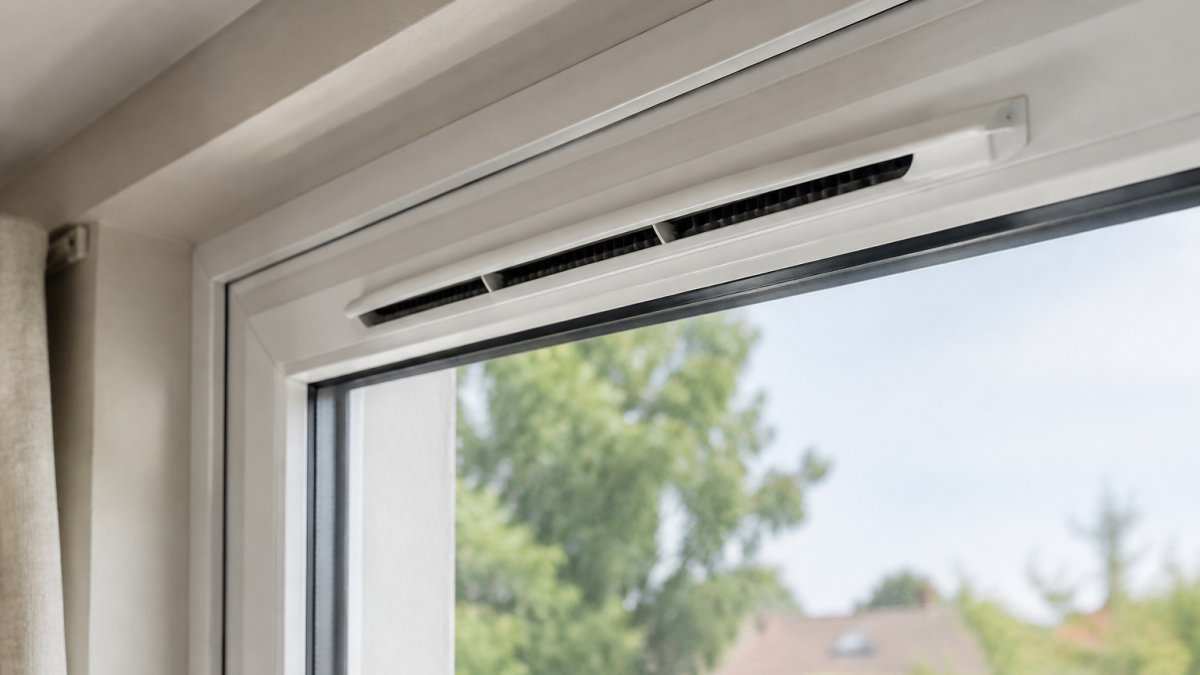
Trickle vents are small, adjustable openings built into the frame of a window, and they let a steady trickle of fresh air into a room without the window ever being opened. Building regulations updated in 2022 require ventilation in newly installed windows and doors to extract excess moisture and contaminated air, which is why you'll find them on almost every new window fitted in the UK today Building Regulations Part F ventilation requirements.
Their purpose is background ventilation. Trickle vents are designed to improve background ventilation, reduce condensation and damp, and help maintain indoor air quality Trickle vent function and background ventilation guide. In other words, they keep air moving even when every window is shut, which is the state most homes spend most of the winter in.
Background ventilation versus purge ventilation
It helps to separate two strategies. Background ventilation is the slow, constant exchange that trickle vents provide. Purge ventilation is the deliberate, short burst you get by opening a window fully for a few minutes, clearing cooking smells or steam quickly.
Trickle vents provide a more manageable quantity of fresh air compared to opening a window, particularly during winter months Comparison of trickle vents and open-window ventilation. The trade-off is simple: you get less air, but you get it all day without the heat loss or security risk of an open casement.
Trickle Vents and Condensation: How Continuous Airflow Helps
Condensation is where trickle vents earn their place. Moist air from showers, cooking and breathing condenses on cold glass and reveals itself as damp patches, peeling paint and, eventually, black mould. A continuous flow of drier air dilutes that moisture before it settles.
This is also where the supporting question of whether trickle vents reduce condensation gets a clear answer: yes, when they are sized and used sensibly. The vents draw in fresh air and let humid air out, so surfaces can stay drier.
The Main Benefits of Trickle Vents for Window Ventilation
The core benefit is consistent airflow that doesn't depend on someone remembering to open a window. That consistency pays off in several ways, and the case for trickle vents is strongest when you look at all of them together, but the benefits only hold if the vents are sized and positioned to suit the room.

Indoor air quality, noise and security
Indoor air quality is the most important of these.
Noise is the second. Acoustic trickle vents are a cost-effective solution for allowing air circulation while preventing noise intrusion Acoustic trickle vent specifications.
Security is the third. Because the window stays closed and locked, a trickle vent lets you ventilate while keeping the home secure, a point that purge ventilation simply cannot match.
Sizing and performance: what the numbers mean
A trickle vent is not a one-size-fits-all product. Its capacity is expressed as an equivalent area, usually in square millimetres or square centimetres, and that figure tells you how much open area the vent provides for airflow.
The correct equivalent area depends on the room's volume, occupancy and moisture load, so sizing should be checked for each room.
Watch out: fitting the same small vent in every room is one of the most common mistakes, a bathroom with a high moisture load may need a larger vent or an additional one, and undersizing is a frequent reason condensation persists after new windows are fitted.
Fresh air without the heat loss of an open window
Trickle vents provide a more manageable quantity of fresh air compared to opening a window, particularly during winter months Comparison of trickle vents and open-window ventilation. The trade-off is simple: you get less air, but you get it all day without the heat loss or security risk of an open casement.
Where trickle vents are most useful
They earn their place in bathrooms, kitchens, bedrooms and utility rooms, the rooms where moisture and pollutants are generated fastest. In a living room with low moisture generation, a single vent may be enough. In a flat with no cross-ventilation, trickle vents on opposite sides of the dwelling help air move through rather than stagnate.
The core benefits of trickle vents are easier to compare side by side, using only the points the article makes.
| Benefit | What it gives you | Key condition |
|---|---|---|
| Background ventilation | Steady fresh air with windows shut | Vent left open |
| Condensation | Drier surfaces from continuous airflow | Sized for the room |
| Indoor air quality | Supply of fresh air in airtight homes | Vent positioned well |
| Noise | Air flow while blocking noise | Acoustic rated vent |
| Security | Ventilation with the window locked | Window kept closed |
| Heat loss | Far less cold air than an open window | Closed in unused rooms |
Trickle Vents Pros and Cons: Where They Fall Short
Trickle vents are not a complete solution, and it's worth being honest about where they fall short. The most useful way to judge them is to separate the genuine advantages from the situations where they simply cannot do the job, because treating them as a universal fix is where most disappointment comes from.
The advantages:
- Continuous, low-effort airflow that works while windows stay shut
- Reduced condensation and mould risk when properly sized
- Better security than leaving a window ajar
- Acoustic options for noisy locations
- Inexpensive to fit and easy to adjust
The drawbacks:
- The airflow is modest, so they rarely clear a room quickly after cooking or a bath
- Performance depends on weather, wind and how the occupant sets them
- Some critics argue they can open profile chambers to cold air and undermine the thermal performance of high-rated glass
- Closing them to save energy defeats their purpose and invites damp
When trickle vents are not enough
Trickle vents handle background moisture and air quality, but they are not a remedy for every ventilation problem. There are clear situations where they will underperform or fail altogether:
- Severe or persistent damp. If a room already has rising damp, penetrating damp or a long-standing mould problem, a trickle vent will not fix it. The underlying defect needs to be addressed first, and ventilation is a supporting measure rather than a cure.
- High-moisture rooms with heavy use. A family bathroom used for long showers several times a day, or a kitchen with a powerful extractor hood, generates moisture faster than a trickle vent can dilute it. Mechanical extract ventilation, a fan, preferably with a humidity or timer control, is the appropriate primary measure, with the trickle vent providing background air to replace what the fan extracts.
- Very airtight homes. In a well-sealed new-build, a trickle vent alone may not deliver enough air change in a large open-plan space. Whole-house mechanical ventilation with heat recovery (MVHR) is often the better specification where airtightness is high and background ventilation demand is significant.
- Rooms with no external wall. A trickle vent needs an external wall to draw from. Internal bathrooms and basements cannot use one, and need mechanical ventilation instead.
- Listed and conservation-area properties. Altering historic windows may be restricted, and a vent that is acceptable in a modern uPVC frame may not be permitted in a listed timber window.
The sensible position is that trickle vents handle background moisture and air quality, while purge ventilation handles the spikes and mechanical extract handles the heavy-moisture rooms. Treating one as a replacement for the other is where most problems start. A common pattern is for a household to fit new windows with trickle vents, close them in winter to save heat, and then wonder why condensation returns, the vent only works if it is left open and sized for the room.
Heat Loss, Draughts and Seasonal Use
Heat loss is the most common objection to trickle vents, and it deserves a straight answer. The vents do let some cold air in, but they deliver far less than an open window, and that controlled, steady flow is exactly why they are sometimes preferred for energy efficiency.
Seasonal use changes the calculation. In summer, open the vents fully and let air circulate. In winter, keep them open in moisture-heavy rooms and consider closing them in rooms that are unused.
Trickle Vents Regulations in the UK
Trickle vents are not optional on new windows. Building regulations updated in 2022 mandate ventilation in newly installed windows and doors, and the requirement is set out in Part F of the Building Regulations for England, with equivalent rules in Scotland and Wales Approved Document F ventilation guidance. If you are replacing windows, the installer should confirm that the new units meet current ventilation requirements.
Compliance is part of the value. A window fitted without adequate background ventilation can contribute to condensation problems, so the regulation exists for a practical reason.
Can You Add Trickle Vents to Existing Windows?
Often, yes. Some existing windows can be retrofitted with trickle vents, depending on the frame and glazing. Retrofitting is often less disruptive than replacing the whole window.
The exception is older or listed buildings, where alterations to windows may be restricted. If your property is listed or in a conservation area, check with your local planning authority before making any changes.
Getting Trickle Vents Right in Your Next Window Project
If you're planning a window project, browse our window fittings to see the hardware options that suit your frames.
For a detailed, room-by-room view, you are welcome to get in touch with the Arborfield Joinery team to talk through your home's needs.
Frequently Asked Questions
Are trickle vents worth it? For most homes, yes.
Do trickle vents cause heat loss? They allow a small amount of cold air in, but far less than an open window.
Can I fit trickle vents to existing windows? Usually, yes, by retrofitting a vent into the frame.
Frequently Asked Questions
What are the benefits of trickle vents in windows?
Trickle vents provide a small, steady flow of fresh air while windows stay closed and secure. This continuous background ventilation helps dilute moisture and airborne pollutants that build up from cooking, showering and breathing. Because the airflow is controlled, you avoid the heat loss that comes with leaving a window ajar. They also help reduce condensation on glass and frames, which in turn lowers the risk of damp and mould. For most homes, they are a simple way to keep air moving without compromising security.
Do trickle vents help prevent condensation?
Yes, when they are sized and positioned correctly. Condensation forms when warm, humid air meets cold surfaces such as window glass. A trickle vent lets that moist air escape gradually and admits drier air, which reduces the moisture load on the room. They work best alongside adequate heating and sensible habits like drying laundry outdoors. They will not solve condensation caused by a building fault, so persistent problems should be investigated.
Can you add trickle vents to existing windows?
In many cases, yes. Trickle vents can be retrofitted to some existing timber, uPVC and aluminium windows, provided the frame has suitable space and the vent can be fitted without compromising the structure or seals. The practicality depends on the frame profile and glazing, so an assessment by a qualified installer is sensible. Arborfield Joinery can advise on what suits your property. Pricing depends on the window type, quantity and delivery, so please request a quote from our website.
Are trickle vents required when replacing windows?
Building regulations generally call for background ventilation in new and replacement windows and doors, so trickle vents are commonly expected when windows are replaced. The exact requirements depend on the room type and the scope of the work. Check the approved document relevant to ventilation or ask a building control officer if you are unsure. Choosing windows that already include suitable ventilation can simplify compliance.

Share:
Acoustic Internal Doors for UK Homes and Workplaces
Internal doors for period homes: choose a style that fits