
Table of Contents
- Timber Windows vs Aluminium Windows: Key Differences at a Glance
- Frame Material Characteristics: What Sets Them Apart
- Timber Window Costs 2026: Initial and Long-Term Investment
- Timber vs Aluminium Window Energy Efficiency: Thermal Performance Explained
- Timber Window Maintenance: What to Expect Over Time
- Timber Windows for Conservation Areas: Heritage Suitability and Regulations
- Durability, Lifespan and Repairability: Which Wins Long-Term
- Which Should You Choose? Decision Framework by Property Type
- Frequently Asked Questions
Last Updated: October 6, 2026
Timber Windows vs Aluminium Windows: Key Differences at a Glance
Replacing windows means choosing in the timber vs aluminium windows decision, which shapes your maintenance schedule, energy bills, home's appearance, and 20-year spend. The answer depends far more on your property type and priorities than on which material is objectively "better."
Timber windows offer natural character, excellent thermal performance, and a perfect fit for non-standard openings. Aluminium frames deliver slim sight lines, minimal maintenance, and contemporary aesthetics. Neither wins across every measure.
Comparison Table: Frame Material Characteristics
| Characteristic | Timber | Aluminium | Winner Depends On |
|---|---|---|---|
| Thermal Performance | Excellent natural insulator | Requires thermal break | Timber (unless thermal break specified) |
| Maintenance | Regular painting/varnishing needed | Minimal upkeep | Aluminium |
| Lifespan | 40-60 years with care | 30-40 years typically | Timber |
| Appearance | Warm, traditional, period-appropriate | Modern, sleek, slim frames | Your property style |
| Repairability | High, individual components replaceable | Lower, often full frame replacement | Timber |
| Cost (initial) | Higher | Lower | Aluminium |
| Cost (lifetime) | Moderate when maintained | Can be higher at replacement | Timber (if maintained) |
| Suitability for Conservation Areas | Preferred or required | Often restricted | Timber |
| Bespoke Non-Standard Sizes | Easily accommodated | More expensive | Timber |
Frame Material Characteristics: What Sets Them Apart
Timber and aluminium age, perform, and look distinct. Understanding those differences prevents costly mistakes.
Timber is a natural insulator: wood's low thermal conductivity means heat doesn't travel through it as easily as through metal, so timber windows feel warmer and condensation is less likely in winter.
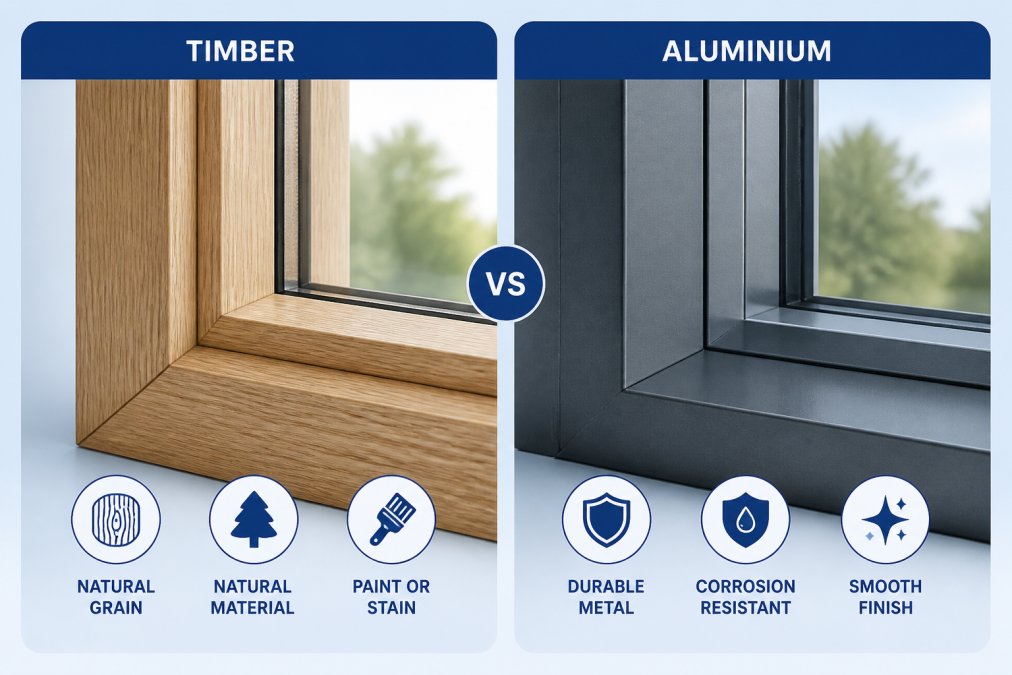
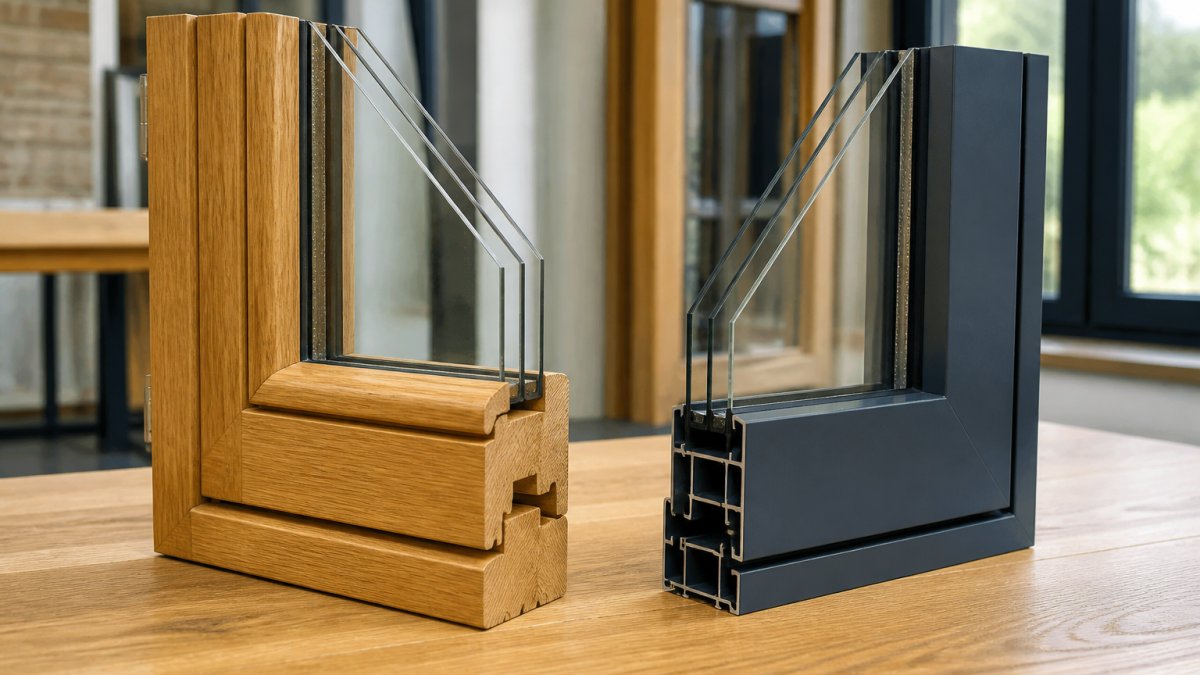
Visually, the difference shapes how much glass you see. Timber frames are thicker because wood needs more material for structural strength; aluminium allows slim frames because the metal is stronger per unit thickness. For maximum natural light and a contemporary look, aluminium's narrow sightlines win.
Durability depends entirely on maintenance. A well-maintained timber window lasts 40-60 years or more; paint or varnish protects the wood from moisture and UV damage, and neglect means rot within 5-10 years. Aluminium needs virtually no maintenance, no painting, no varnishing, and its anodised or powder-coated finish resists corrosion.
Repairability matters more than most people realise. A timber window with a broken sash cord, damaged glazing, or worn hardware can be repaired component by component, keeping the frame. Aluminium windows, once seals fail or the thermal break degrades, often require replacing the entire unit.

Timber Window Costs 2026: Initial and Long-Term Investment
Timber windows cost more upfront than aluminium. But initial cost is only half the story.
Bespoke timber windows for non-standard openings, Victorian sashes, arched tops, or terraces with uneven reveals, are where timber's flexibility becomes a cost advantage. Aluminium manufacturers charge significantly more for custom sizes because each unit requires tooling changes; timber is cut to order at modest premium. Standard rectangular openings favour aluminium on price; character properties with odd dimensions often cost less to fit properly in timber.
Installation costs are similar for both materials. The difference emerges in the long term.
Over 20 years, a timber window painted every 5-7 years incurs recurring costs. An aluminium window costs nothing to maintain, but when it fails you're replacing the whole frame. A maintained timber window at the same age still functions and can be refurbished rather than replaced.
The real long-term cost question: do you plan to stay 20+ years? If yes, timber's maintenance cost is offset by its longer usable life. If you're selling within 10 years, aluminium's lower upfront cost and zero maintenance make it the financial winner.
Timber vs Aluminium Window Energy Efficiency: Thermal Performance Explained
Energy efficiency is where timber wins on physics alone, but modern aluminium with a proper thermal break closes the gap.
Timber's natural insulation means a timber window without a thermal break still outperforms an aluminium window without one. The U-value (heat loss through the frame) for timber typically sits around 1.5-2.0 W/m²K, versus 5.0-7.0 W/m²K for aluminium without a thermal break, more than three times the heat loss.
Modern aluminium with a thermal break narrows that gap: a quality thermally-broken frame achieves 1.8-2.2 W/m²K, comparable to timber. The glazing itself (double or triple glazing, gas fill, spacer bar) now contributes more to overall performance than the frame material.
Practically: in winter a timber frame stays closer to room temperature, so condensation is less likely on the inside. An aluminium frame, even with a thermal break, will be noticeably colder, and in high-humidity bathrooms or kitchens condensation forms more readily.
For EPC ratings and building regulations, both materials meet current standards with modern glazing. The heating cost difference between timber and properly specified aluminium is modest, real money over 20 years but not the dominant cost factor.
Timber genuinely is the better thermal performer, but once you've specified double or triple glazing and a thermal break on the aluminium, the practical difference is smaller than the marketing suggests.
Timber Window Maintenance: What to Expect Over Time
This is where timber and aluminium diverge most sharply.
Timber windows need painting or varnishing every 5-7 years, the difference between a window lasting 50 years and one that rots in a decade. The process involves:
- Cleaning the frame thoroughly
- Sanding off old paint or varnish
- Filling gaps or cracks in the wood
- Applying primer and topcoat (or varnish equivalent)
- Sealing joints and glazing compounds
Doing it yourself saves labour but invests time and skill. Either way, it's a recurring cost and commitment.
Between repaints, timber windows need occasional attention: check glazing compounds annually (cracks let water behind the frame), inspect sills for standing water, and clear drainage channels so moisture doesn't pool. Small tasks, but skipping them accelerates deterioration.
Aluminium windows require none of this: wipe them down occasionally, no painting, sanding, or sealing. For busy homeowners or those who dislike maintenance, aluminium is the obvious choice.
The maintenance difference is stark enough to drive your decision if you're indifferent between the aesthetics: timber requires active care, aluminium is passive.
Timber Windows for Conservation Areas: Heritage Suitability and Regulations
In conservation areas and on listed properties, timber windows are often the only legal option, with strict rules on what can be replaced.
Many local planning authorities require timber windows for pre-1980 properties in conservation areas. Modern aluminium frames look visibly different from original timber, and visual consistency across a historic streetscape matters; aluminium's slim frames and contemporary finish read as obviously modern, breaking the character.
Casement Fastener Antique Brass →
For listed buildings the rules are stricter: listed status typically means you cannot change windows without listed building consent, rarely granted for aluminium. Timber-for-timber is the standard requirement, so assume timber is your only path forward.
Even outside conservation areas, many period properties benefit from timber simply because it looks right: a Victorian terrace with aluminium frames looks compromised, while the same property with timber looks restored, not replaced.
If you're in a conservation area or have a listed building, check your local planning authority's guidance first. Many councils publish design guides stating window material requirements, and assuming aluminium is allowed because it's cheaper or easier is a common, costly mistake.
Arborfield Joinery specialises in bespoke timber windows for exactly these scenarios, properties with character, non-standard openings, and conservation area restrictions. We provide bespoke manufacturing capabilities for period-appropriate windows into Victorian terraces, Georgian properties, and listed buildings where standard off-the-shelf solutions don't work.
Durability, Lifespan and Repairability: Which Wins Long-Term
Timber windows, properly maintained, last 40-60 years or longer; some installed in the 1950s are still in use. The frame is incredibly durable, the finish protecting it needs renewal, but the underlying material doesn't degrade if kept dry.
Aluminium windows typically last 30-40 years. The frame doesn't rot, but hinges, locks, and seals wear out, and the thermal break can degrade over time. Once it fails, thermal performance drops sharply and replacement is often more economical than repair.
Repairability is where timber's advantage becomes concrete. A broken sash cord is a £50-100 repair; damaged glazing can be re-glazed without replacing the frame; damaged wood can be spliced or patched. Individual components are replaceable.
Aluminium windows are less repairable: if the thermal break fails you replace the frame, if the glass-to-frame seal fails you replace the unit, and worn hinges or locks can sometimes be swapped but access is often limited.
This matters most over 30-50 years. A timber window installed in 1990 might have had its paint refreshed three times but remains fundamentally the same window; an aluminium window from the same era is likely at or past its lifespan.
For whole-life cost, timber wins if you maintain it; aluminium wins if you want zero maintenance and don't mind replacing windows sooner.
Which Should You Choose? Decision Framework by Property Type
Your property type and priorities should determine your choice:
Victorian or Georgian terraces: Timber, almost always. The character depends on it. Planning authorities often require it. Non-standard openings are common, and timber accommodates them easily.
Listed buildings: Timber. Assume it's your only option unless your conservation officer explicitly approves aluminium.
Modern suburban homes (post-1980): Either works. If you value low maintenance and contemporary aesthetics, aluminium. If you prefer warmth and natural materials, timber.
Period conversions or renovations: Timber if the original windows were timber. Aluminium if the building has no heritage character to preserve.
Holiday properties or rentals: Aluminium. Zero maintenance appeals when you're not living there full-time.
Your own home, long-term: Timber if you'll commit to maintenance. Aluminium if you won't.
Budget-conscious renovation: Aluminium for standard sizes. Timber if you have non-standard openings (it's often cheaper to custom-make than to custom-order aluminium).
The honest answer when comparing timber vs aluminium windows: there's no universal winner. Timber wins on aesthetics, thermal performance, and repairability; aluminium wins on maintenance and initial cost. Decide based on what matters most to your property and lifestyle.
When you're ready to move forward, Arborfield Joinery can help. We provide expert advice, transparent pricing, and reliable installation. Shop now!
Choosing between timber and aluminium windows shapes your home's comfort, appearance, and maintenance for decades. Timber delivers character, thermal performance, and repairability but demands maintenance; aluminium offers simplicity and contemporary aesthetics with a shorter lifespan and lower repairability. Arborfield Joinery is a family-run business established in 1953.
Frequently Asked Questions
Are timber windows more energy efficient than aluminium windows?
Timber has superior natural insulation properties compared to aluminium. A timber window with double glazing typically achieves a U-value of 1.4-1.8 W/m²K, whilst aluminium (without a thermal break) can reach 5.0+ W/m²K. Modern aluminium with thermal breaks improves to 1.4-2.0 W/m²K, making performance comparable. However, timber's inherent thermal mass helps regulate temperature fluctuations, reducing cold spots and condensation risk in real-world conditions.
Which lasts longer, timber or aluminium windows?
Well-maintained timber windows last 40-60 years or longer, with individual components (like sashes) repairable and replaceable. Aluminium typically lasts 30-40 years before seal failure or corrosion occurs, and is harder to repair. Timber's repairability gives it a significant longevity advantage: a timber frame can be refurbished and brought back to original condition, whilst aluminium frames often require full replacement.
What are the downsides of using timber windows?
Timber windows require regular maintenance: repainting every 5-7 years, annual inspection for rot or moisture damage, and protective treatment against weather. They are more expensive upfront. Timber can warp, split, or rot if exposed to prolonged moisture or poor ventilation. They also have longer manufacturing lead times for bespoke options, and are unsuitable for coastal properties with salt spray unless specified with marine-grade timber.
How much do timber and aluminium windows cost in 2026?
Whole-life costs favour timber: whilst initial outlay is higher, lower repair and replacement costs over 50+ years often result in better value.
Are timber windows suitable for conservation areas?
Yes, timber windows are the preferred choice in conservation areas. Planning authorities in heritage zones typically require timber frames to match original character and materials. Aluminium is often rejected as incongruous with period properties. Timber windows with slim frames, glazing bars, and traditional hardware (such as brass casement fasteners from £12-£13) preserve authentic appearance whilst meeting modern Building Regulations for energy efficiency when paired with high-performance double glazing.
Share:
What Style of Internal Door Suits a Modern Home?
Bespoke Joinery Lead Times Explained 2026