
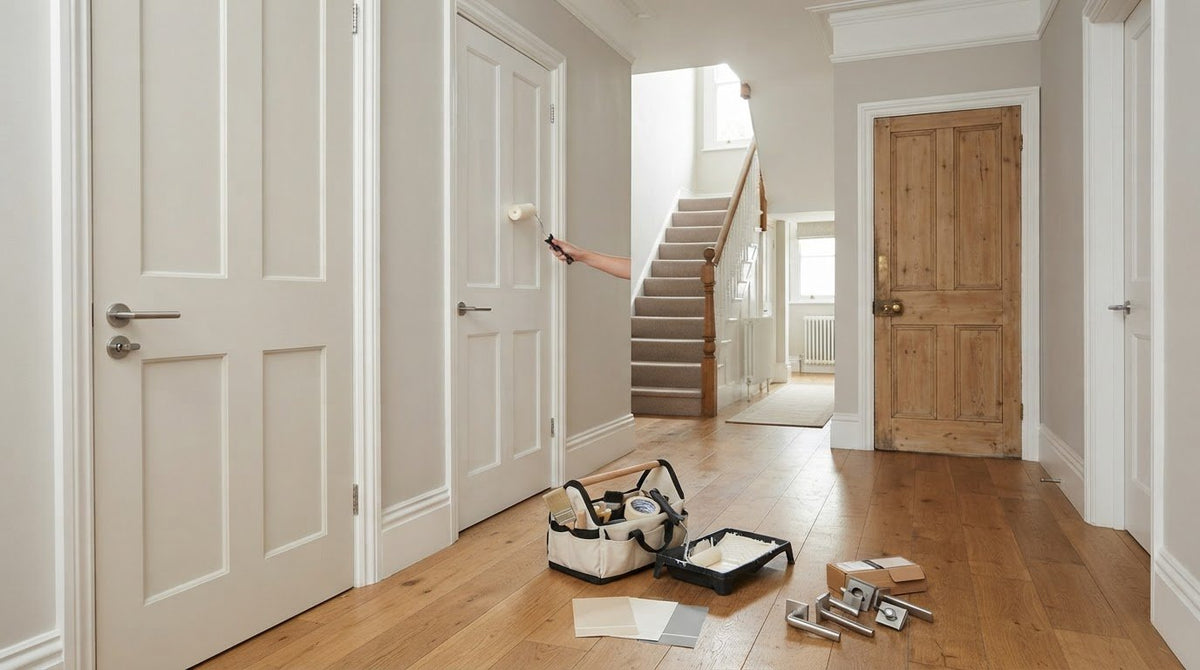
A dated door doesn’t always need replacing. If the finish is tired but the door itself is sound, modernising internal doors on a budget can be as simple as a considered refresh. The right update can help a newly decorated room feel complete without the cost and work of changing every door.
It’s understandable to wonder whether paint and new hardware will make enough difference, or whether an update will draw attention to worn surfaces and mismatched styles. Start by assessing each door’s condition, then spend where the change will have the greatest visual impact. A staged refresh can preserve doors that are in good shape, while replacement may make more sense where damage or the desired finish calls for it.
This guide covers affordable ways to refresh doors, how to create a more cohesive look between adjoining rooms, and signs that a new door may offer better long-term value. You’ll also find replacement options, from white primed and laminate doors to oak, walnut and glazed styles, from Arborfield Joinery, a family-run business supplying doors since 1953.
Key Takeaways
- Check stability, damage, finish, sticking and visible wear to decide whether each door is a good candidate for a refresh.
- Compare repainting, updated door furniture and decorative details by the work involved and the visual change you want.
- Modernising internal doors on a budget works best when you prioritise doors visible from shared spaces, rather than tackling every room at once.
- Weigh the work involved in refreshing a sound door against replacing one whose condition or style no longer suits your home.
- If replacement is a better fit, explore options such as oak, walnut, white primed, laminate, glazed, bi-fold and pocket doors.
Modernising internal doors on a budget starts with checking their condition
Want to improve tired-looking doors without replacing every one at once? Start with a careful inspection. A door can look dated yet still be stable and straightforward to refresh. A fresh coat of paint, however, won’t solve damage or a door that is difficult to use. When modernising internal doors on a budget, base your first decision on condition as well as appearance.
Check each door in good light, then open and close it a few times. Look for:
- Stability: Does the door feel secure on its hinges, without excessive movement or sagging?
- Damage: Are there cracks, holes, swelling or deep dents, rather than minor surface marks?
- Finish: Is the existing paint or coating intact, or is it peeling, lifting or uneven?
- Movement: Does the door open and close smoothly, or does it stick repeatedly?
- Visible wear: Are the main issues scuffs, faded colour and tired handles, or does wear affect the door’s structure?
Note the problem on each door. This helps you separate cosmetic work from practical concerns and replacement decisions. It also makes it easier to prioritise doors that are most visible or used most often.
Which door problems can a cosmetic refresh address?
Surface scuffs, a dated colour and worn-looking handles are often good candidates for a visual update if the door is otherwise sound. Repainting or changing the door furniture can improve its appearance without requiring a whole-home overhaul. A restrained decorative detail may also suit a plain door, provided the surface is in suitable condition.
Before choosing paint, adhesive or another finish, identify the door material and what is already on its surface. Doors can have different constructions and components, as outlined in this guide to types and components of internal doors. Follow the door manufacturer’s instructions for preparation and refinishing, since a product that works on one surface may not suit another.
When is refreshing a door not the right starting point?
Pause before cosmetic work if the door has significant damage, feels loose, sticks persistently or no longer functions properly. These issues may need a practical solution before appearance becomes the priority. Painting over damage or disguising an ongoing problem can use time and materials without resolving what makes the door unsuitable.
Look at the frame as well as the door. A door that catches may be affected by the opening or frame, so refreshing its surface alone may not resolve the issue. Consider how both parts fit and function together; the internal doors and door frames guide offers further context on their relationship.
After assessing each door, group them by what they need: a cosmetic refresh, a closer practical assessment, or replacement to suit their condition and the look you want. This simple inventory helps direct your effort towards the right solution, rather than spending on a finish that cannot address the underlying problem.
Choose budget-friendly internal door updates by effort and visual impact
Once you know a door is suitable for a cosmetic update, choose an approach that matches the finish you want and the time you can give it. A hardware change may sharpen the overall look with little preparation, whilst repainting or adding trim involves more work. When modernising internal doors on a budget, compare the preparation as well as the materials. An apparently simple DIY job can take longer if the surface needs extensive attention.
| Update | Likely effort | Most suitable for | Change it creates |
|---|---|---|---|
| Repainting | Moderate, with preparation and drying time | Sound doors with a suitable surface and finish | A fresh colour that can connect the door to the room |
| Changing door furniture | Low, if the existing fittings can be replaced straightforwardly | Doors that look tired mainly because of dated or worn handles | A more considered, coordinated detail |
| Adding trim or moulding | Higher, as careful measuring, fixing and finishing are needed | Plain doors whose surface can take decorative detail | A stronger change to the door’s character and profile |
Use the table to shortlist an option, then check the materials and preparation your particular door needs. If a refresh requires substantial repair, or the door’s condition limits the finish, include that in your assessment instead of assuming DIY will automatically be the cheaper route.
Can paint make a dated internal door feel more current?
It can. A considered colour may echo a room’s woodwork, wall tones or other details, creating a more cohesive impression without demanding a dramatic contrast. Test a sample in the room and view it in different light before committing. A colour can look quite different beside a window than in a dim hallway. Prepare the surface and choose products suited to the door’s material and existing finish, following the manufacturer’s instructions.
Will new handles or decorative details make the bigger difference?
New door furniture can make a clear difference with less work than repainting, particularly if the handles are scuffed or visually out of step with adjoining rooms. Aim for a consistent finish across nearby doors, and make sure replacement fittings suit the existing fixing points. For one specific styling direction, explore these black door handle pairings.
Trim or moulding changes more of the door’s visual character, so it needs careful measuring and a neat finish. Keep the detail restrained if the room already has strong features; an elaborate design can compete with them. Before choosing either option, consider how it will look across the adjoining doors, not just on one leaf.
Finally, weigh the full project: materials, preparation, time and any additional work the door needs. Compare that with what replacement would involve for your specific opening, rather than relying on assumed savings. If you’re considering a different door style, you can compare internal door designs and finishes at Arborfield Joinery.
Refresh or replace internal doors: compare the practical trade-offs
A refresh keeps the existing door leaf and its established character; replacement gives you the chance to change the look more substantially. Neither option is automatically cheaper or easier. The balance depends on the door’s condition, the finish you want, how much preparation is involved and whether the existing style works with the rest of your home.
Think beyond the immediate appearance. A paint update may be relatively contained, but achieving an even finish takes time and careful preparation. Replacing a door involves choosing a new design and considering how it will work with the existing opening. If you’re updating several rooms, consistency matters too: a refreshed door may look out of place if its finish differs sharply from those nearby.
When does a refreshed door offer enough change?
Choose a refresh when the door works well and the main concern is how it looks. A new finish or coordinated furniture can bring a tired door closer to the room’s palette while retaining its familiar style. Repeating the same handle finish or paint approach on adjoining doors can help spaces feel connected. Before starting, consider the walls, flooring and other woodwork so the update complements the room rather than competing with it.
This is a measured way to make progress: update the doors that are most visible first, then review the result before deciding whether other rooms need attention. If the existing door has a distinctive profile that suits the house, refreshing it may preserve more of the home’s character than replacing it with a noticeably different design.
When should a new internal door be part of the plan?
Consider replacement if damage or poor function is central to the problem, or if you want a substantial change in style that a surface update cannot deliver. A new door can alter a room’s character, not just its colour. It can also help create a consistent look across adjoining rooms, though the work involved depends on the project and how the door relates to its opening.
Compare door categories by the look you want, rather than assuming one material or style suits every space:
- Oak doors can bring a natural timber look to an interior.
- White primed doors offer a light, paintable starting point.
- Laminate doors provide another finish category to consider; the laminate internal doors buying guide can help you compare this option.
- Glazed doors introduce glass as a visible design feature.
- Urban doors offer a different style direction from traditional timber looks.
When modernising internal doors on a budget, compare the full work involved in each route: materials, preparation, any necessary repairs and the visual result you expect. A sound door that only needs a fresh appearance may be worth keeping. If the door itself is the obstacle, replacement may be a more considered long-term answer.
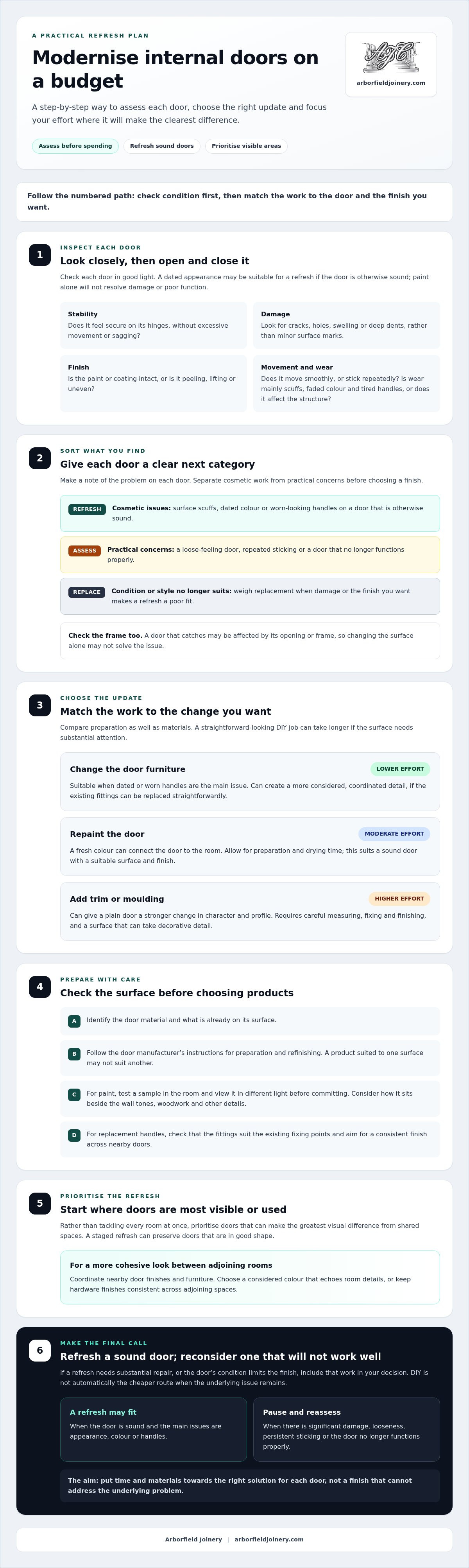
Plan a budget-conscious internal door refresh step by step
A little planning helps keep a DIY update focused, especially if several doors need attention. Decide on a finish and hardware approach before buying materials, then start with the doors that have the greatest effect on shared spaces. A clear sequence also makes it easier to spot when a refresh isn’t the right solution.
How can you prioritise doors when the budget is limited?
Begin with doors you see from the hallway or connected living areas, as these shape the first impression between rooms. Group similar doors by style or location so you can plan a coherent finish without making every room identical. Complete one representative door first. This lets you assess the look, effort and process before extending the update across the home.
- Assess each door. Note its condition, how it functions and whether the planned change is cosmetic or needs to address a practical issue.
- Choose the update. Decide whether paint, new furniture or a simple decorative detail suits the door and the finish you want.
- Plan materials. Check the door’s surface and existing finish, then list suitable products and tools. Follow the manufacturer’s instructions.
- Prepare the work area. Organise the space and allow time for preparation and drying. Don’t rush these stages to finish in one session.
- Complete the update. Work methodically, following product directions and keeping the finish consistent with your plan.
- Review the result. Look at the finished door in the room’s usual light and alongside nearby doors before deciding whether to continue with the same approach.
What should you plan before starting a DIY update?
Write down the door’s condition and surface material, the finish you’ve chosen, the tools required and the preparation involved. A painted door’s final appearance depends heavily on sound preparation, because a new coat can show flaws left underneath. Follow product instructions and allow adequate time for preparation and drying before using the door or moving on to the next one.
Compare the time and materials needed for each door rather than assuming the same update will be equally straightforward everywhere. A door with a worn finish may need different preparation from one with an intact surface, so adapt the plan to suit each group. If your trial door shows that a refresh won’t achieve the look you want, consider another approach before buying supplies for the remaining rooms.
If a refresh isn’t the right fit, explore internal door styles and compare options for your home before deciding on the next step.
Find a lasting next step for modernising internal doors
A sound door that works well may only need a thoughtful refresh. If damage, poor function or a desired change in style makes the door itself the issue, replacement is worth exploring instead. The aim isn’t to replace for the sake of it, but to choose an approach that suits each door’s condition and the look you want across your home.
For a replacement, Arborfield Joinery’s range includes oak, walnut, white primed, urban, laminate, glazed, bi-fold and pocket doors. Each offers a different starting point for considering material, finish and style. The right choice depends on the interior you’re bringing together and the practical needs of the opening.
Which door styles might suit a refreshed interior?
Oak and walnut are timber choices to consider if you want the door’s material to be part of the room’s visual character. White primed and laminate doors offer alternative categories for comparing finishes. Glazed doors may suit a design where glass is part of the look, whilst urban doors provide another style direction. Bi-fold and pocket doors are options to explore where the layout or available space informs the choice.
Rather than selecting a door in isolation, consider how it will sit beside nearby doors, flooring and woodwork. A consistent finish can help adjoining rooms feel connected, while a deliberate change may suit a space intended to stand apart. The right balance depends on your home, not a rule that every door must match exactly.
How can you compare replacement doors with confidence?
Compare the overall style, material and finish, then consider how the door will relate to the existing interior and opening. If you’re changing more than one, decide whether you want a shared look throughout or different choices for particular rooms. Thinking through these details before settling on a design helps keep the decision focused on the result you want.
Arborfield Joinery is a family-run business supplying doors since 1953, with more than 120 doors displayed in its showroom. Seeing a broad selection in one place can help you compare styles and finishes side by side, especially if you’re weighing a timber look against a painted or glazed option.
Whether you’re continuing with a considered refresh or ready to explore replacement, take the next step at your own pace. Explore Arborfield Joinery’s internal door range and find a style that suits your home and project.
Make your next door decision with confidence
A considered update doesn’t need to transform every doorway at once. Let the rooms guide the pace: once one change feels right in the home’s everyday light and alongside its existing details, decide whether to carry that direction further or try a different finish elsewhere. That flexibility is at the heart of modernising internal doors on a budget, helping each choice feel intentional rather than rushed.
If a door no longer suits the look or needs of your home, exploring replacement styles can open up fresh possibilities. Arborfield Joinery’s range spans oak, walnut, white primed, urban, laminate, glazed, bi-fold and pocket doors. As a family-run business supplying joinery since 1953, it also displays more than 120 doors in its showroom, giving you the chance to compare options in person.
When you’re ready to explore replacement, browse Arborfield Joinery’s internal door range and compare styles for your home.
Frequently Asked Questions
Can I paint an internal door without taking it off its hinges?
Yes, some internal doors can be painted in place, provided their condition and the paint instructions make this suitable. Protect the floor, nearby walls, hinges and handle, and make sure the door can stay open or closed without being touched while the finish dries. Painting both sides may be awkward if you can’t leave one side undisturbed, so plan the order of work before you begin.
Can you paint a veneer internal door?
Some veneered doors may be suitable for painting, but the veneer, its condition and the existing coating all matter. Check the door manufacturer’s guidance and the paint system instructions first. Avoid aggressive sanding, which could damage a thin veneer layer. If the veneer is lifting, chipped or bubbled, don’t treat paint as a simple cover-up; assess the surface carefully before choosing how to proceed.
Do internal door handles need to match throughout the house?
No, handles don’t have to be identical in every room. A shared finish, such as coordinating metal tones, can create a subtle thread between spaces, while different handle shapes can suit doors with distinct characters. Look at the fittings together from the hallway as well as close up. If rooms have separate schemes, repeating one small detail can help the variations feel deliberate.
How do I choose a paint colour for internal doors?
Start with the colours already present in the room, then decide whether the door should blend with the walls or provide contrast. Consider how it appears from adjoining rooms and in both daylight and artificial light. A sample on a discreet area or test surface can help reveal undertones before you commit. Also check that the chosen paint is suitable for the door’s material and existing finish.
Can I add moulding to any internal door?
No, moulding isn’t suitable for every door. The surface, construction and condition affect whether it can be added securely and finished neatly. Consider how the extra detail will relate to the room’s skirting, architrave and proportions; a simple layout may look more balanced than elaborate trim. Follow the fixing product’s instructions, and don’t alter a door if doing so could affect safety requirements.
Should I replace door hinges when updating handles?
Not necessarily. If the hinges are secure and the door moves smoothly, replacing them just because you’re changing handles may add unnecessary work. Check whether the existing hinges suit the door and frame, and whether their finish will sit comfortably beside the new furniture. If you do replace them, compare the fixing positions and dimensions first, since mismatched fittings can mean additional adjustment.
How can I make different internal doors look coordinated?
Choose a linking detail rather than making every door identical. For example, a shared handle finish can bring together doors with different colours or profiles, while a related colour palette can connect doors in adjoining spaces. View the doors from the hallway or another shared area to judge the overall effect. When modernising internal doors on a budget, a consistent detail can help create unity without updating every surface in the same way.
Share:
Oak Stair Treads and Risers: A Practical Buying Guide
Best Wood for Exterior Staircases: A Selection Guide