
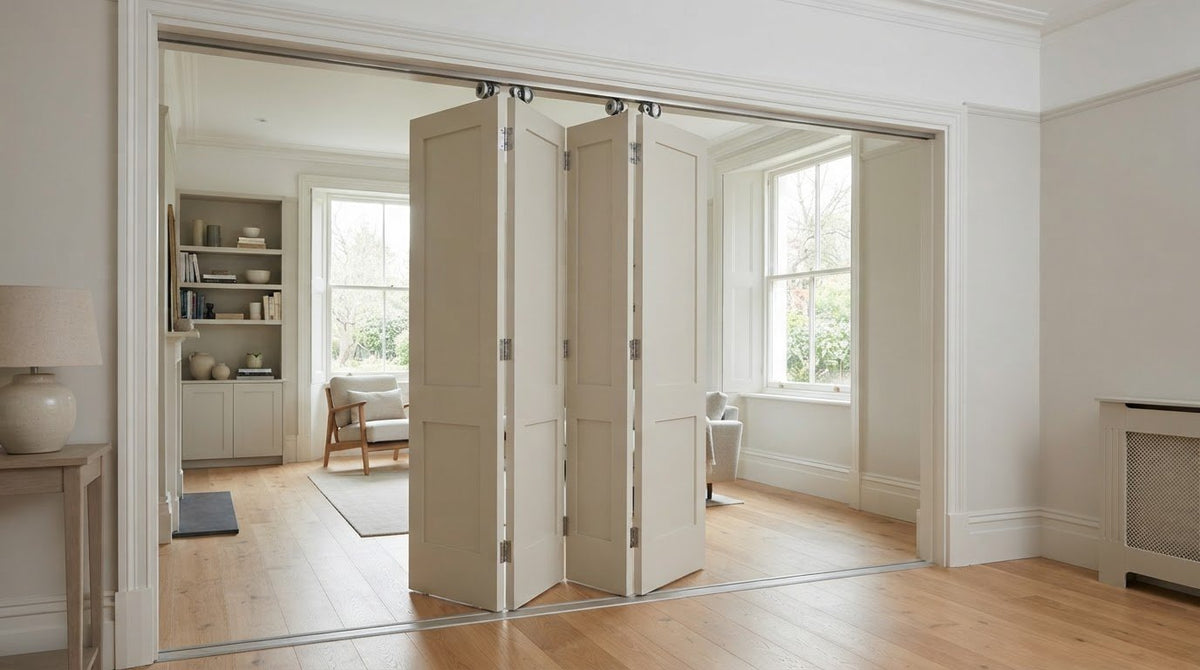
Could the neatest-looking track be the wrong choice for your doors? An internal bifold hardware track kit needs to match the door leaves and opening, not just the room’s style. Before buying, compare the kit’s stated capacity, supported layout and included components with the doors you plan to use.
The right choice starts with compatibility. This guide explains what the hardware does and what to compare, including the number and size of the leaves, their weight and the finished opening. You’ll also learn how top-hung and floor-guided systems differ, so you can weigh up their practical features before choosing a door arrangement. Arborfield Joinery has supplied doors and folding systems since 1953. Read on to understand the specifications and explore suitable internal bi-fold doors and folding systems with greater confidence.
Key Takeaways
- Start with your door layout and opening measurements, then match the hardware specifications to them.
- Learn how an internal bifold hardware track kit guides and supports folding leaves, and why the kit’s included components matter.
- Compare top-hung and floor-guided arrangements to understand how their guidance methods and visible hardware differ.
- Use a pre-purchase checklist to compare leaf count, folding direction, measurements and kit details with your door requirements.
- Choose the door arrangement first, then explore compatible internal bi-fold doors and folding systems with greater confidence.
What does an internal bifold hardware track kit do?
An internal bifold hardware track kit is a set of components designed to guide and support folding door leaves as they move across an opening. It helps the leaves follow the movement intended for that door system. The kit is separate from the door leaves, surrounding frame and finished opening, so these parts need to suit one another.
The term folding door covers designs that fold in different ways; the general overview of Folding doors explains some of this terminology and variation. In an internal system, the hardware arrangement affects how the leaves are supported, guided and connected as they open and close.
Which parts may be included in a bifold track kit?
The track provides a route for movement along the opening. Depending on the system, rollers may travel within or along it, while guides help keep parts of the assembly aligned. Pivots can support or locate a leaf at a turning point, and hinges connect adjacent leaves so they fold together. These are possible functions, not a standard contents list: kits differ, and some components may be supplied separately or built into a particular system.
A bifold track kit is system-specific hardware that guides and supports folding door leaves, with components and arrangements varying by design. Before comparing options, read the product description to see what is included and which door configuration the kit is intended for. Don’t assume that a kit contains every hinge, pivot or fitting required just because it includes a track.
How does the hardware work with folding door leaves?
Imagine opening a pair of linked leaves across a room opening. As you draw one leaf to the side, the hinges let the connected leaf fold towards it, while the track, guides and pivots, where included, direct the movement. The leaves gather to one side, clearing the passage. Closing them reverses the movement and brings them back across the opening.
The precise arrangement depends on the number of leaves and how they’re intended to fold. A set that gathers to one side may need a different hardware layout from one that divides into groups opening in opposite directions. That’s why you should consider an internal bifold hardware track kit alongside the door layout, not as a standalone length of track. The leaves, supporting hardware and opening form one working system, and a mismatch can affect how the doors travel.
How to match an internal bi-fold track kit to your doors
Choose the door arrangement before comparing track kits. The number of leaves, their folding direction and the finished opening all influence the hardware layout. Use these steps to narrow down suitable options and avoid relying on a generic description or assuming that one kit suits every set of doors.
- Establish the door layout. Record how many leaves the system has, whether they gather to one side or split in two directions, and how they’re intended to fold. A different leaf count or folding direction can mean a different arrangement of tracks, pivots, guides and connecting hardware.
- Check the measurements. Start with the finished opening’s width and height, following the measurement instructions for the door system you’ve chosen. The opening sets the available space, while the door layout determines how the leaves move within it. Record the measurements so you can compare them directly with the product specifications.
- Compare the kit specifications. Check that the product documentation covers your leaf count and arrangement. Compare its stated door dimensions and weight limits with the actual doors, then review the kit contents and compatibility instructions. The manufacturer’s instructions take precedence over general guidance.
Which door measurements should you check first?
Measure the finished opening’s width and height, and note the dimensions of the door leaves. Use the chosen system’s instructions to establish exactly where and how to measure; don’t assume the nominal opening size alone determines which kit will fit. The relationship between the frame, opening and doors matters too. For more context, see our guide to internal doors and door frames.
Why do door weight and leaf configuration matter?
Hardware has product-specific limits, so compare the stated capacity and supported dimensions with your actual leaves rather than estimating. Leaf count and folding direction also affect which parts are needed and where the system supports or guides the doors. A kit is suitable only when its documented specifications match the doors and their planned arrangement.
For broader context on the role of standards in door-hardware selection, The Construction Specifier’s overview of ANSI/BHMA standards discusses how standards relate to hardware. As it covers a different standards framework, use it as background, not as a replacement for the selected system’s own documentation.
Once you’ve established the opening and layout, explore internal bi-fold doors and folding systems as you consider which door arrangement will suit your space.
Top-hung or floor-guided: compare bifold track arrangements
The key difference is how the door leaves are supported and guided. Top-hung arrangements use an overhead track as part of the support system, while floor-guided designs use guidance at floor level. Construction varies between systems, so use the comparison below as a starting point and check each detail against the product documentation.
| What to compare | Top-hung arrangement | Floor-guided arrangement |
|---|---|---|
| Support and track position | The overhead track forms part of the system supporting the leaves. Check how the documentation describes the track and its fixing requirements. | Guidance is provided at floor level. Check whether the design uses a floor track, guide or another documented arrangement. |
| Visible hardware | The track may be visible above the opening unless the system is designed to conceal it. | Floor-level hardware may be more apparent and can affect the look of the floor across the opening. |
| Opening and floor | Some designs have no raised floor track, which may leave the threshold less interrupted. Confirm the actual arrangement and required clearance. | Floor-level guidance may influence the threshold and surrounding floor finish. Check the product details before planning the opening. |
| Door configuration | Confirm the system supports the number, dimensions and layout of the leaves. | Check the same details, including the documented guide position and folding arrangement. |
What should you compare between track systems?
Look beyond the broad label. Compare the stated support method, track position, guide arrangement and compatible door configuration. Consider how visible hardware will look against the room’s finish, and whether floor-level components affect the threshold or flooring. Don’t infer performance or suitability from the system type alone; use the manufacturer’s specifications and requirements.
Can one bifold kit fit every internal door arrangement?
No. An internal bifold hardware track kit is compatible only when its stated configuration and specifications suit the actual doors. Check door thickness, dimensions and weight against the product documentation, as well as the number of leaves and their folding direction. Two kits may look alike yet use different track profiles, guides or fittings. Appearance alone doesn’t prove that they’re interchangeable.
Choose an arrangement that suits the opening and intended floor finish, then compare the complete system details. If a general description differs from the product instructions, follow the manufacturer’s documentation for that specific kit. This gives you a practical basis for assessing suitability without treating either arrangement as universally better.
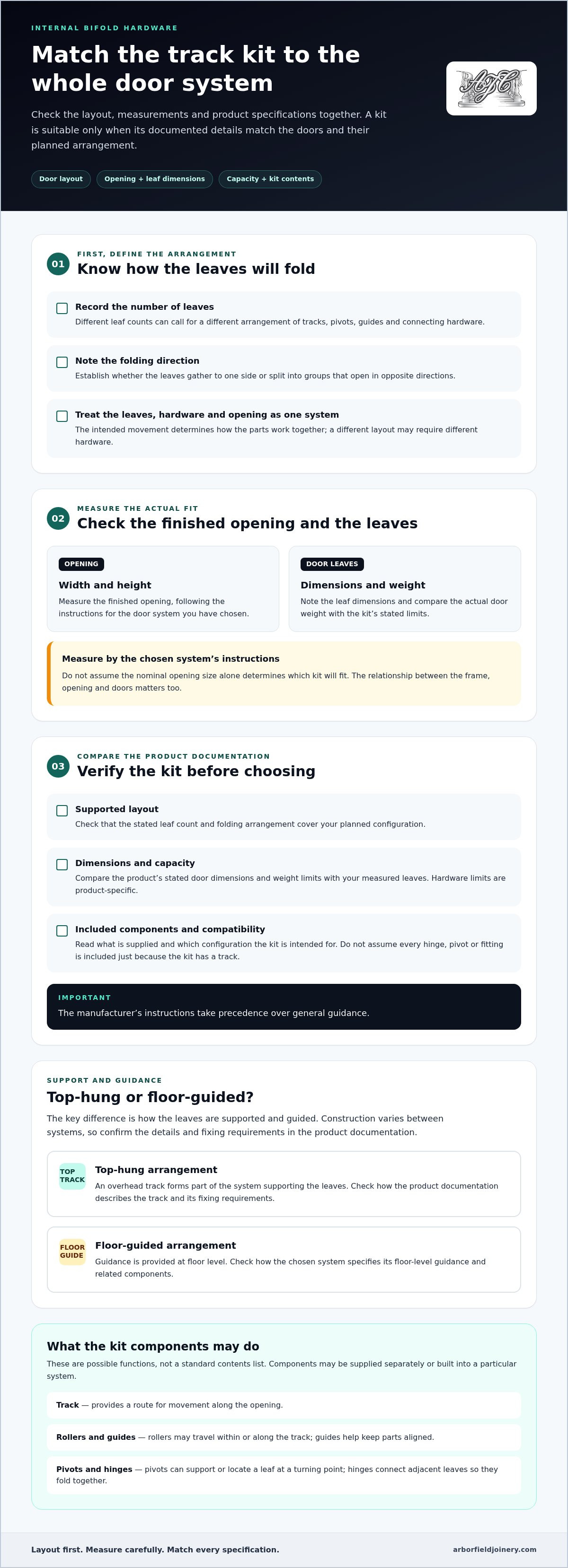
What to check before buying an internal bifold hardware track kit
Before checkout, compare the kit’s product description with your actual doors and finished opening. A checklist can help you spot a mismatch early, such as a different track arrangement, missing fittings or a stated limit that doesn’t suit your project.
A practical compatibility checklist before checkout
- Confirm the layout. Note the number of leaves, which way they fold and whether they gather to one side or open in separate groups.
- Record the opening measurements. Measure the finished opening’s width and height using the chosen door system’s guidance, and keep the figures together for comparison.
- Check the door specifications. Compare each leaf’s dimensions and weight with the limits stated for the kit. Don’t estimate or assume that a similar-sized door will fall within them.
- Review the kit contents. Check which parts are included and identify any hardware or fittings the product description lists separately. A track alone may not include all the components needed for the intended arrangement.
- Read the product instructions. Look for compatibility details, required tools, preparation steps and stated installation conditions. Keep the instructions to hand as you assess the kit and plan the work.
What common buying mistakes can you avoid?
Track length is only one part of compatibility. A track that appears long enough may still be intended for a different number of leaves, folding direction or door specification. Similarly, fittings that look alike aren’t necessarily designed to work together. Choose by documented suitability, not appearance alone.
Another easy mistake is overlooking the layout. For example, a set designed to fold together to one side may need a different arrangement from leaves that divide and fold in opposite directions. Check that the product description covers your planned configuration, then compare every stated dimension and weight limit with your door details.
Read the instructions before buying, too. They can clarify what the system requires and what preparation the opening needs. If product information and general advice differ, give the manufacturer’s documentation for that specific kit priority. This careful comparison helps you select an internal bifold hardware track kit based on the actual requirements, not assumptions.
With your checklist in hand, explore Arborfield Joinery’s internal bi-fold doors and folding systems as you plan a compatible door arrangement.
Choose bifold doors and folding systems with confidence at Arborfield Joinery
Hardware selection makes more sense once you’ve settled on the door arrangement. Consider the opening, how many leaves you want and where they’ll fold, then compare the door’s published dimensions and weight with the hardware’s compatibility requirements. This keeps the decision focused on a suitable system rather than choosing a track by appearance alone.
Arborfield Joinery is a family-run joinery business supplying doors and folding systems since 1953. Explore our internal bi-fold doors and folding systems as you consider the look and layout for your home. Door material is another part of the choice: if oak is on your shortlist, our guide to internal oak doors offers further context on this option.
How should the door choice guide your hardware decision?
Start with the opening and the way you want the leaves to gather. Then consider the door material and the details of each leaf, since its weight and dimensions need to fall within the chosen system’s stated specifications. For example, if the doors are planned to fold to one side, the hardware must be specified for that layout. Don’t assume a kit is compatible simply because it looks appropriate or has a similar track length.
Once you’ve chosen a door style and arrangement, use the product information to compare the actual door details with the system requirements. Select an internal bifold hardware track kit around verified compatibility, rather than treating it as a universal accessory.
What are the next steps before placing an order?
Take a final look at your measurements and compare them with the selected door and hardware documentation. Check the number and direction of the leaves, their dimensions and weight, the listed kit components and any stated compatibility details. Keep the product instructions close as you plan, including notes on tools, preparation or conditions for the work. These checks help you make an informed choice before ordering.
With the arrangement and specifications considered together, you can move forward with greater confidence. Explore Arborfield Joinery’s internal bi-fold door range and folding systems to find an option that suits your plans.
Make your next door choice with confidence
A suitable internal bifold hardware track kit is chosen around the door arrangement and opening, not appearance alone. Confirm the number of leaves and folding direction, then compare your measurements and door specifications with the kit’s published compatibility details. Consider whether a top-hung or floor-guided system suits your project, and review the listed components and instructions before ordering.
These checks help you make a considered choice and plan a folding door arrangement for your space. Arborfield Joinery is a family-run business supplying doors, windows and stairs since 1953, with more than 120 doors featured in its showroom.
Ready to explore the possibilities? Browse our internal bifold doors and folding systems as you plan your next home improvement. Choose a door layout, then use its specifications to guide your next step.
Frequently Asked Questions
What is included in an internal bifold hardware track kit?
Contents vary by system, so check the product description rather than assuming every kit is the same. A kit may include a track and some of the hardware used to guide, support or connect the door leaves. Depending on its design, this could include rollers, guides, pivots or hinges. Check which parts are supplied and whether the product lists any fittings separately for your chosen arrangement.
How do I choose the right track kit for my bifold doors?
Choose a kit whose published specifications match your doors and opening. First establish the number of leaves and how they’ll fold, then measure the finished opening according to the door-system instructions. Compare the leaves’ dimensions and weight with the kit’s stated limits, and check its support arrangement and included components. Follow the manufacturer’s compatibility guidance, as appearance or track length alone can’t confirm a suitable match.
Can I use any bifold track kit with my internal doors?
No, bifold track kits aren’t universal. Systems that look similar may be designed for different door thicknesses, dimensions, weights or leaf arrangements. Compare your actual doors with the kit’s published specifications, including the number of leaves and folding direction it supports. Don’t assume that a kit will suit your doors based on appearance alone.
What is the difference between a top-hung and floor-guided bifold system?
A top-hung arrangement uses an overhead track as part of the system supporting the leaves, while a floor-guided design uses guidance at floor level. This can affect which hardware is visible and how the floor or threshold is arranged. Designs differ, so check the manufacturer’s description for the track position, support method, door configuration and opening requirements. Neither type is automatically right for every project.
How do I measure for an internal bifold track kit?
Start by measuring the finished opening’s width and height, then record the door leaves’ dimensions and weight. Follow the measurement instructions for the door system you’re considering, since methods and clearances can vary. Keep the figures together with the leaf count and folding direction, then compare them with the kit’s published requirements. The opening measurement alone won’t establish compatibility if the door arrangement or specifications differ.
Can I fit an internal bifold hardware track kit myself?
Whether you can fit a kit yourself depends on your experience, the door system and the work involved. Read the manufacturer’s instructions before deciding, and note the required tools, preparation, fixing details and any stated installation conditions. Handle and align the doors and hardware according to the system guidance. If the instructions or task are beyond your experience, pause and plan suitable installation support rather than improvising.
Do bifold track kits include hinges, pivots and guides?
Not always. Some kits may include hinges, pivots or guides, while others may supply only certain components or require additional fittings. Their roles and arrangement depend on the system and door configuration. Read the contents list and product instructions carefully, and compare them with the hardware specified for your doors. Don’t rely on a generic kit description to establish what’s included or assume separate parts will be compatible.
Share:
Expert Advice for Home Renovation Joinery
Internal Door Alternatives to Vibrant Doors