

Table of Contents
- Contemporary Timber Window Styles: A Quick Comparison
- Flush Casement Timber Windows: The Modern Standard
- Tilt and Turn Timber Windows for Flexible Ventilation
- Energy Efficient Timber Windows UK: U-Values and Glazing
- How to Prevent Window Condensation Issues in Timber Frames
- Hardware and Ironmongery Choices for Contemporary Timber Windows
- Planning Permission and Conservation Areas for Contemporary Styles
- Lifecycle Costs and Maintenance for Timber Windows
- Frequently Asked Questions
Last Updated: September 16, 2026
Contemporary Timber Window Styles: A Quick Comparison
Timber windows are now the default specification on high-end renovations. At Arborfield Joinery, we've supplied and manufactured timber windows since 1953, and the shift in what homeowners and architects ask for has never been sharper: slimmer frames, larger glass, and an engineered rather than rustic finish.
| Style | Signature Look | Best For | Ventilation | Typical Frame Depth |
|---|---|---|---|---|
| Flush casement | Frame sits level with the sash | Modern extensions, full-house replacement | Side or top hung | 56-68 mm |
| Tilt and turn | Dual-action opening | Upper floors, ventilation control | Tilt inwards or full turn | 68-78 mm |
| Traditional sash | Vertical sliding, slim meeting rail | Period properties, conservation areas | Sliding sashes | 56-68 mm |
| Fixed picture | No opening, maximum glass | Feature walls, garden views | None | 56-68 mm |
| Pivot | Rotates centrally or off-centre | Contemporary new-builds, statement openings | Full rotation | 68-80 mm |
Flush Casement Timber Windows: The Modern Standard
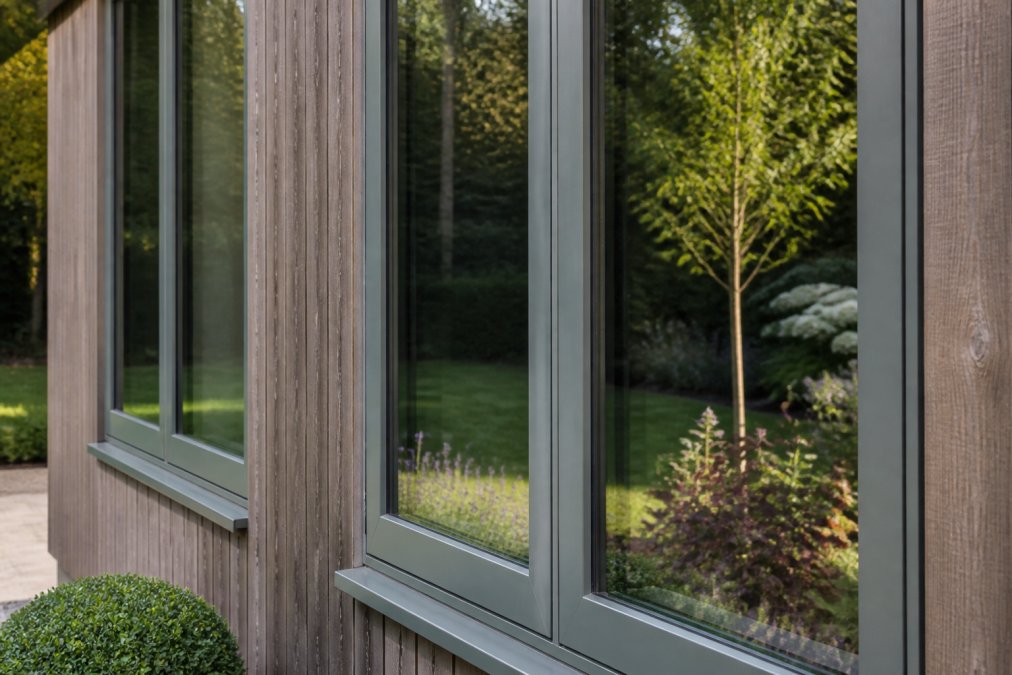
The flush casement is the workhorse of contemporary timber design. The sash closes level with the outer frame rather than sitting proud of it, producing a flat, uninterrupted plane across the elevation, the detail that separates a modern-looking timber window from a replacement unit.
Slim Sightlines and Frame Proportions
Slim sightlines matter more than any other specification on a contemporary elevation. A 56 mm to 68 mm frame profile keeps the timber visible without dominating the glass, and engineered timber keeps those dimensions stable through seasonal movement.
Tilt and Turn Timber Windows for Flexible Ventilation
Tilt and turn windows open two ways: the sash tilts inwards at the top for controlled background ventilation, or turns fully inwards on a side hinge for cleaning and escape. For upper floors and rooms where a wide-swinging casement would foul furniture or curtains, this is the most practical contemporary format.
Energy Efficient Timber Windows UK: U-Values and Glazing
Timber is a naturally good insulator, and the frame is rarely the weak point in a modern window. The U-value you achieve is decided mostly by the glazing specification and installation quality, not the timber itself.
What U-Values Actually Mean in Practice
A U-value measures heat loss in watts per square metre per degree of temperature difference (W/m²K), so a lower number is better. The whole-window U-value is always worse than the centre-pane figure quoted for the glass alone, because the frame, spacer and installation all contribute, so a centre-pane number is not the figure that matters for compliance.
- Standard double glazing with a warm-edge spacer and argon fill: roughly 1.4 to 1.6 W/m²K for the whole window.
- High-performance double glazing with a low-emissivity coating and a wider cavity: roughly 1.2 to 1.4 W/m²K.
- Triple glazing with two low-emissivity coatings and argon or krypton fill: roughly 0.8 to 1.1 W/m²K.
Double Glazing vs Triple Glazing for Thermal Performance
Double glazing is the sensible default for most renovations. It meets current standards, keeps the unit lighter, and costs less per opening.
Acoustic Performance: The Metric Most Guides Ignore
Thermal performance gets all the attention, but for anyone living near a road, railway or flight path, acoustic performance is the specification that changes daily life. Sound reduction is measured as Rw in decibels (dB), and the glazing build-up matters more than the frame.
-
Single glazing: around 25 to 30 dB.
-
Standard double glazing: around 30 to 33 dB.
-
Asymmetric double glazing (one pane noticeably thicker than the other): around 35 to 38 dB.
-
Laminated acoustic glazing with a dissimilar pane thickness: around 38 to 42 dB.
-
Confirm the target U-value for your project
-
Check the glazing rebate depth against your chosen frame profile
-
Specify warm-edge spacers and argon fill as standard
-
Ask for the unit's energy rating certificate, not just a verbal claim
-
If noise is a concern, request the Rw figure and the glazing build-up in writing
How to Prevent Window Condensation Issues in Timber Frames
Condensation on a timber window is almost never the timber's fault. It is a ventilation and humidity problem, and treating it as a frame defect wastes money.
- Trickle vents: specify them on replacement windows. They provide continuous background ventilation without opening the window.
- Extractor fans: make sure kitchen and bathroom fans vent outside, not into the loft.
- Warm-edge spacers: they raise the internal edge temperature of the glass, which is where condensation forms first.
- Surface temperature: the inner face of the glass should stay above the dew point. Better glazing raises that temperature.
- Timber treatment: a factory-finished frame with a proper coating resists surface moisture far better than a site-painted one.
Hardware and Ironmongery Choices for Contemporary Timber Windows
Hardware is where a contemporary window is won or lost visually. Chunky, ornate ironmongery undoes the effect of a slim frame instantly.
Planning Permission and Conservation Areas for Contemporary Styles
Most replacement windows fall under permitted development, but the rules change the moment your property sits in a conservation area, is listed, or is in an area with an Article 4 direction removing those rights.
Lifecycle Costs and Maintenance for Timber Windows
Timber windows are not maintenance-free, and any supplier who says otherwise is selling you something. What they are is repairable, which is the real financial argument. This section sets out the whole-life cost structure so you can judge the premium against the alternatives on evidence rather than assertion.
The Maintenance Schedule
An engineered timber frame with a factory-applied finish will typically need a clean and a check every year, and a recoat of the exposed faces every few years depending on elevation and weather. A softwood frame that was site-painted will need attention sooner. Hardwood and engineered sections hold their finish longer because the coating is applied under controlled conditions before installation.
A realistic schedule looks like this:
- Annual: clean frames and glass, check seals, check hardware operation and tighten fixings.
- Every three to five years: recoat exposed faces, particularly south-facing and west-facing elevations that take the most weather.
- Every ten to fifteen years: fuller redecoration, including rubbing down and treating any minor splits before they admit water.
The Repair Advantage
A timber frame can be sanded, repaired, and refinished. A frame that has failed at the joints can be cut out and replaced section by section. Compare that with a unit that has to be replaced whole, and the cost curve crosses over well before the end of the window's life.
Comparing Whole-Life Cost Across Materials
A fair comparison looks at purchase, installation, maintenance, repair and eventual replacement over a 25 to 30 year horizon, not just the invoice at the point of sale. Most practitioners find the pattern runs like this:
- Timber: higher upfront cost, moderate ongoing maintenance, low replacement cost because sections can be repaired rather than replaced.
- uPVC: lower upfront cost, minimal maintenance, but a shorter service life and whole-unit replacement when it fails, with limited repair options.
- Aluminium: higher upfront cost than uPVC, low maintenance, good durability, but repair is usually replacement and the thermal performance depends heavily on a thermal break in the frame.
- Aluminium-clad timber: the highest upfront cost of the common options, but the lowest ongoing maintenance because the external face is protected, while retaining the timber's repairability internally.
Frequently Asked Questions
What are the most popular contemporary timber window styles?
Flush casement and tilt and turn styles are the most popular for contemporary homes. Flush casements sit level with the frame for a clean, minimal look, while tilt and turn windows offer flexible ventilation. Both suit modern architecture and can be made in engineered timber for stability and slim sightlines.
Are timber windows suitable for modern architectural designs?
Yes. Contemporary timber windows are made with engineered timber that resists warping, allowing for large panes and slim frames. They can be finished in modern colours and paired with minimalist ironmongery. For listed buildings or conservation areas, check with your local planning authority before specifying.
What are the benefits of flush casement timber windows?
Flush casement timber windows sit flush with the frame, creating a clean, modern appearance. They offer excellent thermal performance when combined with double or triple glazing, and the flush design reduces thermal bridging. They also suit both traditional and contemporary properties, making them a versatile choice.
How do contemporary timber windows compare to uPVC in terms of energy efficiency?
Timber naturally insulates well, and when paired with high-performance glazing, timber windows can achieve U-values comparable to or better than uPVC. The exact performance depends on the glazing specification and frame profile. Look for windows with a BFRC energy rating and consider triple glazing for the best thermal performance.
Do modern timber windows require a lot of maintenance?
Modern timber windows are often factory-finished with microporous stains or paints that require less frequent upkeep. A simple clean and occasional re-coat every few years will keep them looking good. Engineered timber is more dimensionally stable than solid wood, reducing the risk of warping and extending maintenance intervals.
Share:
7 Modern Steel Front Door Designs for 2026
PAS24 Fire Door Sets: The Ultimate UK Homeowner’s Buying Guide 2026