
Table of Contents
- Oak Staircases vs Pine Staircases: Benefits at a Glance
- Hardwood vs Softwood Staircases: What the Difference Means for You
- Staircase Renovation Costs: Where Oak and Pine Differ
- Maintenance and Environmental Impact Compared
- Staircase Building Regulations UK: What Applies to Both Timbers
- Matching Timber to Stair Parts and Under-Stair Storage
- Conclusion: Which Timber Suits Your Project?
- Frequently Asked Questions
Last Updated: September 15, 2026
Oak Staircases vs Pine Staircases: Benefits at a Glance
Choosing between oak staircases and pine staircases comes down to a simple trade-off: oak delivers density and longevity, pine delivers affordability and easy workability. Oak staircases suit high-traffic family homes and period properties where structural integrity matters. Pine staircases suit tighter budgets, painted finishes, and lighter renovation projects. This guide from Arborfield Joinery breaks down durability, cost, maintenance, and regulations so you can specify the right timber with confidence.
| Factor | Oak Staircases | Pine Staircases |
|---|---|---|
| Hardness | Very hard, high dent resistance | Soft, dents more easily |
| Grain pattern | Prominent, open grain | Subtle, even grain |
| Best finish | Clear staining, varnishing | Paint or light stain |
| Cost | Higher upfront | Lower upfront |
| Best for | High-traffic areas, period homes | Painted schemes, tight budgets |
Hardwood vs Softwood Staircases: What the Difference Means for You
Hardwood vs softwood staircases is not about which timber is "better" but which suits your traffic, finish, and budget. Oak is a hardwood; pine is a softwood. That botanical distinction drives everything from dent resistance to how the timber takes a finish.
Durability and Wear on Treads and Risers
Treads take the punishment. Every footstep concentrates load on a narrow surface, so wood density decides how well a staircase survives years of wear and tear. Oak's density gives it strong structural integrity and noticeably better dent resistance than pine, which makes it the safer choice for busy hallways and rental properties. Pine holds up fine in low-traffic lofts or spare rooms, but expect visible scuffs on the nosings within a few years in a family home.
Grain Patterns, Finishes and Acoustic Performance
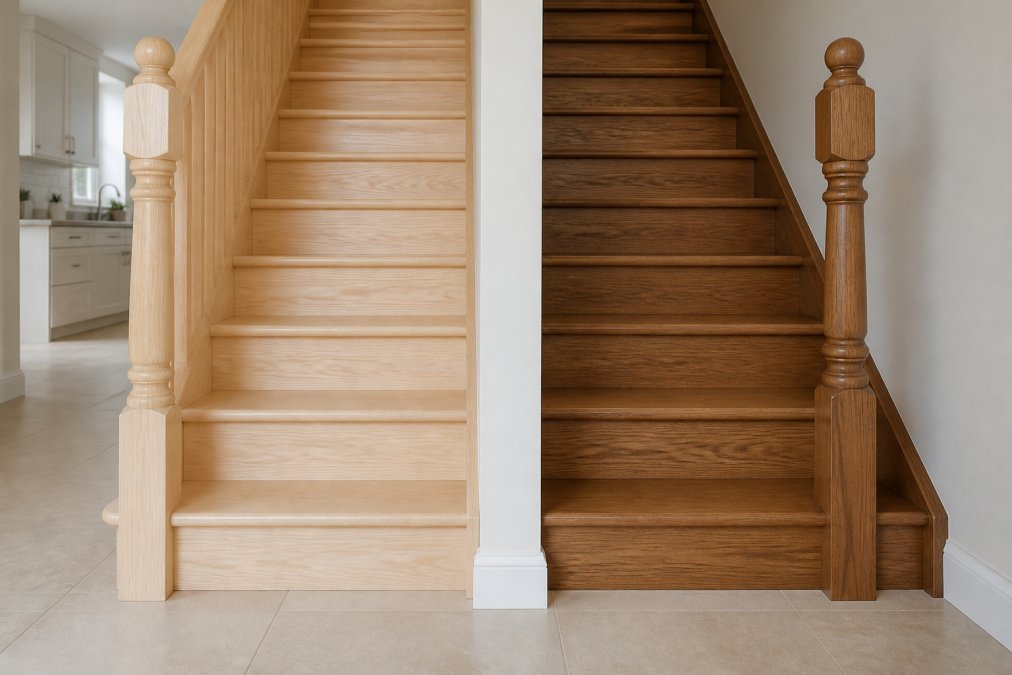
Grain pattern is where the two timbers look most different. Oak has an open, expressive grain that rewards staining and varnishing, giving a timeless aesthetic that suits period properties. Pine has a tighter, subtler grain that paints beautifully but rarely stains evenly.
Acoustic performance is the angle most guides ignore. Denser timber absorbs and deadens footfall noise better than softwood, so an oak staircase typically transmits less impact sound through the structure. If your staircase sits above a bedroom or adjoins a party wall, that difference matters more than most buyers expect.
Staircase Renovation Costs: Where Oak and Pine Differ
Staircase renovation costs depend on timber choice, the number of stair parts, and whether you are replacing treads only or the whole flight. Oak costs more per linear metre than pine, and that gap widens once you factor in handrails, newel posts, and spindles. Pine keeps the material bill down and is genuinely DIY-friendly for competent hands.
| Project Scope | Oak | Pine |
|---|---|---|
| Treads only | Higher material cost, long lifespan | Lower cost, faster wear |
| Full flight replacement | Premium, adds resale value | Budget-friendly, paint-ready |
| Balustrade upgrade | Durable handrails and newel posts | Light, easy to work on site |
Pricing depends on quantity, specification, and current timber availability, so request a quote rather than relying on ballpark figures.
Long-Term ROI: Twenty Years of Ownership
Long-term value favours oak, but the useful comparison is not the sticker price, it is the cost per year of ownership. A pine staircase in a busy family home may need filling, sanding and repainting more frequently than an oak staircase, which typically needs only occasional polishing and a re-finish every eight to twelve years. Over a twenty-year horizon that is roughly four to six pine refresh cycles against one or two oak refreshes.
Each refresh carries labour as well as materials: preparation, masking, priming and two topcoats on a full flight is a job that requires professional attention. Add the cost of filling dents on nosings and the gap between the two timbers narrows considerably. Oak also reads as a long-term investment at resale, particularly in period or higher-value properties, where buyers recognise solid hardwood as a specification point rather than a finish choice. Prioritising this level of solid wood quality ensures that your staircase remains a structural asset rather than a maintenance burden, a principle that applies equally when evaluating the longevity of solid wood vs particle board furniture.
A simple way to frame it: divide the total installed cost plus expected maintenance over twenty years by twenty.
What Actually Drives the Quote
Three variables move a staircase quote more than the species itself:
- Stair parts count. Newel posts, handrails, spindles and treads are priced individually. A balustrade upgrade can add more to the bill than the treads.
- Specification grade. Clear-grade oak with minimal knots costs more than character-grade; pine is usually sold in a narrower range of grades.
- Site conditions. Non-standard openings, winders and open-riser designs add joinery time regardless of timber.
Ask for a breakdown by component rather than a single figure, so you can see where the money is going and where you could substitute without compromising the structure.
Maintenance and Environmental Impact Compared
Maintenance is lighter for oak. A dry dust and occasional polish keeps the finish fresh, with re-varnishing every few years in high-traffic areas. Pine needs more frequent attention: soft timber marks easily, so sanding and repainting become routine rather than occasional. On a painted pine staircase, knocks on nosings and newel posts may show as chips that need filling before the next coat, whereas oak dents tend to bruise the grain rather than break the surface film.
A Realistic Maintenance Schedule
| Task | Oak | Pine |
|---|---|---|
| Weekly | Dry dust or microfibre | Dry dust or microfibre |
| Annually | Polish; check fixings | Polish; touch up paint chips |
| Every 3-5 years | , | Fill, sand and repaint high-wear areas |
| Every 8-12 years | Light sand and re-varnish | Full repaint |
For both timbers, keep the staircase dry and well ventilated. Seasonal movement is normal, but persistent squeaks usually mean fixings have loosened or the timber was fitted above its ideal moisture content.
Sustainability: What to Look For Beyond 'Responsibly Sourced'
On sustainability, both timbers can be sourced responsibly, but the specifics matter more than the slogan. Look for chain-of-custody certification, FSC or PEFC, and ask where the timber was grown. European oak is typically slower-grown and denser than fast-grown plantation softwood, which contributes to its durability.
The carbon argument for timber staircases is that a well-made staircase locks up carbon for decades. Both hardwood and softwood can be sourced responsibly, and a certified, long-lived staircase, in either species, offers environmental benefits. The Timber Trade Federation sustainability guidance sets out what responsible sourcing looks like for UK buyers, and the British Woodworking Federation guidance on timber selection covers species choice and end-use suitability.
Ask your supplier for the certification number and the country of origin, not just a 'sustainable' claim. A certificate you can verify is worth more than a label on a brochure.
Staircase Building Regulations UK: What Applies to Both Timbers
Staircase building regulations UK apply to the geometry of the staircase, not the species of timber. Rise, going, headroom, handrail height, and balustrade spacing are all governed by the Building Regulations, and they apply identically whether you fit oak or pine.
That means the timber choice never changes your compliance obligations. What it does change is durability and how well the staircase tolerates the loads and wear that regulations assume. For the current requirements, check the government guidance on stairways and balustrades before you specify the design.
Never reduce balustrade or spindle spacing to save on materials. Gaps that fail the regulations are a safety risk and will be flagged at inspection, forcing a rebuild.
Matching Timber to Stair Parts and Under-Stair Storage
Stair parts should match the timber you choose for consistency. Oak handrails, newel posts, and spindles give a coherent, hard-wearing finish. Pine balustrades suit painted schemes and cost less, though soft spindles are more vulnerable to knocks.
Compatibility with under-stair storage is a practical consideration most comparisons skip.
Conclusion: Which Timber Suits Your Project?
Frequently Asked Questions
Is oak more durable than pine for staircases?
Oak is significantly denser than pine, so it resists dents and wear from daily foot traffic far better. Pine treads and risers can mark easily under heavy use and may need sanding and refinishing more often. For busy family homes or rental properties, oak staircases usually hold their appearance for longer, while pine suits lighter-use areas or projects where a painted finish hides minor damage.
Does a pine staircase require more maintenance than oak?
Pine generally needs more frequent attention because its softer surface scratches and dents more readily. Expect to sand and recoat pine treads every few years in a busy home, whereas oak can often go longer between treatments. Both benefit from regular dusting and occasional polishing, and keeping moisture levels stable helps prevent any timber from warping or splitting.
Which timber is more cost-effective for a staircase renovation?
Pine usually costs less upfront, so it suits tighter budgets or temporary installations. Oak costs more initially but often works out cheaper over decades because it needs less repair and refinishing. When comparing staircase renovation costs, factor in the full lifespan rather than just the purchase price, and ask your joiner for a quote covering both options.
Can you paint a pine staircase to look like oak?
You can stain and varnish pine to imitate oak, but the grain pattern and colour variation will never match the real thing. Pine also absorbs stain unevenly, which can lead to patchy results. If you want a convincing oak look, choose oak treads or a veneered finish. Painting pine a solid colour is usually a better option than trying to fake oak.
Share:
Front Door Security: The Homeowner’s Buying Guide to Hardware and Protection
The Ultimate Buying Guide to Internal Room Dividers: Style, Light, and Space